LWW Nominated for MovieFone MovieGoer Award, Vote Now

It’s movie award season again, and while we all know what the critics and industry groups think are the best films and performances of the year, Moviefone wants to hear the opinions of the real moviegoers who spend their $10 for a ticket.

Voting is now open for the 11th Annual Moviefone Moviegoer Awards. Real movie fans on Moviefone.com selected the five nominees in each category below, and now millions of movie fans across the country will cast their votes for the winners, to be announced Feb. 28. Don’t miss your chance to make your voice and heard and help your favorite film, actor or actress take home the award. Vote now at:

[MovieFone.com]

The Nominees for VILEST VILLAIN are:
Ralph Fiennes, HARRY POTTER AND THE GOBLET OF FIRE
Hayden Christensen, STAR WARS: EPISODE III – REVENGE OF THE SITH
Tilda Swinton, THE CHRONICLES OF NARNIA: THE LION, THE WITCH AND THE WARDROBE
Ian McDiarmid, STAR WARS: EPISODE III – REVENGE OF THE SITH
Elijah Wood, SIN CITY

And don’t forget to vote for James McAvoy for the Orange Rising Star Award for the The Orange British Academy Film Awards 2006.

[BAFTA Voting]

Tilda Swinton: Queen of Mean

Tilda Swinton was born to play a villainess — or so she says.

“It was really, really easy,” says Swinton, also known as Jadis, the cold-blooded White Witch who terrorized characters in last month’s Chronicles of Narnia: The Lion, the Witch and the Wardrobe.

“Maybe it was my revenge on people who had been unkind to me as a child,” she adds, laughing.

Penned by author C.S. Lewis, Narnia follows the Penvensies, four children who are destined to save a mythical kingdom from Jadis’ tyranny.

For Swinton, who last starred 2005’s sci-fi thriller Constantine, the role was a chance to break away from more emotional characters. The super-human White Witch, who does not understand mortal compassion, readily hurts children and turns animals to stone.

“She wants all-out domination and she’ll do anything to get it,” Swinton says at a roundtable interview in New York City, fingering a strand of platinum blonde hair. “She has no sentimental attachment to the idea of childhood.”

In one scene, she locks Edmund Penvensie (14-year-old Skandar Keynes) in an ice prison. In another, she hits him.

“We rehearsed the slap for months,” Swinton says with a laugh, glancing at Keynes, who smiles. “I kept saying I couldn’t get it right.”

But if Jadis resembles a wicked witch, it’s only in spirit.

Swinton worked with costume designers to produce an “anti-witch” appearance, one that undermines the dark, ugly, cackling stereotype.

“I thought about fantasy beauties like the Good Witch in The Wizard of Oz that played away from the cliché of a villainess,” says Swinton, who received a Golden Globe nod for 1991’s The Deep End. “What children, what all of us at any age, find really frightening is a kind of unreliability and emotional coldness — not black hair, red lips, or black eyeliner.”

Swinton criticizes Hollywood for this “dishonorable” portrayal. White witches can and should be just as evil as non-white ones, she says.

“Jadis isn’t dark, nor is she Jewish or Arab,” Swinton says, comparing the White Witch to a Nazi. “She looks like the utmost white supremacist, which is what she is.”

[Read the rest at Daily Northwestern]

As a witch, Swinton casts spell

When considering whether she wanted to play the role of the evil White Witch in “The Chronicles of Narnia,” Tilda Swinton remembered what Margaret Hamilton said about being the Wicked Witch of the West in “The Wizard of Oz.”

“She was talking about waiting for a subway train in New York and noticing, out of the corner of her eye, little children backing away from her,” Swinton recalls. “And I thought, ‘Is this what I want? Children shying away from me for the rest of my life?’ ”

Swinton took the role.

“What I loved about the White Witch is that she’s not a stereotypical villain with the whole mustache-twirling thing,” Swinton says. “Her evil is more unfathomable. It’s a kind of coldness, an emotional remove. She’s quiet.”

In the film, the White Witch has cast a spell over Narnia, creating a winter that never ends. The four children who venture through the wardrobe door into Narnia must summon their strength to join with the mystical lion Aslan and break the witch’s curse.

“It’s intense,” Swinton says. “My children (twin girls, age 7) don’t want to see it. I think they’re very wise.”

As for other children who have seen it, Swinton says she’s already had her subway moment.

“After a recent screening, there was a question-and-answer session and this tiny child – way too young for the movie, I would have thought – was bursting to come up to me,” Swinton says. “She couldn’t get close enough. So there you have it – the insatiable masochism of the child. Or her exceptional good taste.”

Swinton gets swept up in ‘Narnia’

Tilda SwintonForgive Tilda Swinton if she engages in flattery of the filmmakers behind The Chronicles of Narnia: The Lion, the Witch and the Wardrobe.

Fiercely independent, highly educated and outspoken, the English actress is known more for her withering analysis, not her praise, of the Hollywood dream machine.

“Most big-budget, industrial films are such rubbish,” she tells the Sun in a private interview after a morning of round-table sessions with dozens of media. “What I don’t understand is why this film isn’t.”

But the key, Swinton says, is the magical spell cast by New Zealand director Andrew Adamson (celebrated for his animated hits Shrek and Shrek 2). Adamson, drawing on his childlike enthusiasm for a book that had enchanted him at the age of eight, makes his live action directorial debut with The Chronicles Of Narnia.

“I think it was very, very clever that he was asked to make it,” Swinton says of the genesis of the new film, which opens Friday. Walt Disney Pictures executives hope this is the first in a franchise that will rival the success of The Lord of the Rings and the Harry Potter series, both inextricably linked to the original Narnia books by the late C.S. Lewis.

“I truly believe honestly, gloves off, that he has made a classic film,” Swinton says of Adamson. “I think that it is a classic children’s film. And it is for this reason: As a special effects master, he knew what children need is not a virtual world but a ‘real’ world. They needed to see real 3-D children interacting with a 3-D world.”

[Read the rest at Jam Showbiz]

The White Witch of Narnia, who has imprisoned the land in a hundred years of winter (and no Christmas!), was supposed to be Nicole Kidman at one point, from what I understand. If that’s true, director Andrew Adamson lucked out that she couldn’t do the film, as Tilda Swinton is fantastic in the role.

In real life Tilda’s hair is white, or a very very platinum blonde, and she kind of looks like David Bowie. Skandar is much less of a little [jerk].

Q: White Witch vs Lord Voldemort. Who wins?

Swinton: Can I ask you a question? Are you talking about a character from Lord of the Rings? Seriously, because I haven’t seen Lord of the Rings.

Q: Harry Potter.

Swinton: I haven’t seen that either. Sorry. [to Skandar] But you say, since you’ve seen Harry Potter.

Keynes: I’ve seen Harry Potter. White Witch all the way! But I haven’t seen Voldemort alive yet.

Swinton: That’s a fantastic idea. To do a film where they fight.

Q: Skandar, Edmund could be seen as a real jerk in this movie. He betrays his brothers and sisters. How do you make him likable at the end?

Keynes: I don’t think you’re supposed to like him at first. You’re not supposed to sympathize with him, anyway. It’s when he gets redeemed that you like him. It was easy with Andrew’s direction and the script.

[Read the rest at Chud.com]

==========================================

ComingSoon.net spoke with Swinton and Keynes recently about their respective characters and their relationship in this story.

CS: Did you read C.S. Lewis’ books as a child?

Tilda Swinton: I didn’t. I’m the only living person who did not read this as a child.

Skandar Keynes: I read it, and I was never really aware that it had such a big following and now I’ve noticed that it does. I never really felt any pressure.

CS: But did you have a sense that this film would be important, and if so, what do you feel is the importance?

Swinton: We got a sense of the size, and we got a sense they were spending some money on it, because 1500 people turned up for lunch every day. I’m not a person to answer about the importance, because as I say, I was an infidel. I wasn’t a “Narnian” as a child so I didn’t have the feeling of the pressure. I knew that Narnia was a big thing for people, but I didn’t realize until the last few days quite how big and how many people it is a big thing for. (to Skandar) You might have more of a sense of that cause it was a big thing when you were a child.

CS: Having now read the books, do you think that Andrew stayed true to them with his focus?

Keynes: Yes, and it is. We had Lewis’ stepson as a supervisor on the set, making sure we didn’t go too far which we didn’t. It’s very faithful. Many fans of the book having seen the film now say that they’re glad we didn’t go too far in reinventing things. We never reinvented things, we sort of expanded on them… taking little gambles. The battle scene was only a page long [in the book].

Swinton: In fact, the entire book, for those like me who came to it so late… Now knowing the film so well, you go back to the book as I did the other day and it’s tiny! It’s really, really tiny and CS Lewis writes so beautifully that a line will evoke an entire world and the battle is only that much. (makes a hand gesture to represent a small amount)

CS: In the book, there’s a scene where the White Witch has a talk with Aslan in his tent. Was that actually shot for the film?

Swinton: No, it’s not, by the way in the book either, it’s just to do with them walking off. I don’t think in the book they ever go into a tent they just go walk up the side of a hill and have a little chat – but you’re never there. The narrator never takes us there, we don’t know what goes on. Who knows what goes on between the force of all evil and the force of all good I mean that really is something to have in one’s mind.

CS: So what did each of you like the most about your characters?

Swinton: I don’t really play a character because the White Witch is not human, so that gave me a free pass to allow her not to add up at all. I don’t know that I like anything about her, really. She’s inhuman in that she’s just interested in dominating in a doubtless way and I find that truly despicable and not really useful for human beings. But she looks good.

Keynes: I like Edmond and the fact that he goes through such a new journey and changes the most, and that I got the chance to do the most sort of varied performance. It was great for me, because it challenged me, and it meant I could push myself further. Andrew is a perfectionist, which is great because it meant that he would never really give up on me. At the end of the day, I could come away feeling that reward.

CS: Skandar, how was the transition for your character to go from bratty to good, and were you ever asked to play it even naughtier?

Keynes: Not necessarily easy, changing ways, but once I’d done it was most rewarding, so it was what was wanted. I don’t think they wanted me to be naughtier. They were fine with the naughtiness.

CS: Skandar, this being a huge epic, how was it for your first movie?

Keynes: Cool. It was fun. I don’t know about other movie sets that are like it… but it was fun.

CS: Did you become friends with the cast?

Keynes: Yeah we did. Something that Mark and Andrew noticed on the final screen test and wanted to make sure [of] was that we bonded well like a family and fitted our roles, which was kind of luck in a way. When we were in New Zealand we were like a family, so it was great that we had bonded well.

CS: Did you have to go through a lot of training for the fight scenes?

Keynes: Yes, I did all my own stunts.

Swinton: Even eating Turkish Delight, which was the biggest stunt of all.

CS: For those of us whom aren’t Turkish, what is Turkish Delight anyway?

Swinton: Well there are those who will tell you it’s the most delicious thing on earth and there are those who will tell you it’s disgusting and I’m in the latter camp. It tastes of soap.

Keynes: They actually made a fiberglass one with a talcum powder. It’s delicious if you have the really good stuff in small amounts. Not in industrial quantities.

Swinton: It’s like a jello… I can’t think of a western equivalent.

Keynes: It’s one of those things that if you hold in your hand too long it will start molding over your hand.

Swinton: It’s like something you’d get from a joke shop.

CS: Did you know that you’d be required to do so much for this film?

Keynes: Well, I had talked to Andrew, and we did rehearsals. During the first day we got to New Zealand at 5 o’clock in the morning he sent us straight to base camp and we started rehearsing. Also, during auditions, I had talked to Andrew and we sort of collaborated a bit.

CS: Did you learn how to ride a horse?

Keynes: Yes, I learned how to. During the final cut it didn’t get into that much, but I know how to.

Swinton: Neither Will nor Skandar had ever been on a horse before this film, which is really impressive. They’re galloping across plains with no saddle and no bridle.

CS: And had you ridden in a chariot before?

Swinton: Not on film.

CS: Tilda, what sort of tricks did they use to make you look so big on screen?

Swinton: The dress and tiny, tiny, tiny costars and heels. (To Skandar) You were so much smaller though when you started. Basically, you grew 6 and a half inches during the shoot and I think you must have grown two more since then.

Keynes: I was 4′9″.

Swinton: We were doing television interviews the other day in front of a poster of us and Skandar looks [completely different].

CS: What did they do to your eyes to make them look so scary?

Swinton: I wear a variety of different colored contact lenses. There was an idea that Andrew and I had that when the witch killed that her pupils would dilate like a cat when a cat has killed a mouse or a bird, pupils dilate. We had this idea – anything to make her that bit more frightening.

CS: How was it for you to work with younger, inexperienced actors?

Swinton: The great thing about working with anybody, whether they’re an experienced actor or not, is that you hope they’re going to be a person. Actors either are people who have so much experience that they know what you really need to be as a person or people who haven’t got any experience tend to know that as well. Again, given what I said earlier about choosing filmmakers, I had a really good conversation with Andrew, to put together this group of children?(To Skandar) Sorry to call you a child, I know you’re really a dude, but you were a child once? He picked real people, and the fact that they’re not experienced might have something to do with it, but I suspect that they’ll always be very variable people even when they make films. The same is true with a film like “Thumbsucker.” You know, it’s just putting different people together in a group.

CS: How much of the religious allegory was in your mind while making this movie?

Swinton: The religious allegory never occurred to me, but then I’m not looking for religious allegory and so maybe it wouldn’t. Maybe those who look for such a thing might find it. I don’t know, but it depends on their religion. I think it’s all in the eye of the beholder. I think it’s pre-religious, really. It’s a classical fairy story about surviving and being self-sufficient; which is actually the opposite of being religious, which is the opposite of relying on other people or any kind of belief system. It’s about really digging deep and learning who you are when you’re away from your mother and father.

CS: Did you see any similarities between your characters in this and in “Constantine”?

Swinton: No similarities at all. They’re kind of bookends. I love the fact that I actually decided to do both these films right about at the same time; and the decisions were related in a way. I loved the fact that at the beginning of this year, I play the righteous right-hand of God, and at the other end of the year I play the epitome of all evil. I think that they’re very different in the sense that the arc-angel is righteous and is absolutely determined that God needs souls, and as many souls the better. The arc-angel is the illustration of the idea that the road to hell is paved with good intentions, but is also demonically warm. I was interested in the idea that it’s possible for people to get completely carried away with the idea of doubtless righteousness; and we all know this now, it’s really a possibility. I would say actually that’s the one similarity between them, is that they’re doubtless. That’s why both of them are involved with or incline to evil because that’s what is truly the idea of being absolutely and unswayably doubtless. Of course the White Witch is not even interested in being righteous at all. She’s just bad.

CS: Considering that you’ve made a career of making those smaller independent films, what makes you say “yes” to a bigger film like this?

Swinton: Honestly I’m not aware of having a career, I’m aware of having a life and I just choose the friends I want to hang out with for however long it is that it takes to make a film. Particularly in the independent world, that can mean years so you need to pick well. I learned very early on when I was spoiled with my working experience with Derek Jarman, through my work for nine years on seven films, that friendship’s the best thing you can find on a film set. It’s worth sticking with your mates, really. So I’m always looking for people who I want to hang out with. I’ve been very, very fortunate.

CS: But business-wise, is it good to do a “Constantine” or a “Narnia” in order to help gets butts in the seats for when you do the smaller films?

Swinton: There are people who I’m associated with who would be nodding right now and they’d probably say “yes.” There’s no doubt about it. I’m truly thrilled at the idea that maybe thanks to Walt Disney, people might, if we pull it off, go and seek out Derek Jarman films or Lynn Hershman films, and that really gives me a thrill. It might make it easier for me to get films made in the future, so that would be a great bonus. Having said that, I would have made this film with Andrew Adamson if he had wanted to make it in a parking lot on $200,000 dollars, I really would. It was a sort of an added joke that it was this juggernaut, and we went to the set in helicopters every day.

CS: What are your post-Narnia plans?

Keynes: I’m going to school. I go to auditions and stuff, I went through an entire string of auditions right when I got back from New Zealand, so nothing’s confirmed yet.

Swinton: I’m going home to reacquaint myself with my children, and then, I’m going to make a film in the New Year in New York with George Clooney. It’s a film called “Michael Clayton” by Tony Gilroy, made by the same team who did “Traffic” and “Syriana” – a political/corporate sleeze type story set in New York.

CS: Has the studio left the door open for more films and do you have any sort of contract that says whether you’ll be in the next film?

Keynes: I should check. I don’t know if they’re going to make another film, you’d have to ask Andrew or Mark.

CS: Tilda, could you come back for a sequel?

Swinton: I can actually, because “The Magician’s Nephew” is a prequel and Jadis is in that one. I really, really hope they do that one because it is wicked, and I love it.

CS: So the possibility has been mentioned?

Swinton: Obviously they’re calling this thing “The Chronicles of Narnia” so obviously somewhere before they printed posters someone was thinking that if this one draws a few people into the cinemas, they might consider doing some more so I don’t know, but literally, nobody knows.

[Read the rest at ComingSoon.net]

Narnia star Tilda Swinton told yesterday how her children will snub the blockbuster movie.

Seven-year-old twins Honor and Xavier told the flame-haired actress they won’t be going to see her star as evil witch Jadis in The Lion, the Witch and the Wardrobe.

Tilda, 44, who lives with artist husband John Byrne in Nairn, said: “I don’t know why they don’t want to go. It may be because the film took me away from them so much.”

Their refusal to watch the movie, which hits UK cinemas on December 8, came as a surprise because they encouraged her to take the role.

She said: “I had never read any of the Narnia stories but, while reading them to my twins, they suggested I should play this nasty woman

Adamson made Swinton fall in Love with Narnia

Tilda Swinton, 45, was reluctant to jeopardise her indie movie image by starring in the [Walden Media] adaptation of C.S. Lewis’s children’s book – but she was won over by director Andrew Adamson’s vision for her role as Jadis, The White Witch in The Lion, the Witch and the Wardrobe.

She says, “I would have made it with him if it had been a garage production for $200,000. I really would have.”

And Adamson knew he had made the right choice as soon as he saw Swinton transform herself into the magical character.

He says, “What we really wanted was a true human type of evil, and I knew that Tilda had the sort of intelligence and sophistication to pull that off.

“You can never imagine anyone else playing this role when you see Tilda onscreen.”

“The Chronicles of Narnia” as a potential best picture nominee? Is that movie’s witch casting crazy spells to make Oscar watchers say such things?

“Go ahead and call us nuts, but we really think we have a possible contender for Best Picture on our hands,” a rep for Disney told me last week. I resisted all temptation to scoff — or worse, snicker — while he made comparisons to “Lord of the Rings.”

Sure, both are epic fantasy films based upon popular books. Both even have similar characters, special effects, monsters and, to some degree, plots. But the hobbit books were targeted to general audiences; C.S. Lewis wrote for kids. Oscar voters often care about that, thereby dismissing the latter as, literally, kids’ stuff.

But — presto! change-o! — here comes an email from Thelma Adams of Us Weekly: “Just saw ‘Narnia.’ Slot it into one of five best pic noms. It’s this year’s ‘LOTR.’ Perfect. Maybe even Tilda Swinton supporting as the White Witch.”

Wow. Very gutsy of you, Thelma! But here’s a loopy, alternative idea that might have worked, if thought of earlier: “Narnia” as a nominee for best animated picture.

Why not? Obviously, it missed the list of this year’s contenders, which was issued today by the academy, but perhaps it should’ve been included. Nowadays so many movies rely so much on fake imagery that they could probably be categorized as “animated.”

A few years ago Joel Siegel kvetched to me, “‘Gladiator’ shouldn’t be up for best picture! All of those crowds you see in the Coliseum, like so much else in that movie, are generated by computer. Theoretically, ‘Gladiator’ could be nominated for best animated picture.”

[Read the rest at Gold Derby]

A wardrobe is one of the cover stars of the next issue of Total Film magazine.

The monthly title, published by Future Publishing, is giving readers the choice of three limited edition covers for its December issue, each featuring one of the heroes of the Lion, The Witch and The Wardrobe film.

The magazine has made the new Disney movie – the first installment of a potential Chronicles of Narnia series tipped to rival the success of the Lord of the Rings Trilogy – the focus of its issue out on Thursday 4 November.

[More at Mediaweek]

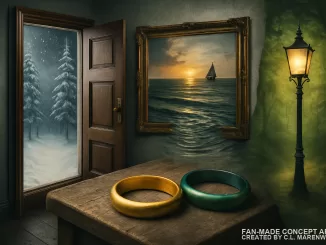
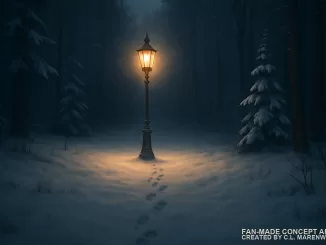
The Lion, the Witch and the Wardrobe Concept Artwork

Daan Almighty sent us a load of new concept art images. He took photos of them at a recent Narnia event in Amsterdam (at which, he said, the lighting was terrible, sorry for that). SPOILERS!