
Posts Tagged ‘The Magician’s Nephew’

NarniaFans Mailbag #44: Filming Order, Regina Spektor and Invisible Army

Thursday, July 30th, 2009

This week has been flying by.  I just remembered that it was Thursday, and that I hadn’t written this week’s mailbag.  So I’m spending lunch time writing this week’s installment.  I spent Tuesday riding roller coasters at Cedar Point, and around that day there were some really huge things happening in the world of Narnia.  The third film started shooting, and we’ve gotten some great photos of the Dawn Treader nearing completion.  I’ve got a couple of e-mails to answer this week, but before I do, I just wanted to give a status update on the secret project.  I’m currently working on speed issues on it, but it’s moving forward.  I have guests up from Florida so it’s going to take me a little longer than I had initially anticipated, but I hope that it’s worth the wait.

And a quick update on Chesterton’s The Everlasting Man that just came in from a woman named Barbara:  “C.S. Lewis’s appreciation for Chesterton’s The Everlasting Man in correspondence is well known. Tolkien borrowed the idea for Ents from Chesterton’s The Trees of Pride!  I hope these facts were brought to your attention.” Thanks Barbara!

(more…)

3 people like this post.

Texas State Professor finds Lost Lewis Manuscript

Wednesday, July 8th, 2009

In the last few years, we’ve had a lot of lost manuscripts begin to surface from the likes of C.S. Lewis’ friend J.R.R. Tolkien.  From The Children of Hurin to The Legend of Sigurd and Gudrun, the wealth of literature from Tolkien has been expanded greatly, and it’s about time that something new from Lewis has been discovered.  Communications Professor Steven Beebe of Texas State discovered a lost manuscript fragment in Oxford University’s Bodleian Library.

(more…)

1 people like this post.

NarniaFans Mailbag #33: Updates on Anna Popplewell, William Moseley, Andrew Adamson’s past, and C.S. Lewis and J.R.R. Tolkien

Thursday, May 7th, 2009

This week’s mailbag features a topic that is very interesting to me: that of the relationship of J.R.R. Tolkien and his writing to C.S. Lewis and his.  Other topics include what Anna Popplewell and William Moseley are up to next, and Andrew Adamson’s past in Papua New Guinea.  I’ll see if I have the time to reach back into the mailbag archives after the five letters that I received this week.  Be sure to look through the comments from last week’s mailbag for some fascinating follow-up information as well!  Let’s get started!

(more…)

Narnia Producer has List of Directors for Silver Chair

Wednesday, April 23rd, 2008

It’s a question that we can’t help but think would please the old theologian himself: Is C.S. Lewis’s “Chronicles of Narnia” film series dead or isn’t it? First, Disney announced in grand fashion that they would film all seven of Lewis’s books, with a new one coming out each May. Then the rumors started to swirl like the White Witch: Disney wanted to concentrate elsewhere, they wouldn’t commit to any Narnia films after “The Voyage of the Dawn Treader,” which would mean three films and no more. Producer Mark Johnson himself recently told a packed crowd at New York Comic-Con that “Treader” would, in fact, be the last voyage.

Cue the Great Aslan. No, better yet, cue one of his patented resurrections.

“There is a list,” Johnson revealed to MTV News of a group of dream directors being eyed to bring the fourth Narnia book, “The Silver Chair,” to the big-screen. “We have an eye on who might direct.”

Whoa, Whoa. Back up. You’re talking directors? That strikes me as something nobody does with a dead franchise. Not at the level of “Narnia,” anyway.

In fact, Johnson went on to describe how he envisions that the future of the “Narnia” series may very well wind up like “Harry Potter,” with different, visionary directors brought in to reinvigorate the franchise at each step along the way (a la Alfonso Cuaron).

“I think [the director of "Silver Chair"] will be somebody new entirely,” he said when we asked if that list of helmers included previous directors Andrew Adamson or Michael Apted. “I would like to get somebody totally unexpected.”

So it looks like, for now at least and until the next reversal, that the future of Narnia is a bright and comprehensive one, with Johnson planning on taking us from the beginning (”The Magician’s Nephew“) to the end (“The Last Battle“).

Amid those future adaptations, of course, will be many complications – from mere logistics to figuring out how to navigate Lewis’s increasing sexism, religious allegory, and perceived racism.

“I’d be lying if I didn’t say a couple of them I don’t know how to film,” Johnson confessed, adding with a wry smile. “It would be a good problem to have.”

MTV Movies Blog

Tilda Swinton Insists She’s Not In ‘Narnia’ Sequel

Friday, March 14th, 2008

Sharp-eyed viewers of the new trailer for “The Chronicles of Narnia: Prince Caspian” may notice a familiar face where it doesn’t belong – namely, in the trailer at all, joked recent Oscar winner Tilda Swinton, whose character, the White Witch, can be seen in clips for the film but not in the film itself.

She thinks.

“I’m dead! I don’t know what they’re doing there,” she laughed. “What are they playing at? Isn’t she dead? I [certainly] thought so!”

Still, it didn’t surprise Swinton that her face popped up, even if she was never contacted.

“They have my image in their computer bank. They can do whatever they want,” she said. “They can make me sell whatever they want.”

Just give it a couple more years for the hard sell, Tilda. While fans of the C.S. Lewis series can tell you that the White Witch is nowhere to be seen in “Prince Caspian,” she is a major character in “The Magician’s Nephew,” the sixth book written in the series (although the first chronologically). Assuming one a year, Disney should be getting to it in, oh, let’s say 2013.

But we know she was on the set… hmm..

Behind the Wardrobe: An Interview Series with Douglas Gresham. Part 5 of 6: ” On The Lion, The Witch, and The Wardrobe .”

Wednesday, October 10th, 2007

Hey, Narnia Fans! Welcome to “Behind the Wardrobe” an Interview Series with Douglas Gresham. Join me as we find out about CS Lewis, Narnia and more in this interview series.

Special thanks to Paul Martin (The Webmaster for NarniaFans) and to Mr. Douglas Gresham himself for this amazing opportunity. And an even bigger thanks to Mr. Gresham for putting up with a few of my impossible questions. Thanks for being such a great sport about it!

For this week: On The Lion, The Witch, and The Wardrobe .

On The Lion the Witch and The Wardrobe-

JS: The first Narnia movie did extraordinarily well at the box office, and exceeded many people’s expectations . What was your reaction to this?

DG: I expected it.

JS: So then it was really no surprise to you when The Lion, The Witch and The Wardrobe ended up being one of the top grossing films of 2005 along with the likes of Star Wars Episode III: Revenge of the Sith , Batman Begins, or Harry Potter and the Goblet of Fire?

DG: Not at all, what surprises me is that those other movies did so well. :-)

JS: I as a fan thought it was pretty neat that the first time outing for the Narnian film franchise did do as well as such films with a pre-established fan basis, such as Star Wars, Batman, or Harry Potter.

DG: We are all very happy about it too, but of course this success means that we have to make our next movie even better.

JS: Do you think Jack would have been pleased with the film? If so, in what ways?

DG: I certainly hope so otherwise I wasted five years of my life. I think he would have loved the realism we brought to unreal estates and characters. I also think he would appreciate our faithfulness to his book.

JS: Where you pleased with the film?

DG: As a producer of it, if I hadn’t, I would only have had myself to blame.

JS: What do you think led to The Lion, The Witch and The Wardrobe being done so well in terms of acting and quality of the production?

DG: Thousands of things, Philip Anschutz, Mark Johnson, Phil Steuer, Perry Moore, Marcus and McFeely, Andrew Adamson, KC Hodenfield, Roger Ford, Don McAlpine, Howard Berger, William Mosely, Anna Popplewell, Skandar Keynes, Georgie Henley, Isis Mussenden and —but I think you should be beginning to get the idea. Had I the time and you the space I would name every single member of all the teams that put the movie together from the very first to the very last in no particular order. The folks who cleaned the toilets, serviced the generators, drove the trucks and did a myriad of tasks that the public never even think of, all contributed to how well the movie was made. Each and every one of them was indispensable, and I owe them my heartfelt gratitude and admiration.

JS: Of any one in the film, who do you think gave the best performance?

DG: I did. How on Earth could I single out anyone else?

JS:So would you say the film was more of an ensemble piece?

DG: I think the nature of the story makes it imperative that the film be a team effort not only among the cast, but also with all the invisible members of the team, those amazing guys who do the CGI for example, and everyone else involved. I think that it is important that the star of the movie is in fact the story itself and that no one performance eclipses that.

JS: I felt in terms of casting one stroke of genius was that none of the actors were “major names” ( ie No Michelle Pheiffer as Jadis, or James Earl Jones as Aslan or Lindsay Lohan and Hilary Duff as Susan and Lucy).

DG: Yes, I agree with you.

JS: Adamson did a marvelous job directing the film. A lot of things he did had always been things I would have done if I made the film. (Such as opening with the air raid on London, haveing Peter and Edmund wear armor into battle, and even the relationships with the children.) He also did a great job making people who weren’t fans of the book interested in what was happening in the story and care for the characters.

DG: Yes indeed. Human beings are made for relationships, firstly a relationship with God and to achieve a good relationship with God we must guard and develop our relationships with our fellow human beings.

JS: In terms of the children, (and even Adamsons direction) they were perfect in the roles. They actually seamed like real life siblings!

DG: And I think that you will find that they actually feel very like siblings in real life. We are so fortunate to have found four really good young actors who are not only that but also very nice people. As the making of the film progressed it soon became evident that a strong bond was developing between the four children and that in turn came through onto the screen.

JS: How was it to have the cameo as the radio announcer?

DG: Fun, but not as much fun as my cameo in Prince Caspian. >:-}

JS: Did you approve the changes made to the film from the book?

DG: Again, I am a Co-Producer which means that I am one of the team that makes those decisions.

JS: I have to admit one of my favorite things in the film was the design of the wardrobe. Many fans of the book noted that etched onto it were scenes depicting the events of The Magician’s Nephew. Was this your suggestion?

DG: No, I think that came from Andrew or it may have been Roger, I am not sure.

JS: What was your favorite scene in the film?

DG: All of them.

JS: I take it as co-producer you got to be onset?

DG: Yes, of course. My ancillary duties meant that I could not spend as much time as I would have liked to on set, but I did spend quite a lot of time there.

JS: Seeing it on film was great , but to actually see it (come to life), well that had to be amazing!

DG: To me it was both exciting and hugely gratifying. After all it is not a gift given to many people to watch an almost life-long dream come true.

JS: I know when I saw the film it actually seemed like the Narnia I saw in my imagination.

DG: I am so glad that you say that, it means that we got it right.

That’s it for this week. Come back next week when wrap up the interview series with part six, in which we’ll get some special ( and spoiler free) sneak peeks into the next installment of the series Prince Caspian

Granat Comments on Narnia Plans: Silver Chair Fourth

Monday, October 8th, 2007

We’ve reported on this before, but Variety has recently spoken with Cary Granat, president and co-founder of Walden Media, about his plans for the future of the Narnia series.:

Hopes are highest for “Prince Caspian,” which will cost at least $100 million. Granat promises that the battle-filled sequel is easily distinguishable from its predecessor and the third pic on the sked, The Chronicles of Narnia: The Voyage of the Dawn Treader.

Producers had announced at Comic-Con in July that auds could expect one “Narnia” installment each May for the next few years. Granat is committing publicly to only four or five, saying that “Silver Chair” might be the best bet for the fourth, followed by “Magician’s Nephew,” but he admits that there are a multitude of possibilities.

“There are a lot of stories to be taken from the seven books,” he notes.

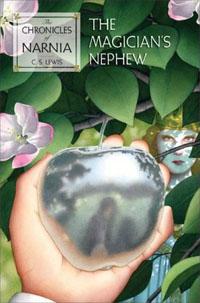
Tumnus’s Book Shelf: The NarniaFans Book Reviews : The Chronicles of Narnia: The Magician’s Nephew

Wednesday, August 29th, 2007

Welcome to Tumnus’s Book Shelf where we review any and all books related to Narnia and CS Lewis! For this weeks review, we will be looking at CS Lewis’s The Chronicles of Narnia: The Magician’s Nephew !

Book Title:The Chronicles of Narnia: The Magician’s Nephew
Author: CS Lewis
Illustrator: Pauline Baynes
Publisher: HarperCollins

Language: English

ISBN-10:0060764902
ISBN-13: 978-0060764906

Summary of the book:

Some Possible Spoilers.( Please Highlight to read)

Summary

Long ago in London around the turn of the 19th Century there was a girl named Polly Plummer. One day she was out in her yard when she saw a boy run out from the house next door. The boy was crying. She introduced herself to him and he to her. His name was Digory Kirke.

After a brief argument about who had the funnier name, who had the dirtier face and whether or not London was a hole, Polly found out why Digory was crying. His mother was horribly sick and about to die, his father was away in India and he and his mother had to come live in London with his insane uncle Andrew Ketterly.

The two children soon became friends and spent lots of time together as it was a very cold and rainy summer in London. Polly showed Digory her favorite hiding spot that they called “ The Smuggler’s Cave” which was an attic like space that connected between their houses.

One day the two of them entered into what they believed was the vacant house in between there respective homes. This house always posed a lot of mystery, as people heard strange noises and saw lights on at odd times of the night. The children believed it was either burglars or haunted while the adults said it was only the drains.

They entered the attic of this house to find a well lit and well furnished study that had many books, and scientific instruments. On a tray were several rings, half were yellow, and half were green. They find out that they were not in the empty house at all, but Digory’s . They turn and see Digory’s uncle standing in front of them.

He locked them in the room and refused to let them go. After a while he gave in, only to trick Polly into taking one of the yellow rings and putting it on. As she did, she immediately vanished. Andrew explains what happened.

The rings were forged from the dust of the lost civilization of Atlantis and had “magical” abilities. The dust was given to him by Andrew’s late godmother LeFay, in a special box that she had instructed him to destroy. He disobeyed and set about to find out what the dust was and what it could do. After several attempts he found out that it had the ability to send people to other worlds. He tested it on guinea pigs and none of them were successful. When Polly came, he tricked her into testing it for him.

After much persuasion, Digory agreed to put on a yellow ring and take two green ones with him. For one reason only: so save his friend. He put it on and soon vanished out of this world and entered into another that was a vast forest with many pools . He found Polly was sleeping.

He went to her and she woke up, at first they had no memory of each other or of life in our world, but after a short time their memories returned. They explored the wood and discovered it was actually a wood between worlds. The pools could send them to entirely new ones. They leapt into one pool and found themselves in a world where all the buildings were in ruins and a red sun hung over head.

They entered into a palace and found a hall of statues. At the end was a statue of a tall and beautiful woman. Next to it was a bell with a strange inscription next to it. The inscription not only warned them not to ring the bell or trouble would come, but also that they would go mad if they didn’t ring it.

Polly said they shouldn’t ring it. Digory ignored her and behaved like a bully as he grabbed her hand and twisted her arm around to keep her from leaving as he rung the bell.

The bell woke up the last statue, which wasn’t a statue at all, but Empress Jadis, the last ruler or the world of Charn who had placed herself under an enchantment. She told them what happened to her world and how she destroyed it by using the “Deplorable Word” in battle against her rebellious sister. The children thought it was horrible, but the witch told them she had the power so she had to use it. They tried to escape her. As they were leaving, she grabbed on to Polly’s hair and left with them.

Jadis was weakened in the wood between the worlds, but she managed to regain enough strength to grab onto Digory’s ear and follow them into our world. Andrew was immediately infatuated with her and agreed to take her into the city . She was less then pleased with him as he was only a man and not a magician or of royal blood, so he could only be her slave.

After fixing himself up, he called a cab for them. Polly had gone home and was ordered by her mother to go to her room for two hours. Some time later Jadis and Andrew returned and there was a riot near the lamp post as she was attacking many people with an iron bar from a lamp post.

Digory and Polly raced outside and managed to grab her in time. Jadis was in contact with Andrew, the cabby, and the horse and buggy, and they were all pulled along out of our world and into the wood between the world. They entered into a pool and found themselves in Nothing. They all heard a strange sound: singing .They watched as light, land and life came into being. Then they saw who the singer was. It was a Lion. They witnessed the creation of a whole new world. Jadis attempted to throw the bar at the Lion. It hit him in the forehead but glanced off him and landed on the ground.

Animals and other creatures were also created. The Lion selects some of them to speak, among them was the Cabby’s horse. Jadis ran away while the rest of them watched as a lamp-post grows from the bar. Andrew claimed it was the land of eternal youth were all things could grow. Digory hoped that meant he could find a cure for his mother.

He went to speak to the Lion who had called into a council several other creatures as evil had entered Narnia through the coming of Jadis. Digory spoke to the Lion, who is named Aslan. Digory asked Aslan to help him. Aslan agreed to nothing, but rather gave Digory a job.

SPOILERS!Since Digory was the one who brought evil into Narnia, he was the one to set it right. Aslan told him go to a hill top an pluck from a tree a silver apple. Digory agreed to the assignment and Polly asked to come with. Aslan turned the Cabby’s horse into a flying horse and instructed him to take them. The horse who’s name was changed from Strawberry to Fledge, accepted his job.

Fledge carried the children to the hill, which was far from the land that was called Narnia. Digory went into the garden where the apples were. The garden was surrounded by a wall, and only by going through the gate could someone go into the garden, to rightfully take the fruit. He found the tree as Aslan instructed. It was a massive tree with a beautiful bird nesting in it, who kept watch over it.

Digory took one of the apples, and turned to see the witch standing behind him eating one herself. After three attempts to get him to disobey Aslan, Digory refuses and returns with Polly to Narnia. Aslan instructed Digory to throw the apple. Then they all witnessed the coronation of Frank the Cabby and his wife Helen (who Aslan brought into Narnia) as King and Queen.

Then Aslan showed them where a tree had grown from the apple. He told them it would serve as a shield to keep Jadis out as she can’t stand the smell of the fruit due to the fact she ate of it. Aslan told Digory he may take one of the apples and give it to his mother. Aslan returned the children and Andrew to their world, but not before first giving them a warning about their race and the potential to be like Charn.

From then on Andrew no longer dabbled in “magic” and was a bit nicer. Digory and Polly were friends for life, and his mother was healed. They planted the core of the apple in the yard and it grew to a great tree, and they buried the rings in the backyard. Digory’s father returned from India and told them they were to go live in a big house in he country. Years later Digory became a professor.

Sometime after, the tree fell down in a storm and Digory didn’t want the wood destroyed. He turned it into a wardrobe and put it in a spare room in his big house in the country.END SPOILERS!

Review.

Where did the White Witch come from? Why was their a lamppost in Narnia? Why was the professor so knowledgeable about the possibility of other worlds? These were some of the questions Lewis sought to unravel in The Magicians Nephew, the prequel to The Lion, The Witch, and The Wardrobe. And he did a great job of doing it, too.

This story is set in the turn of the 19th century, and Lewis makes it clear from the outset that this is a fantastical tale as he informs the reader “At this time Sherlock Holmes was still living on Baker Street and the Bestabels children were searching for treasure on Lewisham Road.” This lets the reader, even a young reader know that they are reading a fictional story set in a strange and weird land as it happens in the same time as the mysteries of Arthur Conan Doyle’s Sherlock Holmes and E. Nesbit’s The Treasure Seekers.

We meet the young Digory Kirke who is around ten years old. He has very few friends and is grieving as his mother is dying. This continues to show how Digory is like Lewis, as Lewis drew from his own experiences as a child, when he watched his own mother die, and than latter in life as his step-sons Douglas and David watched his wife Joy suffer from cancer. Digory is one of few characters in “children’s literature” who encounters grief.

Digory’s best ( and only) friend is a girl named Polly. Lewis again continues to show a different view on girls then most writers had at the time. Polly is independent and free thinking, but also helpful and considerate. If Lucy Pevensie was a voice of faith for her siblings, than Polly Plummer is a voice of reason for Digory as she tries to tell him when to not do something stupid. Both children are very loyal to each other.

There are two villains in this installment. First is Digory’s Uncle Andrew who is in some ways like the villain Weston in Lewis’ Space Trilogy as he cares only about gaining power and wealth at everyone else’s expense. At one point Andrew paraphrases the ideas of Nietzsche by saying that some one of his intelligence and ability is above and beyond all morals, and deserves all the power they have.

Jadis shows similar views in her desire to dominate not only Charn but Earth and Narnia as well. Like Andrew she is willing to use any means necessary to gain power even by using the dreaded “Deplorable Word”, and also believes she is above morals and wishes to set herself above everything else, making her a representative of Satan.

SPOILERS!We also first encounter Aslan and see he is not only the Savior and Ruler of Narnia, but it’s Creator. Like JRR Tolkien in The Silmarillion , he draws on the idea of the music of creation as Aslan sings Narnia into being. It is well known, that through out Lewis’ life he heard all of the tales of Tolkien and was enchanted by them and had great respect for them. It is greatly shown here in the means that Aslan uses for creation.

Lewis draws again from mythology for creatures to inhabit his worlds as he shows the creation not just of the talking animals but the other beings that dwell in Narnia. Even some of the scenery is taken from ancient folklore. For example, the description of the tree upon the hill is drawn heavily from Yggdrasil, the World Tree from Norse mythology that was upon a hill, surrounded by a gate with a bird over looking it. Much as Yggdrasil in Norse mythology, the apples of the tree in Narnia could restore health and give long life to the eater. The wall around it is like the wall around the path to the Celestial City in John Bunyan’s The Pilgrim’s Progress, and it is only through the gate that people may enter.

Much like Tolkien, as well as other authors such as John Milton, Lewis explores the question of the problem of evil. If something is created good, where does evil come from? Lewis shows through the actions of Diggory, the witch and Andrew that it comes from within the created beings who have the right to choose good or evil, and through the extreme pride they all show.

Lewis shows this in a thinly veiled retelling of the temptation and fall of man as Digory awakens the witch, due to his curiosity. Digory giving into his curiosity draws on another story about how evil entered the world, that of Pandora’s box. Digory’s fall to temptation in the hall of wax brings sorrow and trouble to him, Polly and others around them as well as the new world of Narnia.

However, Lewis also shows that there is a solution to evil, that comes through willful submission to a higher authority and through love. Digory then acts not just as Adam-like figure, but also Christ like as it is he who must set things right by doing Aslan’s bidding, and not his own. He is even tempted by the witch, not once, not twice but three times on the hill, as Christ was by Satan. This not only draws on the Bible, but also Milton’s epic poems Paradise Lost and Paradise Regained, which Lewis studied greatly, that tell not only of how Paradise was lost through disobedience and the fall to temptation, but how it was regained through obedience and the resistance to temptation, and humility.

Lewis also shows one of his beliefs about humanity. In his essays on space travel he believed that humanity would bring it’s evil into other worlds and further pollute the universe, this was an idea dealt with in the Space Trilogy.END SPOILERS!

He also shows some of his roots in science fiction. First is that we discover Narnia is not an “imaginary world” but rather one of several parallel worlds that exist separate from our own in it’s own universe with it’s own time-stream( which he deals with heavily through out the other six books in the series.)

He also shows this through the means of getting into the parallel universes. It is through the rings which are forged from the dust from Atlantis. Andrew tells Digory that when our civilization was beginning, Atlantis was far more advanced then us in a variety of ways, which include the ability to travel to other worlds. This goes along the ideas of Arthur C. Clarke’s Third Law in his three laws of prediction, which states that, “ The technology of a sufficiently advanced culture will appear indistinguishable from magic to an under developed mind.” This would be the case for Andrew, and Digory not just with the travel to other worlds, but the witch’s power .

Another way is simply through the descriptions of some of the worlds. For example, Charn is described as an old, dead world. Because of this it has a red sun, which would be a red super giant. Such a star is one near the end of it’s life.

In this book Lewis deals with the questions of life, death, temptation and obedience. He also grapples with the question that is often ignored in adult literature and debated by theologians, that of the problem of evil. He warns against the destructive power of evil with Jadis, and her world of Charn, and even the allusion to Atlantis which according to some accounts was destroyed because of it’s evil. He also warns against the search for power and even more about the danger of pride.

Lewis’s narrations are again very welcome and comforting ,especially as we deal with such things as evil, and death and go to the cold and dreary world of Charn. It feels as though you have a good friend with you in these sad places, much as Digory and Polly had each other. But at the same time he also helps us share in the excitement and wonder of the creation of Narnia.

The only downside to this book, is that the origin’s of the Witch contradict what is told to the children in The Lion, The Witch, and The Wardrobe. Other than that, it’s a children’s book that actually deals with the very serious and philosophically difficult question of the problem of evil. No one can pretend it doesn’t exist for long and try to shield children from it. Lewis can be one author we can trust to help teach younger people about it.

The Magician’s Nephew will leave you as spell bound as Digory and Polly were on their own adventure.

Five out of Five shields

Order the book from amazon.com

BREAKING! All Seven Narnia Books to be Filmed!

Saturday, July 28th, 2007

News has just come out of Comic-Con 2007 that all seven of the Chronicles of Narnia will be filmed. They also added that from Prince Caspian onward, all of the films will be released in May of the following year.

This is very exciting news, and I’m probably the most excited I’ve been, as I now know that I’ll be seeing The Last Battle on the big screen. It’s my personal favorite of the series, and if they get it right, it’s going to be visual effects intensive (not that the rest of the films are not, it’s just got some elements that will need to be poured over to appear completely realistic).

They did not, however, announce the order of release for the films. Currently, they’ve been releasing the films in the original order of the release of the books. That’s a fantastic way to do it, and I’m glad they chose to do it in that way. If they opt to film the next six films as two trilogies of stories, then The Magician’s Nephew might come before The Horse and His Boy.

I’d actually rather have it continue the traditional release pattern set by C.S. Lewis when the books were released, and have The Horse and His Boy come before The Magician’s Nephew. Then we’ll have the two bookends to the Narnia story come one right after the other.

What are your thoughts? Excited? Concerned? Share them on our forum!

From MTV.com:

And, according to director Andrew Adamson and producer Mark Johnson, they’ll be doing it again every year for the next decade.

“As long as you keep embracing these movies, we’ll make all seven,” Johnson told an appreciative audience. “We start the end of January on “The Voyage of the Dawn Treader.’ Our goal is to give you [a new] one every May starting [next year].”

The announcement came after a computer pre-visualization which showed the Pevensie children storming King Miraz’s castle alongside Prince Caspian, flying onto the topmost turrets in the talons of giant griffins.

Griffins, yes – but not Gryffindors. Comparing his work on “Narnia” to that OTHER long running fantasy series, Adamson insisted that future “Narnia” films will be both more consistent and more faithfully inclusive to the source than “Harry Potter.”

“‘Harry Potter’ is a different [animal],” he said via satellite from Prague. “C.S Lewis wrote more efficiently [than J.K. Rowling]. We have a chance to embellish, [not exclude].”

NarniaFansCast – Ep. 35: News, Magician’s Nephew prequel, Part 2

Monday, July 23rd, 2007

We’re back with a new episode! Producer John Burkitt (EveningStar) is joined by Roger Thomas (Prince of the West). Also listen for the second part of a four part prequel to The Magician’s Nephew.

NarniaFansCast – Episode 35
A thought provoking question about the Chronicles of Narnia books and Chapter 2 of 4 from our Bard’s Tale presentation of The Casket of Baktar. Roger Thomas (Prince of the West) joins host John Burkitt for a nearly hour-long show.
Direct Download

Those who listen through our feeds will be now enjoy the shows the instant they are released. Subscribing is free, so click on the link below to subscribe through iTunes!

Subcribe through iTunes

If you have a question that you would like to be answered on the show, please send them to NFC AT narniafans dot com

Want to be ON the show? Click here to learn how! We’re always looking for new cast members to join us on the show. Perhaps even for an episode or two.

If you are interested in transcribing or editing our shows, send an email to NFC AT narniafans dot com with your name, age and why you would like to be on our staff. If you are applying to be an editor, please also include a sample of your work.