Posts Tagged ‘Pauline Baynes’

NarniaFans Staff Member Featured in Silver Leaves

Monday, December 22nd, 2008

NarniaFans Staff Member, Jonathon D. Svendsen, is going to be featured in the second issue of  Silver Leaves, which is put out by the White Tree Fund, a Tolkien-related publication. The theme for this issue is dedicated to the Inklings. Fans of CS Lewis and JRR Tolkien know that the Inklings was the name of the informal literary group that consisted of CS Lewis, JRR Tolkien, Charles Williams and many others.

(more…)

Pauline Baynes, Narnia’s illustrator, dies at 85 – UPDATED (2)

Sunday, August 3rd, 2008

We’ve just received the sad news that the original illustrator of The Chronicles of Narnia has just passed away:

Wayne Hammond reports the death of Baynes at her home in Surrey. Pauline Baynes was the original illustrator of C.S. Lewis’s Chronicles of Narnia series, as well as of Tolkien’s Farmer Giles of Ham (1948), The Adventures of Tom Bombadil and Other Verses from the Red Book (1962), and Smith of Wootton Major (1967).

Read more .. Wikipedia Entry

Narnia expert Brian Sibley has written a blog entry about Pauline Baynes that you can read here:

Brian Sibley’s Blog on Pauline Baynes: Queen of Narnia and Middle-Earth

And note that obituaries will be appearing in The Times, The Telegraph, The Independent and The Guardian later in the week.

Kind regards,

Brian Sibley

Update 2:

Rem, from the Philippine Order of Narnians, sent us an update with links to the articles posted athe both the Independent and the Guardian:

I thought you’d like to know that, as Mr Sibley said they would, Pauline Baynes’ obituaries have already shown up at the Independent and the Guardian.

‘Prince Caspian’ Movie Tie-In Edition Features Exclusive Narnia Timeline Originated by C. S. Lewis

Tuesday, January 8th, 2008

The countdown to Walt Disney Pictures’ and Walden Media’s film ‘The Chronicles of Narnia: Prince Caspian’ begins today with the release of THE CHRONICLES OF NARNIA MOVIE TIE-IN EDITION. For the first time, readers can experience Narnia in a collectible edition featuring an 8-page, fold-out insert based on C. S. Lewis’s own timeline conceived for Narnia. The stunning cover artwork from ‘The Chronicles of Narnia: Prince Caspian’ movie introduces a dashing new hero-actor Ben Barnes (’Stardust’) as Prince Caspian.

The full-color timeline, recreated from C. S. Lewis’s original and paired with Pauline Baynes’ classic full color illustrations for the first time, provides the key to the passage of time in Narnia and Earth by laying the two worlds side by side. Never before has C. S. Lewis’s timeline been included in a complete edition of all seven books of Narnia. Readers can now enjoy the beloved stories and use the timeline as a guide to orient themselves within the epic work.

This Spring the timeline will be expanded into NARNIA CHRONOLOGY: From the Archives of the Last King (April 1, 2008; $19.99), an interactive version of The Chronicles of Narnia. NARNIA CHRONOLOGY will include pop-ups, gatefolds, pull tabs and many other exciting features to tell the stories in a sweeping linear format as C. S. Lewis imagined it.

On May 16, 2008, audiences will be enthralled by the film, ‘The Chronicles of Narnia: Prince Caspian.’ With THE CHRONICLES OF NARNIA MOVIE TIE-IN EDITION and NARNIA CHRONOLOGY, readers will have the chance to experience Aslan’s world first, in their own imagination.

Clive Staples Lewis, known as Jack to his friends, was born in 1898. Lewis and his good friend J. R. R. Tolkien, the author of the Lord of the Rings trilogy, were part of the Inklings, an informal writers’ club that met at a local pub to discuss story ideas. Lewis’s fascination with fairy tales, myths, and ancient legends, coupled with inspiration drawn from his childhood, led him to write The Lion, the Witch and the Wardrobe, one of the best-loved books of all time. Six further books followed to become the immensely popular The Chronicles of Narnia. The final title in the series, The Last Battle, was awarded the Carnegie Medal, one of the highest marks of excellence in children’s literature.

HarperCollins Children’s Books is one of the leading publishers of children’s books. Respected worldwide for its tradition of publishing quality, award-winning books for young readers, HarperCollins is home to many timeless treasures-Charlotte’s Web, The Chronicles of Narnia, Goodnight Moon, Where the Sidewalk Ends and Where the Wild Things Are; and popular new classics-A Series of Unfortunate Events, Warriors and Fancy Nancy. HarperCollins Children’s Books is a division of HarperCollins Publishers, one of the leading English language publishers in the world and a subsidiary of News Corporation . Headquartered in New York, HarperCollins has publishing groups in the U.S., Canada, the U.K. and Australasia. You can visit HarperCollins Children’s Books at www.harpercollinschildrens.com and HarperCollins Publishers at www.harpercollins.com.

THE CHRONICLES OF NARNIA MOVIE TIE-IN EDITION
Written by C. S. Lewis
Illustrated by Pauline Baynes
HarperEntertainment
Paperback / Ages: 10 and up / January 8, 2008 / ISBN: 978-0-06-123105-6 /
$21.99 / 6 x 9 /
767 pages with b & w illustrations and a full-color 8-page foldout

NARNIA CHRONOLOGY
From the Archives of the Last King
Based on the books by C. S. Lewis
Including full color illustrations by Pauline Baynes
HarperCollins Children’s Books
Paperback/ Ages: 8 and up / April 1, 2008 / ISBN: 978-0-06-124005-8 /
$19.99 / 10 1/4 x 11 3/4 /
32 full-color pages

www.harpercollinschildrens.com

Tumnus’s Book Shelf: The NarniaFans Book Reviews : The Chronicles of Narnia: The Last Battle

Wednesday, September 5th, 2007

Welcome to Tumnus’s Book Shelf where we review any and all books related to Narnia and CS Lewis! For this weeks review, we will be looking at CS Lewis’s The Chronicles of Narnia: The Last Battle !

Book Title:The Chronicles of Narnia: The Last Battle
Author: CS Lewis
Illustrator: Pauline Baynes
Publisher: HarperCollins

Language: English

ISBN-10:
ISBN-13:

Summary of the book:

Some Possible Spoilers.( Please Highlight to read)

Summary:

In the Last Days of Narnia, near what was known as Caldron Pool, there was an ape named Shift. Shift was a conniving, deceptive, manipulative creature who had only one friend in the world: a sweet, good natured, but gullible donkey named Puzzle. One day while the two were near the pool they saw something yellow in the water. Shift tricked Puzzle into going into the water to get it. They found it was a lion skin. Shift made the lion skin into a coat and told Puzzle to wear it. The ape told him he looked like Aslan.

Sometime later King Tirian and his unicorn, Jewel, were out at a hunting lodge when Roonwit the Centaur came to report to them some news he heard. It appeared Aslan had come to Narnia and many animals were being taken away to Colarman and many forests were being cut down. Aslan was said to be holding court at a stable on a hill. Tirian and Jewel believed what was happening to the animals and the forest was Aslan’s doing. However Roonwit said that there were no signs to proceed this.

Just then a dryad ran up to them, asking for help. She suddenly fell to the ground and vanished as her tree had been cut down. They sent Roonwit back to Cair Paravel to assemble the soldiers of Narnia while the two of them went to the stable on a hill to inspect the rumors.

They arrived and saw Shift and the Colarmans watching over everything. The Ape made a claim that he was not an ape but a very old man and that Aslan and Tash were one. He also claimed that what was happening to the creatures of Narnia was because they had all been being very bad. Later they watched as they brought out Puzzle and saw that it is not a lion at all but a donkey.

Tirian and Jewel attempt to interrupt and tell everyone that Shift was an Ape and “Tashlan” as they call him, was a donkey. Shift dismissed both of them as liars and said if they were not arrested then “Tashlan” would poor out his wrath on Narnia. Tirian and Jewel are taken away.

Some kind creatures came to visit him. Tirian told them to head south and as they were “gnawers and nibblers” ( such as mice, rabbits and rats) to free the wild talking horses of Narnia and send them North.

While he was tied up to a tree, Tirian called out to Aslan for help and pleaded with them to send the children from our world. Tirian soon had a vision. In it he saw four men and three women sitting around a table. One of the men stood up and recognized Tirian was from Narnia. The man said he was King Peter and in the name of Aslan, Tirian must speak.

Tirian vanished from our world and back into Narnia. Moments later Eustace and Jill arrived. Eustace untied the King and they explained how after he appeared, “The Friends of Narnia” or Diggory, Polly, Peter, Edmund, Lucy, Eustace and Jill, realized there was trouble in Narnia. They decided to send Eustace and Jill with the magic rings into Narnia, which Peter and Edmund went to retrieve.

Somehow Eustace and Jill ended up in Narnia before ever meeting up with the others at a rail way station, as just when their train was pulling in they heard a loud crash. Then they found themselves in Narnia.

The three of them went to a citadel that Tirian knew of and disguised themselves so they could sneak up to the hill. Eustace and Tirian rescued Jewel the Unicorn while Jill snuck off and freed Puzzle. They discovered the donkey was doing all of this against his will. They left the hill and hid to make further plans.

While they were hiding, they heard a sound of thunder and saw smoke in the distance. They looked and saw Tash was coming into Narnia and heading for the stable. He had been called into Narnia and now he was coming.

Along the way they freed some dwarves who refused to join them except for one, named Poggin. SPOILERS! Farsight the Eagle found them and gave them some terrible news. Cair Paravel was destroyed, and all reinforcements they could expect were either slaves in Colarman or killed in battle. Narnia had fallen.

The King told the children they could leave, but they refused for two reasons. First they wanted to help defeat the ape, and second they couldn’t return on their own. Only Aslan could do that. The children had no choice but to help him fight the final battle of Narnia.END SPOILERS!

They went to the hill where Shift was already putting a spin on everything that happened. He told them that Tirian and his friends had dressed up the donkey to deceive every one and Tashlan was still in the stable. SPOILERS! A cat that was on their side went in to see this, and returned scared, and what is more, this cat was a no longer able to speak , just as Aslan told them when he created them.END SPOILERS!

Then a Colarman named Emeth entered the stable. Moments later the door burst open and another Colarman who had also been in the stable fell down dead, and Shift claimed it was Emeth. Tirian and his small band fell upon them and told the truth about what the ape was doing. Several dogs, a wild boar and a bear joined Tirian’s side and a battle was fought.SPOILERS! Tirian and Eustace threw Shift into the Stable.

Some dwarves joined the fight but were unallied. They not only shot at the Colarmans, but shot at the band of horses that were coming to help the heroes. Jill watched in horror as Eustace was captured by the army of Rishda Tarkaan of Colarman and thrown into the stable to be fed to Tash. The dwarves had also been captured and thrown in the stable.

At the end of the battle the remaining heroes were captured. Tarkaan declared that if the animals gave themselves willingly they would live , as only Jill, Farsight, and Tirian would be given as sacrifices to Tash. They refused to surrender and continued to fight the Colarmans. As Tirian fought he watched as Jill was thrown into the stable. Jewel the unicorn was killed as well.

Then Tirian had an idea. He grabbed the Tarkaan and dragged him along to the stable door and flung themselves in and closed the door behind them. Tirian watched as Tash devoured the Tarkaan with one peck and then turned his attention to Tirian.

Suddenly a voice declared in the name of Aslan that Tash be gone. The creature vanished. Tirian turned and saw a nobly dressed man behind him. Next to him he saw two younger people who were Eustace and Jill. They introduced the other people who were with them. It was Diggory, Polly, Peter, Edmund and Lucy.

Tirian asked where Susan was. Peter told him that his sister was “no longer a friend of Narnia” She had stopped believing as she had been more concerned with the pursuit of vanity and worldly pleasures. Then they told him how they came into the world behind the stable and how they watched as Tash devoured the ape.

Lucy also tells them how she attempted to make friends with the dwarves. They went to them and tried to get them to see. All the dwarves could see was the cold dark stable. Aslan appeared to them. He commended Tirian for standing firm to the end. Lucy asked Aslan to help make the dwarves believe. He explained that dwarves could not believe as the were so hurt by the deception of Shift that they refused to ever believe again.

Then Aslan told them he had other work to do. He opened the door and they heard him yell out the word “TIME!” They watched as a giant shape appeared. Eustace and Jill recognized it as the Giant Father Time they saw in the Underworld. Time blew his horn and the stars began to rain down upon Narnia. The stars burnt all the grass.

They watched as many creatures of Narnia, both human, Marshwiggle, Dufflepod, dwarf and animal ran for the door. Those that looked at Aslan with contempt went to the left and vanished in his shadow. Those with love went to his right and entered the door. Among those that entered were Poggin the dwarf, Jewel the unicorn, Roonwit the Centaur, the dogs, horses, the boar, the bear and Farsight the Eagle all who were brought back to life by Aslan.

Then dragons came up from the earth and devoured the rest of the plants on Narnia. Then the dragons died and withered. The rivers, lakes and seas of Narnia flooded over and the land was covered with water. The sun rose up and they saw that it was red. Time put out the sun and the world of Narnia was over.

Then Aslan told Peter to shut the door and lock it. After he had done this, Aslan told them to follow him. Lucy, Jill, Diggory, and Tirian mourned the loss of Narnia. As they were following Aslan they see Emeth. He had been saved! It was revealed to them that when he arrived in the door he meet Aslan. Instantly upon the meeting he realized he was seeking him all along. Aslan forgave him his wrongs and welcomed him in his kingdom.

As they continued following Aslan they saw many thing that they recognized from Narnia, except it was larger and grander then before. Peter, Edmund and Lucy were surprised by this as the thought it was all destroyed and they were told they could never return. Diggory explained that what they saw destroyed was merely a copy or a shadow, and that was the land they couldn’t return to. They could however go to Aslan’s true kingdom.

They arrived at a hill with a great gate in front of it. The gate opened and Reepicheep came out to greet them. Peter, Edmund and Lucy ran to hug their old friend. Tirian was greeted by his father and Jewel watched as Polly and Diggory were reunited with Fledge.

Then more old friends came to greet them such as Puddelglum, Rillian, Caspian, Mr. and Mrs. Beaver and Mr. Tumnus the Faun. Last of all King Frank and Queen Helen came to see them all. Then Aslan beckoned them all to enter in.

Lucy spent some time catching up with Tumnus. As they were talking Peter and Edmund called them over to see something. It was their parents, and the Professor’s old house where their adventures first began and even all of England. They were surprised to see the house as it had been destroyed some time ago. Tumnus told them that in Aslan’s kingdom nothing good was ever destroyed.

Aslan comes to them and notices they seem sad. They tell him they are afraid of being sent back. He tells them that won’t happen. There was an accident on the rail road near the station. He explained to them, “All of you, and your parents are as they call it-in the Shadow-lands-dead. The term had ended, the holidays have begun. The dream is over. This is the morning.”

The real adventures for the Pevensies and their friends had only just begun. They had a brand new world in which.END SPOILERS! they all lived happily ever after.

Review:

It would not be presumptuous to assume that the late 20th Century would probably be best known for it’s apocalyptic films and books as it was drawing close to the dawn of not only a new century but the new millennium. However, long before the summers were filled with films about meteors, aliens and killer ice storms destroying the world (or all three at the same time), and before Tim LaHaye and Jerry Jenkins set the publishing world ablaze with the Left Behind series, CS Lewis wrote what could be called not only one of the first, but possibly the best work of apocalyptic themed literature in the final installment of his Narnia series, called The Last Battle. And in a children’s book, none the less!

Such stories can often be difficult to tell the right way, especially if using Biblical imagery. However one of the things that makes The Last Battle so extraordinary is where it is set. The language in Apocalyptic literature is at times very abstract and can be highly symbolic and depict many images that are difficult to decipher. How better to handle it than in a fantasy world where animals talk, the world is flat and stars already come down from the heavens? The realms of sci-fi, fantasy and even comic books, are best suited for it as they also deal in abstraction and can be symbolic at times of other things and contain many difficult images.

Because of this,The Last Battle steers clear of the debatable aspects of eschatology, such as the rapture, the millennium, the identity of the Antichrist, the Mark of the Beast, or if America is Babylon the Great, and performs the same function as the Biblical book of Revelation. It lets us know that in the end, when all is said and done, the King will return, and good will triumph over evil once and for all.

Unlike the rest of the books in the Narnia series, ( save The Horse and His Boy) we do not begin our story in our world. We begin it in Narnia. We also have one of the few times in which some one from Narnia enters our world ( the other being when Caspian and Aslan helped Eustace and Jill teach the bullies at school some well deserved lessons.)

Also unlike the other books there are very few parallels with other literary works in this story. It draws specifically from the imagery of the Bible, in particular in images and language found in many prophetic books of the Bible such as Daniel, Revelation and even the sayings and teachings of Jesus. It is also one of the three most “allegorical” stories in the series, after The Lion, The Witch, and The Wardrobe, and The Magician’s Nephew.

In this book we meet Tirian, the last king of Narnia and his friend Jewel the unicorn. Tirian is someone who wishes to fight for his faith and his beliefs in a time that they are all abandoned. He and the unicorn, stand for those of the faithful who will hold on to the end.

There is also Roonwit the Centaur,SPOILERS! who serves as a prophet for what is to come and try to tell others of the truth and warn them of the coming danger. Notably, much like the prophets, even Tirian, though faithful attempts to argue with them about the message they give.END SPOILERS! Similarly, Farsight the Eagle,SPOILERS! also serves as a prophet as he is the one to bear the news of the fall of Narnia.END SPOILERS!

Eustace and Jill are back as well.SPOILERS! They are far more faithful and devoted to Aslan then in their first journeys to Narnia and have grown not just in that way but as warriors as well. They also represent those who stand firm to the end even to the point of their deaths. When they are welcomed into the world beyond the stable, they are clothed in fine garments and crowns, much as the faithful are described as receiving in the book of Revelation..END SPOILERS!

We also meet some unbelieving dwarvesSPOILERS! who have sadly been hurt so much by the deception of Shift that the refuse to believe the truth. They are much like those who refuse to believe in God after they had been deceived and tricked by false prophets and teachers.END SPOILERS!

Shift the Ape SPOILERS!is an obvious Antichrist parallel. He fits the bill not just of the kind who appear in Apocalyptic literature but various historical figures who have been seen as such a person; from Emperor Nero in the Roman Empire to Adolph Hitler. According to scriptures such people ( or Antichrists and False prophets) claim they are God Himself. Shift makes a similar false claim as he says he is a man. In Narnia it was only a Son of Adam who was appointed to be the ruler of Narnia.

Shift’s name is ironic as it is the root of the word “shifty” which was often used in literature to describe the trickster characters, most notably Loki in Norse mythology who ushered in Ragnarok through some of his own tricks and deceptions. As is typical of the Narnia stories Shift meets his end horribly ( but deservingly) as he is devoured by Tash.END SPOILERS!

Fans also get a special treat SPOILERS!as we are reunited with Diggory, Polly, Peter, Edmund and Lucy. Even though they had all grown up they still believed in Narnia and represent those who hold on to their child like faith. Further more, Peter continues to parallel the apostle Peter as Peter Pevensie is told by Aslan, to shut the door and lock it, as Christ had told Peter the Apostle “ I give you the keys to the Kingdom of Heaven.”END SPOILERS!

Saddly,SPOILERS! only one of our old friends isn’t back, and that is Susan. This is one of two points of controversy in the Last Battle. Many modern readers misread her lack of involvement in this story as Lewis’s condemnation of femininity and womanhood as she’s being described as “ caring more about lipstick and nylons and invitations.” This is a misreading of Lewis’s work.

People who have made such claims fail to notice Lucy, Polly and Jill are in the story. Lucy is by this point a teenager, and Polly an old woman who has no doubt grown up and would be very much a woman and feminine. Susan was left behind not because she was female, but because she stopped believing as she was more concerned with materialism and vanity then her beliefs. It should be noted that she never truly believed from the beginning. She was also one of the last to see Aslan in Prince Caspian.END SPOILERS!

Another point of controversySPOILERS!is that of Emeth the Colarman who is allowed into the kingdom of Aslan. Aslan allows him in despite his beliefs in Tash. Many fans take this to mean Lewis is saying that all beliefs are acceptable. This is not the case. It is revealed that Emeth was truly seeking Aslan all along. It should also be noted that when he sees Aslan he renounces his beliefs, he is in that regard like the dying thief on the cross, or any one who has what is called a “death bed conversion.” This shows that any one can be saved only if they accept the truth . Notably, Emeth’s name means “Truth” in Hebrew.END SPOILERS!

There is one final thing Lewis does that is unique to this story:SPOILERS! long before the controversy JK Rowling generated by the sheer possibility she’d kill of either Harry, Ron or Hermione in her final Harry Potter book, Lewis went all the way and allowed for Peter, Edmund, Lucy, Eustace, Jill, Diggory and Polly to die. Not many writers are willing to allow a majority of the characters, in particular the ones they love, to die. This adds a level of maturity and depth to Narnia that is missing in children’s literature as they see that people die.

This of course was something parents objected to as they thought it was too scary for children to read. However, children had no problems with it. Perhaps because Lewis, our kindly grandfather of a narrator didn’t shy away from telling us this truth about life: that there is death. It is also one of the reasons this book garnered the Carnegie award for children’s literature.END SPOILERS!

However, Lewis also gives readers a special gift in his final tale of Narnia SPOILERS! He lets us know that there is a better world for our heroes. We also get to see them reunited with many of our old friends such as Mr. Tumnus and Prince Caspian. In a way, in The Last Battle, we join them all in this reunion too.

As he tells this story, Lewis comforts us as we watch as Narnia falls and comes to it’s end. We grieve with Lucy and the others at the loss of our beloved country. We feel as though we have lost something as well. At the same time we are assured that something better lies ahead.

The possibility of the end of the world. Death. Holding on to your beliefs until the end. Those are all themes not only present in the Last Battle, those are things that children will have to face in their life times. Most of the time such books are depressing, but Lewis gives us hope by letting us know there is a better world in store, one better than Narnia or Earth.END SPOILERS!

Who can ask for better than that for our happily ever after?

Five out of Five shields

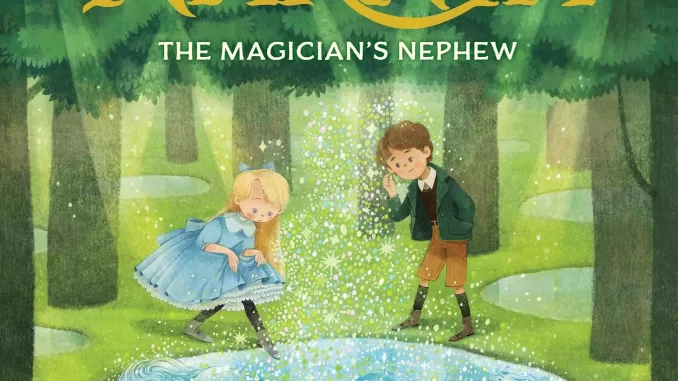
Tumnus’s Book Shelf: The NarniaFans Book Reviews : The Chronicles of Narnia: The Magician’s Nephew

Wednesday, August 29th, 2007

Welcome to Tumnus’s Book Shelf where we review any and all books related to Narnia and CS Lewis! For this weeks review, we will be looking at CS Lewis’s The Chronicles of Narnia: The Magician’s Nephew !

Book Title:The Chronicles of Narnia: The Magician’s Nephew
Author: CS Lewis
Illustrator: Pauline Baynes
Publisher: HarperCollins

Language: English

ISBN-10:0060764902
ISBN-13: 978-0060764906

Summary of the book:

Some Possible Spoilers.( Please Highlight to read)

Summary

Long ago in London around the turn of the 19th Century there was a girl named Polly Plummer. One day she was out in her yard when she saw a boy run out from the house next door. The boy was crying. She introduced herself to him and he to her. His name was Digory Kirke.

After a brief argument about who had the funnier name, who had the dirtier face and whether or not London was a hole, Polly found out why Digory was crying. His mother was horribly sick and about to die, his father was away in India and he and his mother had to come live in London with his insane uncle Andrew Ketterly.

The two children soon became friends and spent lots of time together as it was a very cold and rainy summer in London. Polly showed Digory her favorite hiding spot that they called “ The Smuggler’s Cave” which was an attic like space that connected between their houses.

One day the two of them entered into what they believed was the vacant house in between there respective homes. This house always posed a lot of mystery, as people heard strange noises and saw lights on at odd times of the night. The children believed it was either burglars or haunted while the adults said it was only the drains.

They entered the attic of this house to find a well lit and well furnished study that had many books, and scientific instruments. On a tray were several rings, half were yellow, and half were green. They find out that they were not in the empty house at all, but Digory’s . They turn and see Digory’s uncle standing in front of them.

He locked them in the room and refused to let them go. After a while he gave in, only to trick Polly into taking one of the yellow rings and putting it on. As she did, she immediately vanished. Andrew explains what happened.

The rings were forged from the dust of the lost civilization of Atlantis and had “magical” abilities. The dust was given to him by Andrew’s late godmother LeFay, in a special box that she had instructed him to destroy. He disobeyed and set about to find out what the dust was and what it could do. After several attempts he found out that it had the ability to send people to other worlds. He tested it on guinea pigs and none of them were successful. When Polly came, he tricked her into testing it for him.

After much persuasion, Digory agreed to put on a yellow ring and take two green ones with him. For one reason only: so save his friend. He put it on and soon vanished out of this world and entered into another that was a vast forest with many pools . He found Polly was sleeping.

He went to her and she woke up, at first they had no memory of each other or of life in our world, but after a short time their memories returned. They explored the wood and discovered it was actually a wood between worlds. The pools could send them to entirely new ones. They leapt into one pool and found themselves in a world where all the buildings were in ruins and a red sun hung over head.

They entered into a palace and found a hall of statues. At the end was a statue of a tall and beautiful woman. Next to it was a bell with a strange inscription next to it. The inscription not only warned them not to ring the bell or trouble would come, but also that they would go mad if they didn’t ring it.

Polly said they shouldn’t ring it. Digory ignored her and behaved like a bully as he grabbed her hand and twisted her arm around to keep her from leaving as he rung the bell.

The bell woke up the last statue, which wasn’t a statue at all, but Empress Jadis, the last ruler or the world of Charn who had placed herself under an enchantment. She told them what happened to her world and how she destroyed it by using the “Deplorable Word” in battle against her rebellious sister. The children thought it was horrible, but the witch told them she had the power so she had to use it. They tried to escape her. As they were leaving, she grabbed on to Polly’s hair and left with them.

Jadis was weakened in the wood between the worlds, but she managed to regain enough strength to grab onto Digory’s ear and follow them into our world. Andrew was immediately infatuated with her and agreed to take her into the city . She was less then pleased with him as he was only a man and not a magician or of royal blood, so he could only be her slave.

After fixing himself up, he called a cab for them. Polly had gone home and was ordered by her mother to go to her room for two hours. Some time later Jadis and Andrew returned and there was a riot near the lamp post as she was attacking many people with an iron bar from a lamp post.

Digory and Polly raced outside and managed to grab her in time. Jadis was in contact with Andrew, the cabby, and the horse and buggy, and they were all pulled along out of our world and into the wood between the world. They entered into a pool and found themselves in Nothing. They all heard a strange sound: singing .They watched as light, land and life came into being. Then they saw who the singer was. It was a Lion. They witnessed the creation of a whole new world. Jadis attempted to throw the bar at the Lion. It hit him in the forehead but glanced off him and landed on the ground.

Animals and other creatures were also created. The Lion selects some of them to speak, among them was the Cabby’s horse. Jadis ran away while the rest of them watched as a lamp-post grows from the bar. Andrew claimed it was the land of eternal youth were all things could grow. Digory hoped that meant he could find a cure for his mother.

He went to speak to the Lion who had called into a council several other creatures as evil had entered Narnia through the coming of Jadis. Digory spoke to the Lion, who is named Aslan. Digory asked Aslan to help him. Aslan agreed to nothing, but rather gave Digory a job.

SPOILERS!Since Digory was the one who brought evil into Narnia, he was the one to set it right. Aslan told him go to a hill top an pluck from a tree a silver apple. Digory agreed to the assignment and Polly asked to come with. Aslan turned the Cabby’s horse into a flying horse and instructed him to take them. The horse who’s name was changed from Strawberry to Fledge, accepted his job.

Fledge carried the children to the hill, which was far from the land that was called Narnia. Digory went into the garden where the apples were. The garden was surrounded by a wall, and only by going through the gate could someone go into the garden, to rightfully take the fruit. He found the tree as Aslan instructed. It was a massive tree with a beautiful bird nesting in it, who kept watch over it.

Digory took one of the apples, and turned to see the witch standing behind him eating one herself. After three attempts to get him to disobey Aslan, Digory refuses and returns with Polly to Narnia. Aslan instructed Digory to throw the apple. Then they all witnessed the coronation of Frank the Cabby and his wife Helen (who Aslan brought into Narnia) as King and Queen.

Then Aslan showed them where a tree had grown from the apple. He told them it would serve as a shield to keep Jadis out as she can’t stand the smell of the fruit due to the fact she ate of it. Aslan told Digory he may take one of the apples and give it to his mother. Aslan returned the children and Andrew to their world, but not before first giving them a warning about their race and the potential to be like Charn.

From then on Andrew no longer dabbled in “magic” and was a bit nicer. Digory and Polly were friends for life, and his mother was healed. They planted the core of the apple in the yard and it grew to a great tree, and they buried the rings in the backyard. Digory’s father returned from India and told them they were to go live in a big house in he country. Years later Digory became a professor.

Sometime after, the tree fell down in a storm and Digory didn’t want the wood destroyed. He turned it into a wardrobe and put it in a spare room in his big house in the country.END SPOILERS!

Review.

Where did the White Witch come from? Why was their a lamppost in Narnia? Why was the professor so knowledgeable about the possibility of other worlds? These were some of the questions Lewis sought to unravel in The Magicians Nephew, the prequel to The Lion, The Witch, and The Wardrobe. And he did a great job of doing it, too.

This story is set in the turn of the 19th century, and Lewis makes it clear from the outset that this is a fantastical tale as he informs the reader “At this time Sherlock Holmes was still living on Baker Street and the Bestabels children were searching for treasure on Lewisham Road.” This lets the reader, even a young reader know that they are reading a fictional story set in a strange and weird land as it happens in the same time as the mysteries of Arthur Conan Doyle’s Sherlock Holmes and E. Nesbit’s The Treasure Seekers.

We meet the young Digory Kirke who is around ten years old. He has very few friends and is grieving as his mother is dying. This continues to show how Digory is like Lewis, as Lewis drew from his own experiences as a child, when he watched his own mother die, and than latter in life as his step-sons Douglas and David watched his wife Joy suffer from cancer. Digory is one of few characters in “children’s literature” who encounters grief.

Digory’s best ( and only) friend is a girl named Polly. Lewis again continues to show a different view on girls then most writers had at the time. Polly is independent and free thinking, but also helpful and considerate. If Lucy Pevensie was a voice of faith for her siblings, than Polly Plummer is a voice of reason for Digory as she tries to tell him when to not do something stupid. Both children are very loyal to each other.

There are two villains in this installment. First is Digory’s Uncle Andrew who is in some ways like the villain Weston in Lewis’ Space Trilogy as he cares only about gaining power and wealth at everyone else’s expense. At one point Andrew paraphrases the ideas of Nietzsche by saying that some one of his intelligence and ability is above and beyond all morals, and deserves all the power they have.

Jadis shows similar views in her desire to dominate not only Charn but Earth and Narnia as well. Like Andrew she is willing to use any means necessary to gain power even by using the dreaded “Deplorable Word”, and also believes she is above morals and wishes to set herself above everything else, making her a representative of Satan.

SPOILERS!We also first encounter Aslan and see he is not only the Savior and Ruler of Narnia, but it’s Creator. Like JRR Tolkien in The Silmarillion , he draws on the idea of the music of creation as Aslan sings Narnia into being. It is well known, that through out Lewis’ life he heard all of the tales of Tolkien and was enchanted by them and had great respect for them. It is greatly shown here in the means that Aslan uses for creation.

Lewis draws again from mythology for creatures to inhabit his worlds as he shows the creation not just of the talking animals but the other beings that dwell in Narnia. Even some of the scenery is taken from ancient folklore. For example, the description of the tree upon the hill is drawn heavily from Yggdrasil, the World Tree from Norse mythology that was upon a hill, surrounded by a gate with a bird over looking it. Much as Yggdrasil in Norse mythology, the apples of the tree in Narnia could restore health and give long life to the eater. The wall around it is like the wall around the path to the Celestial City in John Bunyan’s The Pilgrim’s Progress, and it is only through the gate that people may enter.

Much like Tolkien, as well as other authors such as John Milton, Lewis explores the question of the problem of evil. If something is created good, where does evil come from? Lewis shows through the actions of Diggory, the witch and Andrew that it comes from within the created beings who have the right to choose good or evil, and through the extreme pride they all show.

Lewis shows this in a thinly veiled retelling of the temptation and fall of man as Digory awakens the witch, due to his curiosity. Digory giving into his curiosity draws on another story about how evil entered the world, that of Pandora’s box. Digory’s fall to temptation in the hall of wax brings sorrow and trouble to him, Polly and others around them as well as the new world of Narnia.

However, Lewis also shows that there is a solution to evil, that comes through willful submission to a higher authority and through love. Digory then acts not just as Adam-like figure, but also Christ like as it is he who must set things right by doing Aslan’s bidding, and not his own. He is even tempted by the witch, not once, not twice but three times on the hill, as Christ was by Satan. This not only draws on the Bible, but also Milton’s epic poems Paradise Lost and Paradise Regained, which Lewis studied greatly, that tell not only of how Paradise was lost through disobedience and the fall to temptation, but how it was regained through obedience and the resistance to temptation, and humility.

Lewis also shows one of his beliefs about humanity. In his essays on space travel he believed that humanity would bring it’s evil into other worlds and further pollute the universe, this was an idea dealt with in the Space Trilogy.END SPOILERS!

He also shows some of his roots in science fiction. First is that we discover Narnia is not an “imaginary world” but rather one of several parallel worlds that exist separate from our own in it’s own universe with it’s own time-stream( which he deals with heavily through out the other six books in the series.)

He also shows this through the means of getting into the parallel universes. It is through the rings which are forged from the dust from Atlantis. Andrew tells Digory that when our civilization was beginning, Atlantis was far more advanced then us in a variety of ways, which include the ability to travel to other worlds. This goes along the ideas of Arthur C. Clarke’s Third Law in his three laws of prediction, which states that, “ The technology of a sufficiently advanced culture will appear indistinguishable from magic to an under developed mind.” This would be the case for Andrew, and Digory not just with the travel to other worlds, but the witch’s power .

Another way is simply through the descriptions of some of the worlds. For example, Charn is described as an old, dead world. Because of this it has a red sun, which would be a red super giant. Such a star is one near the end of it’s life.

In this book Lewis deals with the questions of life, death, temptation and obedience. He also grapples with the question that is often ignored in adult literature and debated by theologians, that of the problem of evil. He warns against the destructive power of evil with Jadis, and her world of Charn, and even the allusion to Atlantis which according to some accounts was destroyed because of it’s evil. He also warns against the search for power and even more about the danger of pride.

Lewis’s narrations are again very welcome and comforting ,especially as we deal with such things as evil, and death and go to the cold and dreary world of Charn. It feels as though you have a good friend with you in these sad places, much as Digory and Polly had each other. But at the same time he also helps us share in the excitement and wonder of the creation of Narnia.

The only downside to this book, is that the origin’s of the Witch contradict what is told to the children in The Lion, The Witch, and The Wardrobe. Other than that, it’s a children’s book that actually deals with the very serious and philosophically difficult question of the problem of evil. No one can pretend it doesn’t exist for long and try to shield children from it. Lewis can be one author we can trust to help teach younger people about it.

The Magician’s Nephew will leave you as spell bound as Digory and Polly were on their own adventure.

Five out of Five shields

Order the book from amazon.com

Tumnus’s Book Shelf: The NarniaFans Book Reviews : The Chronicles of Narnia: The Horse and His Boy

Wednesday, August 22nd, 2007

Welcome to Tumnus’s Book Shelf where we review any and all books related to Narnia and CS Lewis! For this weeks review, we will be looking at CS Lewis’s The Chronicles of Narnia: The Horse and His Boy !

Book Title:The Chronicles of Narnia: The Horse and His Boy
Author: CS Lewis
Illustrator: Pauline Baynes
Publisher: HarperCollins

Language: English

ISBN-10: 0064471063
ISBN-13: 978-0064471060

Summary of the book:

Some Possible Spoilers.( Please Highlight to read)

Summary

During the time when Peter, Susan, Edmund and Lucy reigned in Narnia, their lived a young boy named Shasta who lived in Calorman. Shasta was raised by an old fisherman. One night while in a stable with one of the horses, he over heard the fisherman talking with another man and the man offered to buy Shasta from him. The fisherman agreed. Shasta grew afraid and began to talk with the horse.

The horse spoke to him and revealed he was a talking horse from Narnia. The horse offered him the chance to leave Calorman and head for Narnia and the north. Shasta accepts and during the night the two run off together. The horse introduces himself as “Bree-hinny-brinny-hooey-ha.” or “Bree” for short.

During the night they are pursued by lions and speed up and come in contact with what appears to be the Tisroc on his war horse. The discover it is a girl named Aravis wearing her brother’s armor and riding a talking Narnian mare named “Hwin.”

After telling her story of why she was traveling North, the four of them agreed to travel together. They came to the city of Tashbaan where they posed as common people on ordinary horses. They agreed that if they were separated to meet at the old tombs on the other side of the city. While traveling Shasta is spotted by the Narnians, who are visiting the city, and taken in with them as they mistake him for the missing Prince Corin of Archenland.

While staying with them he meets King Edmund, Queen Susan, and Mr. Tumnus. He overhears their plan to leave Tashbaan in secrecy as Prince Rabadash, the ruler of Calorman, wants to marry her and she refuses. They know they won’t be allowed to leave in public so they have to do it in secret.

Meanwhile Aravis and the horses encounter her old friend Lasraleen who is extremely shallow and flighty. Aravis is forced to hide with Lasraleen and pose as her slave girl, as her father is in Tashbaan searching for her. While in the palace she over hears a plot by Prince Rabadash and Ahoshta Tarkaan to invade Archenland and then Narnia.

Back with the Narnians the real Corin returns. Corin tells Shasta where he has been and helps him escape. Shasta heads for the tombs where a small cat comes and stays with him through the night. He is frightened later on as he hears jackals howling. He awakens and thinks he sees a lion. He discovers it is only the cat.

In the morning the cat is gone. Aravis and the horses finally arrive and she tells Shasta of the plan. The two hurry to Archenland to warn the king. As they enter they look back and see Rabadash and his army are coming. The horses run faster to reach the city of Anvard and are pursued by a Lion who wounds Aravis. They find housing with an old hermit . The hermit agrees to watch after Aravis and the horses while Shasta continues on.

Shasta finds the king out hunting and warns him of the attack .Shasta rides back with the king and his hunting party but they are separated in the fog. SPOILERS!While lost he meets Aslan who tells him how he has helped him along the journey every step of the way , even when Shasta was a baby.

Shasta finds his way to Narnia the next day. He sends a message through a talking Stag to King Edmund and is looked after by some dwarves. Shasta meets up with King Edmund, Corin, and Queen Lucy and joins them in the battle. Aravis and the horses watch the battle through a magic pool.

Aslan soon reveals himself to Aravis, Bree and Hwin and tells how he helped them as well. Shasta arrives and also shares something with them. He is actually Cor, the older twin brother of Corin and a prince of Archenland. Usurpers of his father’s throne had attempted to kill him as a baby by sending him adrift to prevent a prophesy of him one day saving Archenland from being fulfilled.

Edmund, Lucy, Cor, Corin, and the rest of the heroes hold a council to decide what to do with Rabadash. Aslan appears and turns him into a donkey for his foolishness. Aslan assures him he will not be this way forever. If Rabadash returns to his kingdom and stays in the temple of Tash and never leaves it he will be restored. However, if he disobeys he will become a donkey again and the change will be irrevocable. Rabadash follows the command.

In time Cor and Aravis marry and he becomes king of Archenland.END SPOILERS!

Review.

Of the seven books in the Narnia series this is one that many fans have mixed feelings about. Partially because it feels different than the other ones. This story does not have any goings on in Earth. No children from our world go into Narnia as it is set during the time of the Pevensies’ reign in Narnia. This means that they are regulated to cameo appearances. Much of the story is also set south of Narnia where there is little or no mention of Aslan or if he exists as they do not believe in him in Calorman, but serve another god, Tash. SPOILERS!Aslan himself doesn’t even appear until near the end of the book, and it is only at that point when readers understand that he was in the story the whole time guiding Shasta and Aravis.END SPOILERS!

Because of these differences this book is often times confusing for fans and they like it far less than the others. It can some times take them several times to get the hang of this book and understand it. Many fans of the series often even said of the seven books they would not complain if it wasn’t filmed.

However, for the difficulties, differences and challenges the book presents to readers on the outset, it still bears the same ring that the other books possessed and contains as much depth and symbolism as the others and is a highly enjoyable adventure story set in a fantastical land, akin to Aladdin in The Arabian Nights rather than a strict “fantasy”.

Aside from the enjoyable cameos of Edmund, Susan, Lucy and Mr. Tumnus and Aslan’s stirring appearance at the end, we again meet some new characters in this story. First we have Shasta, a young boy who has a great destiny and as a child is set adrift only to be raised by a family not his own and one day grows up to be the one to save his people, despite the attempts to stop him.

Shasta bears some similarity to Moses in the Old Testament as like him some jealous and fearful people wanted to kill him to prevent a prophesy from being fulfilled, and in the process, he was protected and raised by a people not his own, only to return and fulfill what had to happen.SPOILERS! He also encounters Aslan as Moses encountered God, while out in the wilderness and discovers how he had lead him all the way.END SPOILERS!

This leads him to embarking on a dangerous journey to a land he has never been to like Abraham and Moses in the Bible, or even like John Bunyan’s Christian in The Pilgrim’s Progress. Such an influence of the later is possible as that was a book that was very formative to the young CS Lewis’ imagination and was among the many that were instrumental in his coming to the faith. This makes the book also similar to Lewis’s own Pilgrim’s Regress.

SPOILERS! We also meet his real twin brother Corin who is more impulsive and reckless than his brother and more prone to fighting. Cor, or Shasta is more peaceful. This makes the two similar to Castor and Pollex or the Gemini twins in Greek mythology as one was aggressive and war like the other peaceful, which lead to their deaths. Ironically the book was also dedicated to his real life step sons Douglas and David Gresham, who he was beginning to get to know at this point due to his relationship with Joy Davidman Gresham, and may have used their personalities as templates.END SPOILERS!

We encounter the character of Aravis, a young girl who is fleeing her home as she is forced into an arranged marriage, one that she doesn’t like. She is more headstrong and stubborn than Lucy, Susan or Jill were as unlike them she is born from a noble family. This means she is used to getting her way all the time. Along her journey she is humbled and learns to think of others.

Her family line is much like a line of the ancient Egyptian pharaohs, as she is of the family of the Tisroc who claim to be descended from the god Tash as the Pharaoh claimed to have been descended from the line of Amon Ra. The cities in Calorman are also named for rulers and deities as the Egyptians did. Their beliefs also feature a pantheon similar to that of the Hindus, this would not be surprising as Lewis was versed in the mythologies of the Greeks, Romans, Norse, Egyptians and Hindus, so to draw from any of these sources in creating his world is not surprising.

We also meet the talking horses Bree and Hwin who have lived so much among the dumb beasts of the south that they have forgotten much of Narnia and their beliefs. Bree even disbelieves that Aslan is really a lion. Their disbelief is much like the Hebrews in the Exodus, in that did not fully know of Yahweh due to their time among the Egyptians. It is only when Bree and Hwin truly encounter Aslan that they know the truth much as when the Hebrews encountered God in the wilderness.

The villain in this book is Prince Rabadash son of the Tisroc. He is called later in the book “Rabadash the Ridiculous” as he is a very foolish character who underestimates Aslan and the people of the North and makes rash choices . As a villain he isn’t as evil as either of the witches, or as cunning as Miraz in the other books, but more arrogant and stupid. His great flaw is his own hubris, or extreme arrogance against Aslan and Narnia, which for his sin he is punished.

Lewis’ narrations hit the spot as usual. He even at one point shows a self-depreciating sense of humor when he compares children in that world learning how to tell stories with children learning to write essays in our world and says that he thinks more people would rather hear stories than read essays. This comment is humorous for him to make as he wrote many essays, in particular on Christianity, and is best known for them, but was well aware that more people would rather read a story. This is what led to him writing Narnia in the first place, to allow him to write about the concepts he wrote of in essays and allow the readers to sneak past the watchfull dragons and understand these concepts of faith in an easier way.

This story deals a lot with humility and the belief something much larger than you is always in charge, though you may not always see it at the time.

While the story may be confusing at first and different than the others it is still an enjoyable read, and a thrilling adventure and well worth it for any fan of the series. Don’t be afraid to go to Narnia and the North with The Horse and His Boy. Much like Shasta and Bree’s journey it may be hard to get through at first but it is well worth it.

Four out of Five shields.

Order the book from amazon.com

Tumnus’s Book Shelf: The NarniaFans Book Reviews : The Chronicles of Narnia: The Silver Chair

Wednesday, August 15th, 2007

Welcome to Tumnus’s Book Shelf where we review any and all books related to Narnia and CS Lewis! For this weeks review, we will be looking at CS Lewis’s The Chronicles of Narnia: The Silver Chair !

Book Title:The Chronicles of Narnia: The Silver Chair
Author: CS Lewis
Illustrator: Pauline Baynes
Publisher: HarperCollins

Language: English

ISBN-10: 0060764937
ISBN-13: 978-0060764937

Summary of the book:

Some Possible Spoilers. (Please Highlight to read)

The holidays are over and Eustace is back in school. A young girl named Jill Pole is hiding behind the gym because she is being tormented by bullies. Eustace finds her and she worries he’ll rat her out. He says he won’t do that. She is surprised, as he used to be one of the bullies.

This leads to her commenting on how he changed since the holidays. Eustace said the reason was because of Narnia. He tells her more about Narnia, except for one thing: he isn’t sure how to get there. They hear the bullies coming and run, they tumble down the hill and find themselves flying in the air.

They land on a cliff. When Jill starts to loose her footing, Eustace tries to grab her. She accidentally pulls him and sends him tumbling off the side. It is then that she meets Aslan. He tells her that she and Eustace must find Prince Rilian son of King Caspian, who has been missing for years. He gives her very specific instructions or signs, that she must remember. He also informs her that Eustace is safe and sound. Then he sends her into Narnia where she and Eustace meet up at Cair Paravel.

After making acquaintance with Glimfeather the owl, they tell him they have been sent by Aslan to help find the Prince. They see an aged man boarding a ship. Eustace discovers to his horror that it is Caspian. Jill also realizes she has messed up with the first sign: Eustace will see an old friend.

Glimfeather takes them to the aged dwarf Trumpkin, who is of no help to them at first as the dwarf is now so old and deaf he can barely hear. After a long time they are finally taken into Cair Paravel where they hear what happened to Caspian’s son.

Ten years earlier Rilian had been out Maying with his mother, who is known only as “The Star’s Daughter.” His mother lies down and while he and the rest of the party are off, a serpent comes and bites her. She screams and Rilian runs to her rescue, but arrives too late as she is already dead. The serpent slithers off and Rilian chases after it and isn’t seen again. Caspian sent many warriors to find him to no avail.

Because of this, Trumpkin would not send them off. In the night Glimfeather takes the two children to the parliament of the owls to discuss what to do. They take them to the North eastern marshes where they meet the pessimistic Marshwiggle, Puddleglum. He agrees to help the children.

They journey north where they meet a beautiful lady dressed in Green who is aided by a Black Knight. They inform the lady of their errand and she tells them to head to the House of Harfang where some giants live. She tells them they are gentle giants and if they want to get in all they have to do is knock on the door and say they are there for the Autumn Feast.

They do as they are told and are taken in. After she is cleaned up and in her room, Jill notices out the window that she missed another clue. Beneath them is a ruinous city that spells out the words “ Under Me.” She informs Eustace and Puddleglum of this when they come to visit her, and they make plans to escape.

After they sneak out they go under the ruins where they encounter a gnome who leads them down into the Underworld. They are led to the palace of the queen, where they are entertained by the Black Knight ( who with out his armor looks like Hamlet.) He informs them that they must leave him for a while so he can be bound to the silver chair as he is under an enchantment .

SPOILERS!

They return to him and discover that he is Prince Rilian. It was when he is tied to the chair that he is in his right mind. He pleads with them in the name of Aslan to set him free. Jill points out that this is the final sign. They untie him. Rilian destroys the chair and thanks them for rescuing him.

The Lady of the Green Kirtle returns, and attempts to enslave them all with a magical song and a fire. Puddleglum breaks the enchantment by stomping his foot in the fire, putting it out, and forcing them to smell burnt Marshwiggle. The lady transforms into a serpent and Rilian, Eustace and Puddleglum draw swords and kill her.

The four of them mount horses and begin to leave the Underworld. They discover that the creatures are celebrating as they are finally free of the power of the Lady of the Green Kirtle. A crack has opened in the ground, leading to the land of Bism. They are invited by one of the creatures to join them. The four of them decline the invite and continue heading up while the caves are flooding.

They make it to the surface and Jill is pulled out of a hole first, the rest follow after. Puddleglum’s foot is tended to and Rilian returns to his father. Centaurs come and take Jill and Eustace back to Narnia where they watch the funeral of Caspian.

Aslan appears to the children and says it is time for them to leave. They first go to his country where they watch as Aslan resurrects Caspian. Not only is he brought back to life, but his youthfulness is restored. Eustace and Caspian are reunited.

While Aslan returns Eustace and Jill to their own world, He and Caspian help them teach the bullies some well deserved lessons.END SPOILERS! From then on Eustace and Jill were good friends, and all was well in Narnia.

Review.

The Silver Chair is a dark book in a very literal way. Much of the story is set within the caverns and depths of Narnia. It is typical in a fantasy story for the heroes to descend into the depths at some point to conquer their own fears and doubts. It is in these depths that strange things occur and we meet even stranger creatures. This descent just doesn’t apply to going into the Underworld, but the hopelessness inNarnia with the abduction of Rilian, and the despair of the King.

Further darkness is brought by the new character of Puddleglum the Marshwiggle. The name suits him well as he is an extraordinarily pessimistic character. He very clearly subscribes to Murphy’s law as he believes the worst can and will always happen. He is part of a trend seen in 20th century literature and film in which a writer will bring a pessimistic character into the fold of the heroes to juxtapose the constant optimism that the heroes may have. He is similar in some respects to the likes of Eeyore in A.A. Milne’s Winnie the Pooh, Ian Malcolm in Michael Crichton’s Jurassic Park, Marvin the Paranoid Android in Douglas Adam’s Hitchhiker’s Guide to the Galaxy, and even C-3P0 in the Star Wars series.

The character of the pessimist is needed as he is not afraid to confront one thing. The doubts that others may not be willing to voice. While seen as a “wet blanket”,SPOILERS! it’s Puddleglum who helps free all of them from the witch. When she tells them that all there is, is Underworld, even his pessimistic attitude can’t except it and settles for that which he can’t see as even a pretend good world is better then a real bad one in his mind.

We also discover the next king of Narnia, Prince Rilian. His story is almost like that of Persephone in Greek mythology in which he is stolen from the surface world by the ruler of the Underworld. His appearance is described as looking a bit like Hamlet. A fitting comparison as in the play they make reference to the River Lethe, one of the many rivers within Tartarus, in which those who drink of it forget everything, and he has forgotten his life in Narnia.

He is a different type of prince then most. He is the one placed under enchantment and needing to be set free and rescued. With an exception of stories like Beauty and the Beast, and the Frog Prince, that role is typically assigned to the princess. Lewis mixes things up with this story in that regard. He shows sometimes even men need help.

The Lady of the Green Kirtle herself is much like Morgain Le Fay in some versions of the Arthur legends as she wishes to take control of the kingdom that is not her own, while the king is at his weakest, by use of the King’s heir. She also presents to the characters an inverted form of Plato’s allegory of the Cave and his ideas of the higher forms, when she tells them that all they know is an illusion, and the underworld is the real world.END SPOILERS!

We also meet Jill Pole. At the outset she is only Eustace’s classmate and not his friend. She has noticed a changed in him since the holidays and notes it is quite curious. It is because of this that she gains interest in Narnia. She is also very different from the other children in regard to the fact that she is one of the few characters who is not part of the Pevensie family who goes to Narnia. Unlike Lucy and Susan she shows far greater strength and is given a leadership role when Aslan gives her the instructions.

We see growth in the character of Eustace from our first encounter. He is far braver, and kinder than when we first met him. He realizes that he had been a bully and is attempting to make up for it. He continues to parallel CS Lewis’s own faith journey as he pursues Narnia more intellectually, then emotionally like his cousins did. He wants to know more about it and is asking questions and trying to figure out how to get there and trying his best with his limited understanding to explain it to those who may not know of it, such as Jill.

In “The Silver Chair” we confront issues of doubt, faith and trust. We also learn how important it is to remember any instructions that are given to us and not to listen to lies. Children can even get a crash course in the ideas of one of the originators of Western thought. We also deal more with ideas of aging, and even death.

And where would we be in the story with out Lewis as our narrator? He is clearly as mesmerized as his readers by the Underworld and all that lies in it. He knows how to tell a good story for children as well as adults.

While the four Pevensies are all absent from this book, it doesn’t at all detract from one’s enjoyment of the story. Fans of Peter, Susan, Edmund, and Lucy can find many more new friends in this one, and learn just as much as they did before. The Pevensies journey has ended, but ours only continues.

Five out of Five shields

Tumnus’s Bookshelf: The NarniaFans Book Reviews: The Chronicles of Narnia: The Voyage of the “Dawn Treader”

Wednesday, August 8th, 2007

Welcome to Tumnus’s Book Shelf where we review any and all books related to Narnia and CS Lewis! For this weeks review, we will be looking at CS Lewis’s The Chronicles of Narnia: The Voyage of the “Dawn Treader” !

Book Title: The Chronicles of Narnia:The Voyage of the “Dawn Treader”.

Author: CS Lewis
Illustrator: Pauline Baynes
Publisher(US): HarperCollins
ISBN-10: 0064471055
ISBN-13:978-0060764944

Summary of the book:

Some Possible Spoilers.( Please Highlight to read)

It has been another year since the last adventure of the Pevensies in Narnia. Peter is studying with Professor Kirke for an exam, while Susan has gone to America with her parents. As for the younger two they have the worst lot. They have to go stay with their Uncle Harold and their Aunt Alberta and their cousin, Eustace Clarence Scrubb.

Eustace is almost as bad as Edmund was when he first went to Narnia in terms of how he treats them. He can and will bully all of the Pevensie children, especially about Narnia. One particular day while Edmund and Lucy are talking in her room, Eustace comes to bother them. Edmund tries to get him to go away to no avail.

Lucy has been looking at a picture of a ship that reminds her of one in Narnia. When she mentions this, Eustace runs to rip it of the wall just to torment her. It is at this moment that the three children are pulled into the picture and find themselves in the water. They are fished out and find they are back in the world of Narnia.

Not only that, they are on board “The Dawn Treader”, the royal ship of King Caspian. They are reunited with Caspian and Reepicheep and meet his ship’s captain, Lord Drinian. They discover that Caspian is on a voyage to find the seven Lost Lords of Narnia and then to the very end of the world.

The first place they arrive in is in the region known as the Lone Islands. Upon their arrival Edmund, Lucy, Eustace, Reepicheep, and Caspian are taken captive by a slave trader named “Pug”. Caspian is sold to a man who turns out to be Lord Bern, one of the seven Lost Lords. Bern bought him because he could tell Caspian was the son of Caspian the IX . Bern informs him that the Islands are being poorly ruled by a man called Gumpas. With the help of Bern, Gumpas is removed from office. The two then rescue Edmund, Lucy, Reepicheep and Eustace. They return to the ship, with the Lone Islands safely now under Bern’s rule.

They continue on their voyage, Eustace of course is continuing to be unbearable. They stop at an inhospitable island were they make camp on a beach, except for Eustace who sneaks off . He watches a dragon slither out of its cave and die. He then sneaks into the cave and puts on an enchanted bracelet. As he is thinking dragon like thoughts, he himself becomes a dragon.

He returns to the ship and after many attempts finally convinces all of them that he is Eustace. It is only late one night when Aslan himself comes to Eustace that he is returned to normal. After his encounter he apologizes to his cousins for having been such a pain. They forgive him, and they also discover that the other dragon had been another one of the Lords.

They sail on and are attacked by a sea serpent. They stop at another island to repair the ship, but quickly leave the island as they see the body of one of the other lost lords. The lord has been turned to gold as the water is cursed. This causes the passengers of the Dawn Treader to argue with each other as it brings out their greed. They agree to leave quickly before they die as well.

Next they sail to an island that is filled with invisible people. They persuade Lucy to find a magic book and use it to make them visible. When she does it not only makes the invisible people visible but also makes the ruler of the island the wizard Coriakin (who is not human but a star who is under probation) and Aslan visible as well. Aslan reprimands her for her actions, which she apologizes for.

She returns outside and sees the invisible people are in fact one footed creatures who call themselves monopods.

From the island of the Monopods they pass through the Dark Island where nightmares and fears come to life. They rescue one of the lords, Lord Rhoop, and are lead out of the darkness by Aslan in the form of an albatross.

From the Dark Island it appears to be smooth sailing as they arrive at what is called the Island of the Sleepers. The sleepers are the last three Lords who are placed under an enchantment by Ramandu, a retired star.SPOILERS! It is here that Caspian meets Ramandu’s daughter and falls in love with her. He promises to return to her after the journey is complete.

As they arrive near the very end of the world Caspian cannot go further. He and the all but one of the Narnians must turn back as Aslan has ordered it . Only Edmund, Lucy, Eustace and Reepicheep are allowed to go further on.

Reepicheep must sail to the very edge as it is what he is destined for. He climbs inside a little boat and rows on to the edge, but not before getting a hug from Lucy and being cuddled by her. Edmund, Lucy and Eustace also disembark and sail into an area of water lilies where a lamb awaits them with a dinner of broiled fish.

The lamb transforms into Aslan and returns them to England. Before he does he reveals two things to the children. First is that Edmund and Lucy can never return to Narnia, as like their siblings they are now too old. Aslan also tells them that there is another reason they were brought to Narnia. By knowing him for a while in Narnia they could know him better in their world.

The book ends with a few final notes to the reader. First that Caspian did return to Ramandu’s island and married his daughter. Second that Eustace was a much better person back hone afterwards and his parents could never understand why.END SPOILERS!

Review.

Perhaps one of the reasons fans of CS Lewis’s Narnia Chronicles rank
The Voyage of the “Dawn Treader” as a favorite is that they see that the land of Narnia is more then the small country Lucy found in the wardrobe, but an entire world. It is in this book that we finally get to see the Lone Islands which have been referred to since The Lion, The Witch and The Wardrobe. We also encounter lands far beyond the realm of Narnia such as Dragon Island ( where Eustace becomes a dragon), Death Water Island ( where they found the man turned to gold in the cursed water), The Island of the Duffle pods ,and Ramandu’s Island.

Here CS Lewis begins to make up completely new creatures for his land beyond ones borrowed from mythology or talking animals. In a fantasy series this is one of the keys to making it a good one. Can you inhabit your realm with entirely brand new creatures that no one has ever meet besides your standard fair ( elves, dwarves, dragons and such)? One such new species is the Dufflepods, which are bizarre little men who only have one foot.

Another key to a good fantasy is how you can reuse certain fantasy conventions and at the same time make it different. This is the case with another new species we find in that of “the stars”. In the world of Narnia, stars are not balls of gas burning millions of miles away, but actual living beings who appear in human form at times. They are among the few beings in the world of Narnia who have magical capabilities. In this regard, Lewis uses another fantasy staple in granting magical abilities to beings who appear to be human but in actuality are far from human. These “stars” are then like Merlin in the Arthur Legends, the “Istari” (or Wizards) in Tolkien’s Middle Earth, or the various beings in Madeline L’Engle’s Time Quartet.

Because of this, Lewis sets up guidelines for what beings can and cannot perform magic. The stars can, as well as any “magical” being. However, humans cannot. This is evident when Lucy is reprimanded by Aslan for using the magic book, showing that it is forbidden for her to mess with such powers. Such rules are important as even a fantasy world needs it’s own set of rules and laws that cannot be bent. This further shows who Aslan is as he is the one who can defy all magic, as he is above it.

We also see further growth in the characters. One way of showing this is by giving a character flaws. It’s in this book that the once seemingly perfect Lucy is shown to be having some faults. She struggles greatly with caring about what others think of her, and with questions of her beauty as she compares herself to Susan who every one thinks is the most beautiful of the two. These character flaws are shown when she is tempted to use the magic book for those purposes.

Edmund has even more growth as a character. No longer is he Lucy’s tormentor but he’s her friend and protector. In this regard he has gone from the figure that everyone compares to Judas Iscariot in The Lion, The Witch and The Wardrobe, to a figure like the Apostle Paul: some one who at one point hated and tormented those of faith and breathed threats against them, but later becomes their strongest supporter and defender after he is given grace and forgiveness through the sacrifice of one who did no wrong. Edmund even paraphrases Paul’s comment in his epistles about being the chief of sinners when Eustace asks for forgiveness by saying , “I was the worst of all.”

Similarly Eustace is meant to be like another person who was against the faith and later believed. That of CS Lewis. In his biographies he noted that he thought the claims of Christianity were ridiculous, and he’d even mock the likes of Charles Williams and JRR Tolkien for their beliefs as Eustace did with the claims of Narnia, . Then he came to believe after his own encounter and also became a defender of the Faith. Interestingly Eustace’s middle and last initials are CS, and “Eustace” sounds suspiciously like “Lewis”. He also suffers from an equally intolerable name as Eustace did. ( In the first chapter Lewis wrote, “There once was a boy who was called Eustace Clarence Scrubb, and he deserved it. ” And Lewis was no less fond of his own name “ Clive Staples Lewis”, and preferred being called Jack.)

Reepicheep has also grown as a character. His bravery in battle makes him a far more confident creature, despite the fact he is just a mouse. He at times appears to be bigger then himself in this story as he is trying to fulfill his destiny that was spoken to him by a nymph.

We also see Caspian has grown from the boy-prince to the rightful heir to the throne. His voyage is not a pleasure cruise but a quest to continue to find a connection to his father by seeking these lost seven lords. His journey mirrors that of Telemachus in Homer’s The Odyssey, wherein he embarked on a quest to find out about his father and his past. His journey is also similar to that of Odysseus as he encounters many strange lands. One such land, Ramandu’s island, is similar to the Island of the Lotus Eaters in The Odyssey wherein people are put into an enchanted sleep.

We encounter on Caspian’s journey several new characters as Drinian, the various Lords, Coriakin, and Ramandu and his daughter.SPOILERS! It is Ramandu’s daughter that wins Caspian’s heart and ends up marrying him. This romance is a bit unbelievable( how can they be together after only one day!), but could perhaps be part of her tie in to such magical maidens as The Lady of the Lake in the Arthur legends, various fairie princesses in the fairy tales, and Galadriel in Lord of the Rings. It is also similar to Lewis’s poem “The Landing” where a traveler comes to an island and meets a woman of great beauty and falls in love with her instantly. END SPOILERS

Along the voyage readers can learn such lessons about greed, fear, and vanity. SPOILERS! Sadly, this is the book where we must bid good bye to Lucy and Edmund as like their siblings they have grown too old for Narnia. However, Aslan reveals some more of the deeper magic of Narnia to them by explaining that they were brought to that world to know him better in their world.END SPOILERS

Lewis is, as always, our very welcome narrator and guide in this story. No matter how good they make the films, his narrations will always be the things that are most missed in the movies. They add a certain life and vibrancy to the stories that is often missing in most books written for children or adults in this day and age.

“The Dawn Treader” is one exciting “Voyage” that you are going to want to read and reread again and again.

5 our of 5 shields

Tumnus’s Bookshelf: The NarniaFans Book Reviews: The Chronicles of Narnia: Prince Caspian

Tuesday, July 31st, 2007

Welcome to Tumnus’s Book Shelf where we review any and all books related to Narnia and CS Lewis! For this weeks review, we will be looking at CS Lewis’s The Chronicles of Narnia: Prince Caspian !

Book Title: The Chronicles of Narnia:Prince Caspian.

Author: CS Lewis
Illustrator: Pauline Baynes
Publisher(US): HarperCollins
ISBN-10: 0064471055
ISBN-13:978-0064471053

Summary of the book:

Some Possible Spoilers.( Please Highlight to read)

It has been nearly a year since the Pevensie’s first adventure in the land of Narnia. The four children are waiting at a train station to go back to school when all of a sudden they feel themselves being pulled away. Moments later the children vanish and find themselves on a mysterious island.

While investigating the ruins and other items located on it, they discover that they are back at Cair Paravel in the land of Narnia, and that over 100 years have passed in that world. The children rescue a dwarf named Trumpkin, who serves Prince Caspian.

After proving to Trumpkin that they are the four Pevensies, he tells them what as been going on in Narnia. The land has fallen under control of the Telmarines. The current ruler, King Miraz usurped the throne by murdering his brother and exiling seven lords who would have supported the young Prince Caspian. Miraz pretends to raise the young prince as his own.

Caspian loves the old tales of Narnia that his nurse tells him. One day he tells Miraz these tales. Miraz demands to know who told him such things. Caspian, out of fear of his uncle, says that it was the nurse who is then removed of her duties. Miraz hates any and everything to do with Old Narnia, and has removed any mention of it from their history.

Miraz hires a new tutor for Caspian, one Dr. Cornelius who is half dwarf, half human. In secret Cornelius tells Caspian more about Narnia and about Caspian’s true heritage as the rightful heir to the throne.

Then late one night he helps Caspian escape as Miraz and his wife have had a son of their own. This means they no longer have any need for Caspian as an heir and would kill him.

Cornelius gives him a gift: The horn of Queen Susan, which was given to her by father Christmas in The Lion, The Witch, and The Wardrobe. The horn can summon help from any where. Caspian escapes by horse into the forest. He falls off and is found by Trumpkin and another dwarf Nikabrik, and Trufflehunter the badger.

After much persuasion they agree to help him. They take him to meet other Old Narnians, which include Reepicheep the mouse, who are fighting for their freedom. After holding a council with them they all agree to head for Aslan’s How, where the remains of the Stone Table on which Aslan was killed still remain.

Once at the How, Caspian decides it is time to sound the horn. Trumpkin goes to Cair Paravel to see if any help has come. This is then the point where the four children enter the story. They leave the island and head for Aslan’s How.

The children get lost as the land has changed in the hundred Narnian years since they were there. Lucy sees Aslan and insists that they should go to where she sees him. No one believes her , except for Edmund, who insists that they listen to her. As everyone else is against her they decide to go the opposite direction.

They discover they are heading in the direction of Miraz’s troops. They double back and Lucy sees Aslan again. This time they agree to listen to her. Slowly the other children begin to see him. Finally the dwarf does too. Aslan sends the boys and the dwarf to Aslan’s How to help Caspian as there is a new threat to him in his own council.

Nikabrik has brought with him some evil companions, a were-wolf, and a Hag, who wish to bring The White Witch Jadis back from the dead. Caspian refuses. Nikabrik, the Hag and the were-wolf attack him. Peter, Edmund and Trumpkin help Caspian defeat the traitors.

After holding council with Caspian, Peter then makes a plan to duel with Miraz. SpoilersTwo scheming lords convince Miraz to agree. After a very long duel, Peter wins. Miraz is killed by the two lords and a battle breaks out.End of Spoilers.

The battle is won by the Old Narnians.Spoilers Aslan reveals that the Telmarinians are in fact from our world. He gives them all the choice to stay or return to Earth. This is important as only a Son of Adam could rule Narnia and as Caspian is Telmarinian, he is a Son of Adam.End of Spoilers

Spoilers Some of the Telmarinians return to our world.End of Spoilers Aslan crowns Caspian the king of Narnia. Caspian then knights Reepicheep, Trufflehunter and Trumpkin. Aslan sends Peter, Susan, Edmund and Lucy back to our world.

Spoilers However, before he does, he reveals something sad to Peter and Susan. They are too old. They can never return to Narnia.End of Spoilers

The children then find themselves back at the train station, exactly as they left it and head off to school.

Review.

What Lewis did so well with The Lion, The Witch, and The Wardrobe, he does even better with Prince Caspian. Though sequels were hardly his intention, the books follow the same path as any sequel: it’s better then the original. It has to be. The first book is just about building your universe and setting up your characters. A sequel, is more freeing as you can explore your characters even more and enrich your world.

One way to explore the characters more is through growth and change. In the case of Prince Caspian that means examining how different Peter, Susan, Edmund and Lucy are from their first journey to Narnia. It is the fact that these characters actually grow and change that makes the books so unique. How often in a series of children’s books will you find that you have gone through 100 books (with at least five of them being a Christmas/winter story) only to see that the main lead is still 13 years old?

Such things frustrate children as they read such books. Such frustration does not exist in Prince Caspian. The story is set a year later it stands to reason the children would be a year older and they have indeed been changed by going to Narnia the first time. Lucy is now far more stronger and confident. She is willing to actually do things by and for herself. Edmund is no longer a treacherous problem child who harasses Lucy, but rather a kind, gentle and compassionate older brother who is willing to believe her.

Susan and Peter are very much reduced to mere supporting roles next to their siblings. Peter is now a mentor figure, almost like a surrogate Professor Kirke, who examines all things logically. Susan is even more maternal then she was in the first book. This is because the two are getting older and becoming adults, which means in turn that they have to have more adult roles.Spoilers So much so that at the end of the book they are told they can never return to Narnia. This revelation is heart breaking to them and later is one of the many linchpins in Susan’s downfall.End of Spoilers. Lewis is willing in his fantasy series to confront the fact that children grow up.

SpoilersChange is confronted further as the children have to come to grips with Narnia’s different time stream from Earth’s. 100 years have passed since they were there last. Cair Paravel is now in ruins and the peninsula it was on has become an island due to erosion. This also means all of their old friends like Tumnus and Mr. and Mrs. Beaver are all dead. They also have to face that their beloved country has fallen under dark times due to it’s current ruler.End of Spoilers

Because of these dark times they are summoned. Lewis uses his literary history extraordinarily well once again. Lewis makes a comparison in the books to the children from our world returning to Narnia being similar to how many in England believe King Arthur will return to England. A fitting comparison as according to the legends Arthur would return from Avalon in an hour of greatest need, and in deed Narnia is in one of it’s times of greatest need. It is in these dark times that Lewis to an extent explores a nations apostasy or lack of faith. Many in Narnia do not believe or know of Aslan or the four children this leads to Narnia’s downfall. Among the few are Caspian.

Aside from the challenges and changes the children must face there are several new characters the reader encounters in this book. First of all is Caspian. He is very much similar to such Biblical figures as David and King Josiah: a young man with a great destiny who leads his people back to their true faith. He also fits into the literary mode of the young King Arthur in TH White’s The Sword and The Stone, in which the young boy is destined to rule. His heritage and rightful claim to a throne that is filled by a usurper make him a bit like JRR Tolkien’s character of Aragorn in Lord of the Rings.

His uncle Miraz in contrast is like the Biblical kings Saul, and Ahab who lead the nation into apostasy and do not follow the true faith. Miraz is also a figure much like that of Claudius in Shakespeare’s Hamlet as he kills his brother to take the throne.

We also meet Reepicheep the mouse, a character whose bravery is greater then his height. His relationship to Aslan is an indirect reference to Aesop’s fable of the lion and the mouse. However this time it is reversed. After the mice had attempted to free Aslan after his death on the Stone Table they were granted the ability to speak. They are now fiercely loyal to him, Reepicheep most of all. Then in return for their loyalty to Aslan, he restores Reepicheep’s tail when it’s lost in battle. The parallels with the fable lie not just in the lion and mouse helping each other, but also in the message that even those who are very small can help one who is great.

In this book children learn that life is change .We all must grow up. We also must try to hold on to the things we believe in and hold dearly as we grow. They can also learn that even those who are very small can make a big difference.

As always Lewis’s narrations are witty and ironic and always addressing the reader as tough we are on the journey with the children. Admittedly though, most of Caspian’s story is told through a flash back .it shall be interesting to see how that can be pulled off in the film.

Prince Caspian is not only a good sequel , it’s also a good book in it’s own right, chalked full of powerful messages and an even richer literary history. For fans of Narnia, and CS Lewis in reading these books there is only one way to go: “ Further up and further in.”

Five out of Five shields

order the book from Amazon.com

Tumnus’s Book Shelf: A NarniaFans Book Review. The Chronicles of Narnia: The Lion, The Witch and The Wardrobe

Thursday, July 26th, 2007

Welcome to Tumnus’s Book Shelf where we review any and all books related to Narnia and CS Lewis! For our first review we will be looking at CS Lewis’s The Chronicles of Narnia: The Lion, The Witch, and The Wardrobe!

Book Title: The Chronicles of Narnia: The Lion, The Witch and The Wardrobe.
Author: CS Lewis
Illustrator: Pauline Baynes
Publisher(US): HarperCollins
ISBN-10: 0060764899
ISBN-13:978-0060764890

Summary of the book:

Some Possible Spoilers.( Please Highlight to read)

“It all began with a picture in my head of a fawn with an umbrella carrying packages in the snow,” said CS Lewis. He first had this picture in his head as a child and it stuck with him all his life and helped him create the seven Narnia books.

The first book written ( though not the first in terms of chronology) was called, “ The Lion, The Witch, and The Wardrobe.” Set during the air raids of World War II, four British School children Peter, Susan, Edmund, and Lucy Pevensie are sent away to live with Professor Kirke in the country for safety.

One day while exploring the professor’s house the four children come into a spare room with nothing but a large wardrobe inside. The other three leave the room as they find it uninteresting. Lucy however, stays behind as she thinks it would be worth it to try and open the wardrobe door.

She opens it and steps inside only to later find herself in the Land of Narnia. Upon her arrival she meets Tumnus the fawn and has tea with him. It is during this tea party that she discovers that Narnia has been enslaved by the evil White Witch Jadis, who makes it , “Always winter and Never Christmas.” He also tells her that the witch wishes to capture any human children.

Tumnus agrees to help Lucy escape as he cannot bare to harm her. She returns to our world and tells her brothers and sister of Narnia. They don’t believe her. Then one day while playing Hide and Seek she returns to Narnia.

This time she doesn’t go alone. Edmund follows after her, only to loose her in the forest. He comes in contact with the White Witch Jadis. She tricks him into believing that she is right and offers him the kingdom in exchanged for his siblings the next time he comes to Narnia.

The Witch leaves him alone and he soon meets his sister. The two of them return to our world and she is very happy to tell Peter and Susan that Edmund has been to Narnia too. When she tells them Edmund does something very despicable. He lies and says they were just playing.

This leads to further problems with the siblings until the day all four of them arrive in Narnia to hide from Mrs. McCready, Professor Kirke’s unpleasant housekeeper who is giving a tour of the house. The older siblings apologize to Lucy and are very angry at Edmund for lying about Lucy.

Following Lucy’s lead they head to Tumnus’s cave only to find the witch has had him arrested. The children are then found by Mr. Beaver and taken to his house for dinner with Mrs. Beaver, where they hear that there coming has been part of the fulfillment of a prophesy. They being Two sons of Adam and Two daughters of Eve are to help free Narnia. They also hear of the great Lion, Aslan.

During these discussion Edmund leaves to see the Witch. She is furious at Edmund for not bringing his brother and sisters with him and reveals where they are. She sends her wolves to capture them.

The other children and the Beavers escape to meet Aslan. Along the way they discover that the Witch’s spell is breaking. First because they meet Father Christmas who gives them gifts to aid in Narnia’s liberation. Second is the coming of spring.

They arrive at the meeting place and see Aslan. He inquires of Edmund and they tell him what happened. Edmund meanwhile continues to see how truly evil the Witch is and regrets his mistake. Much to his favor Aslan sends some of his soldiers to rescue him.

The Witch comes to demand Edmund back as the Spoilers“Deep Magic” every traitor belongs to her.End of Spoilers. Aslan speaks to her in private, making a deal,Spoilers His life for Edmund’s.End of Spoilers. Later that night he meets her at the Stone Table.Spoilers Susan and Lucy sneak along and watch in horror as Jadis and her allies kill Aslan upon the table.End of Spoilers

SpoilersThey mourn the loss of Aslan and help untie his body and stay near Aslan all morning. Early the next morning they find that the table is broken and his body is missing .Then they hear a sound. Aslan’s voice! They turn and see he is alive!End of Spoilers.

They hurry to the Witch’s castle and free the captives which includes Mr. Tumnus .With the help of those Aslan freed, they rush off to aid Peter, Edmund and the rest of Aslan’s army in the final battle against the witch. With Aslan’s help she is defeated!

The four children Spoilers are then crowned Kings and Queens or Narnia. They reign for many years. Then one day while on a hunt for the illusive White Stag, they End of Spoilers journey back through the Wardrobe door and Spoilers find that they had left our world only seconds ago. End of Spoilers Their first adventure in Narnia has ended but there are many more to come.

Review:

In his dedication to his goddaughter CS Lewis wrote that he wrote the book forgetting that books grow faster then children and that by the time it was published she may be too old for fairy stories. That is one fear I don’t think Lewis concern to have. This book remains one of the few fairy stories that can only get better with age.

The characters are quiet enjoyable. Lucy and Edmund are probably the ones who readers can like the most. These two are polar opposites of each other in the beginning as Lucy is sweet, carring and honest and Edmund is greedy, selfish and treacherous. It is their encounter with Aslan and in Narnia that causes Lucy to grow in confidence, and for Edmund to become a better person.

There has also been much negative criticism in regards to how Lewis treats women. However at the time the book was written his character of Lucy was quiet revolutionary as she is the one to discover Narnia, she Spoilers also, gets to witness Aslan’s resurrection End of Spoilers She is also described as trustworthy person, something that is also rare given the fact she is described as being the youngest. She is also an inherent leader. After seeing Narnia is true, even Peter, the eldest apologizes to her and follows her lead.

Susan is the logical practical character who always like to think things through carefully and at times seems like she’s the oldest. She is also the one to express doubts about Narnia and to suggest turning back when things get to dangerous.

Peter of the children is the one who is simply trying to keep the peace between his siblings. He is also quick to apologize when he’s wrong and willing to follow others.

The White Witch Jadis is simply evil. But she is one of those rare evil characters that is done well. She doesn’t wear the traditional black, but rather wears white and is described as being very beautiful. She also at times appears kind and gentle. These are her strongest points as a villain and a character.

Then there is Alsan. The most powerful character in the story as he is the ruler and creator of Narnia, he doesn’t even need to be visibly in the story to be in it. His presence is clearly through out the Land of Narnia. He is a Lion, and while being fierce, he is also very good. After all ” He’s not a tame lion.”

There are also several side characters as Professor Digory Kirke, the Beavers, Mr. Tumnus the fawn, Father Christmas, Maugrim the wolf, and even a rather excitable lion that help fill the world of Narnia with life and vibrancy.

The story is also very entertaining. Despite the talk of “magic” in Narnia, their really is very little of it in the stories. That is something unique for a fantasy story. So how does Lewis grab the reader with out resorting to someone waving a wand? By engaging you in the world itself and in the struggle to save it.

He also populates existing mythical characters and keeps them grounded in their traditional roots, example if a character like a wear wolf is seen as evil it is on the side of evil, if a character is noble and heroic like a centaur it will be allied with the side of good.

More importantly then the characters, story, fantastical elements, and the magic in Narnia is another aspect of the stories that makes them get better with age. The story has a “Deeper Magic” too it. Lewis’ allegorical imagery in the story is well known by now ,and even more imagery shows itself in constant rereading. There is so much of this packed into the book that it would take another article to go into. Lewis even paraphrases some of his arguments about the deity of Christ from “Mere Christianity” within the text of the story to defend Lucy’s claim about Narnia!

Along with the allegorical imagery is the underlying themes of the story, love, forgiveness, second chances, grace, redemption and sacrifice. I doubt any one can think of better messages to share with children then that.

As a narrator, Lewis is very personal and friendly almost like a tour guide of sorts into this realm he discovers. We get to discover this land right with him and the children. At times you almost expect him to be speaking in hushed tones as if he were sharing a wonderful secret with you. This is shown with such statements he makes as pointing out certain characters really aren’t important to the story or that to describe more of the monsters would probably mean parents would not let children read the book.

Spoilers The only downside to this book is the few contradictions to the later books, making it apparent that Lewis did not initially plan to write sequels. Such things include the lack of mention of The Emperor Beyond the Sea in subsequent novels, the change in the witch’s origins from this volume to “The Magician’s Nephew”, and Professor Kirke’s experience with Narnia.End of Spoilers

Those factors aside it is still an enjoyable book for both young and old alike and only gets better with age. Do yourself and your children a favor and read the book today!

Rating: 4 ½ out of 5 shields.

Order the book from Amazon.com