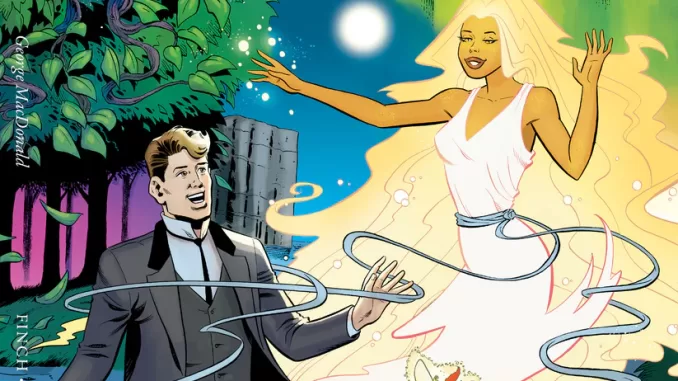
Into the Wardrobe: C.S. Lewis’s Narnia

Jordan Davis has written an excellent article on C.S. Lewis and the Chronicles of Narnia for The Nation. It dives into Laura Miller’s The Magician’s Book, in which she is so deep into her own claimed perspective that she is in constant denial of what she wants to avoid. He writes:

Born in 1898 to a Belfast solicitor and his mathematics-trained wife, C.S. Lewis, or Jack, as he preferred to be called, was deemed by his tutor for the Oxford entrance exams to have been “born with the literary temperament,” and “while admirably adapted for excellence and probably for distinction in literary matters, he is adapted for nothing else.” It was true. An admirer of Beatrix Potter, young Jack wrote talking-animal novels and came to have hopes of success as a poet. One thing got in the way: he was not a poet. And not, by the way, in the manner in which Ford Madox Ford wasn’t a poet–Ford in his poems lived up to his standard that poetry should be at least as well written as prose. Lewis talked down to himself in his poems; this is the fatal flaw in much of what we know as bad poetry.

Read the rest at The Nation

WardrobePart C. S. Lewis-biography, part literary analysis, The Magician’s Book: A Skeptic’s Adventures in Narnia is, at its heart, the story of a journey. The first step came when its author, Laura Miller, was given a copy of The Lion, the Witch and the Wardrobe by her second grade teacher. Today a well-respected writer and literary critic, Miller looks back at the spell this book cast on her and at how it shaped the reader and the person she has become.

Like all journey stories, some parts will be familiar and some will not. Most Narnia fans will be able to relate to Miller’s account of how the Chronicles of Narnia changed the way she looked at the world. They will identify with Miller’s deep desire to be Lucy, “that rare creation, a character who is good without being a prig or a bore.”

But these are side trips, not the main path in a book which promises to reclaim Narnia “for the rest of us,” this meaning readers who, like Miller, loved Narnia as young people but then felt “tricked, cheated, and betrayed” after they discovered that many Narnian themes mirrored themes found in Christianity.

Anyone not belonging to this “rest of us” group may find it hard to understand why this discovery produced so much anger and bitterness in Miller. Although she devotes most of her book to describing her rocky relationship with the Narnia books, she is never able to articulate exactly why learning that they represent C. S. Lewis’s attempt to put his most foundational beliefs into story form “horrified” her.

Would she have felt so horrified had she discovered Lewis was a Buddhist?

Read the rest at the C.S. Lewis Blog

Logos: C.S. Lewis Society (12/8/08)

We’re starting up our regular C.S. Lewis Society updates again! People really tend to like these, and they help to raise awareness of Lewis Societies all over the United States. This is the December 2008 newsletter of the C.S. Lewis Society of California: Logos.

    In This Issue:
    1. New BBC Documentary, The Narnia Code
    2. Other Narnia News
    3. Upcoming C.S. Lewis Society Events

1. BBC Documentary, The Narnia Code:

The BBC is producing the new documentary by Norman Stone, The Narnia Code, based on the seminal book by Michael Ward, Planet Narnia: The Seven Heavens in the Imagination of C. S. Lewis (Oxford University Press) for airing at Easter 2009. Dr. Ward and the book were featured at the C.S. Lewis Society of California’s special screening of the recent film, Prince Caspian, on May 17, 2008, at San Francisco’s Metreon. Stone won a BAFTA and an Emmy for his 1984 BBC production of C. S. Lewis Through the Shadowlands.

“Secret theme behind Narnia Chronicles is based upon the stars, says new research: The hidden theme behind C. S. Lewis’ Narnia books has finally been uncovered, according to a BBC documentary,” by Alastair Jamieson (London Telegraph, November 30, 2008)

“Documentary to lay bare ‘Narnia Code’,” by Alison Flood (Guardian, December 2, 2008)

2. Other Narnia News:

A. Prince Caspian Released on 3 Disc Special Edition (DVD and Blue-ray Disc):

“Newly Released ‘Prince Caspian’ DVD Takes Movie Fans Behind the Magic,” by Josh Kimball (Christian Post, December 2, 2008)

“‘Prince Caspian’ DVD hits stores tomorrow,” by Bob Beltz (San Francisco Examiner, December 1, 2008)

“The Chronicles of Narnia: Prince Caspian 3-Disc Special Edition DVD Review,” by Michael Weyer (411mania.com, December 5, 2008)

B. New Book Presents Skeptic’s Appreciation of The Chronicles of Narnia:

Numerous articles are currently appearing on the new book by Salon.com’s book critic Laura Miller, The Magician’s Book: A Skeptic’s Adventures in Narnia. In the book, Ms. Miller recounts her childhood love for The Chronicles of Narnia, only to turn away from from them as a non-Christian young adult, and later to return to them with skeptical admiration. Along the way, she has come to appreciate Lewis’s immense accomplishment in the Narniad, but largely believes that this relates solely to Lewis’s use of pre-Christian legends and symbols and that the Christian imagery was inappropriate and a “betrayal” (a view she incidentally does not hold for Philip Pullman’s bluntly anti-Christian Dark Materials trilogy). Her error lies in failing to appreciate Lewis’s (and J.R.R. Tolkien’s, Charles Williams’s and G.K. Chesterton’s) deeper point that all truly good literature, including ancient legend, reflects shadowings of Christian truths. For Lewis, the difference between standard myth and Christianity is not that the former is more authentic myth, but that Christianity is most authentically what Tolkien called “true myth,” in which the truths embedded in those legends, which althougth untrue have inspired and thrilled generations for millenia, became all too real in the true story of Jesus Christ.

Indeed, it was this insight by Lewis that was a major factor in his conversion in becoming a Christian. Although having much to be admired, Ms. Miller’s book really is a reflection of her own biases and limitations as a agnostic/modernist journalist, and she would do well to dig deeper into Lewis’s own scholarly writings on this matter, as well as Michael Ward’s superb book, Planet Narnia. In so doing, she (as with both Philip Pullman and Tokien himself) misinterprets numerous aspects of the Narniad stories, predictably based on her ignorance both of the classic literature Lewis was drawing upon and the “Medieval model” Ward reveals is at the heart of the books. Lewis’s Narniad has been so extremely popular because of its profoundly effective and sophisticated integration of enduring truths of the yearning of all mankind for what Lewis rightly called “Joy,” which leads us on a path directly to Christianity.

“A Return to Narnia: Adored in childhood, reconsidered in adulthood and finally embraced,” by Meghan Cox Gurdon (Wall Street Journal, December 6, 2006)

The Magician’s Book: Actual Smart Things About C.S. Lewis (and J.R.R. Tolkien),” by Lev Grossman (Time, December 1, 2008)

“A spy in the house of Narnia,” by Rebecca Traister (Salon.com, December 7, 2008)

3. Upcoming C.S. Lewis Society Events:

C.S. Lewis Society Bay Area Book and Film Club (See year-long schedule here)
Meets bi-weekly Wednesdays at 7:30 p.m.
The upcoming meeting will be held at:

    • God in the Dock is a wonderful book of forty-eight essays and twelve letters written by Lewis between 1940 and 1963. Ranging from popular newspaper pieces to learned defenses of Christian faith, these essays cover topics as varied as the logic of theism, good and evil, miracles, religion and science, ethics and politics, and much more. “These two characteristics in Lewis—the searching mind and the poetic spirit—are readily evident. . . . Here the reader finds the tough-minded polemicist relishing the debate; here too the kindly teacher explaining a complex abstraction by means of clarifying analogies; here the public speaker addressing his varied audience with all the humility and grace of a man who knows how much more remains to be known.”
      —New York Times Book Review

      God in the Dock is available in paperback, on CDs, on audio cassettes, or online.

  • 11990 Skyline Boulevard, Oakland, CA 94619 (atop the Oakland hills)
    RSVP: 510-482-2906 phone
    Wine, beer, soft drinks and other refreshments servedDecember 10 and 17: Discussion:
    God in the Dock: Essays on Theology and Ethics, by C.S. Lewis
    Leader/moderator: Frank and Lucia La Rocca

*******************************

For yourself and others, you can order books by or about C.S. Lewis, as well as videos and DVDs plus audio tapes and CDs.

Logos is made possible by the generous contributions of Members of the C.S. Lewis Society. If you enjoy Logos, please consider becoming a Member and making a donation to the C.S. Lewis Society. Click here for details on the C.S. Lewis Society Membership program, or contact us by phone at 510-635-6892,or by snail mail to C. S. Lewis Society of California, 100 Swan Way, Suite 200, Oakland, CA 94621-1428. All contributions are tax-deductible. Thank you!

-David J. Theroux

Tumnus’s Book Shelf: The NarniaFans Book Reviews: The Magician’s Book

Welcome to Tumnus’s Book Shelf where we review any and all books related to the Chronicles of Narnia and CS Lewis. Today’s Review is of Laura Miller’s The Magician’s Book

Read the rest of this entry »