
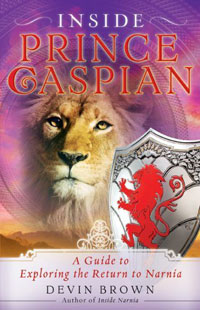
Adam Ferguson at Baker Books contacted us with information about Mr. Devin Brown’s companion comentary in the Inside Narnia series: Inside Prince Caspian

Here is what he said:

Prince Caspian, the highly anticipated second film in the Narnia series, releases in two weeks. The first movie in the series – The Lion, The Witch, and The Wardrobe – brought in over $740 million worldwide and boosted Narnia-related book sales tremendously. Not surprisingly, many commentaries hit bookshelves surrounding its release. Some did poorly while others did quite well.

One of the titles that did well was Dr. Devin Brown’s “Inside Narnia: A Guide to Exploring The Lion, The Witch and The Wardrobe.” Brown, a Lilly scholar and professor of English at Asbury College, wrote a follow-up commentary in anticipation of the upcoming film, “Inside Prince Caspian: A Guide To Exploring The Return To Narnia,” January 2008.

Brown takes readers through Prince Caspian chapter by chapter, illuminating the features of C. S. Lewis’s writing, providing supplemental information on Lewis’s life and other books, offering comments and opinions from other Lewis scholars, and uncovering the work’s rich meanings.

Note: NarniaFans readers can find Claire’s interview with Devin Brown as well as my “Tumnus’s Bookshelf” book review of his new book inside Prince Caspian in our January archives. The book is well worth the read and a wonderful edition to any ones Narnia library.

Prince Caspian: The Battle Within; a Devin Brown Interview

When English Professor Devin Brown started writing a literary analysis of C.S. Lewis’s timeless Chronicles of Narnia in 2003, he soon realized how the incredible depth of each book warranted invididual attention. Thus, the idea of having an “inside” for each book was birthed.

Brown says devoting an entire book to each of the Chronicles has worked well for him. To date, Inside The Lion, The Witch, and The Wardrobe, and Inside Prince Caspian have been published prior to the big screen releases of these films. Currently, Brown is in the process of writing Inside The Voyage of the Dawn Treader, which he says will come out in advance of the third film in 2010.

When CBN.com contacted Brown recently about his insight into Narnia, he was delighted to share the spiritiual lessons he observed in Prince Caspian, particularly how we all expericence the battle within.

HEDLUND: What is it about Prince Caspian that makes it unique to the series?

BROWN: Prince Caspian corresponds to an older time in the Pevensies’ lives and in ours as well, a time when the world is more complicated and less black and white, a time when it is not always easy to know what is the best thing to do. For a good part of the book, Peter, Susan, Edmund, and Lucy are unsure of where they are. After they realize they are back in Narnia, they next have to figure out what they should do and what is the best way to do it.

I think many people will be able to identify with the Christian parallels here. I think that for many mature Christians, the question of what God wants them to do is often more of a struggle than the question of whether they will do it or not.

HEDLUND: What surprises you the most about Prince Caspian?

BROWN: Lewis had a difficult task in writing this sequel. He had to make it different from the first book but not too different, familiar but not too familiar. People who liked The Lion, the Witch and the Wardrobe will be pleased to find the same four heroes, but they will find them one step further along in their spiritual journey. In this sense, we as readers get to grow up along with them and share in their development.

There is a certain innocence that is lost here in the second book. And while, in our own lives, we all regret this loss, there comes a time when we all must leave our childhood world and enter the real world a bit more.

HEDLUND: Do you think there are some lessons in Prince Caspian that perhaps only children will understand and others that make more sense to adults? Why?

BROWN: Children will easily relate to the idea that we all, big and small, have a responsibility to stand up to evil where ever and however we can. Caspian’s wicked uncle has seized power unlawfully, he has mercilessly driven all the Old Narnians into hiding, and he must be stopped. Even the diminutive Reepicheep and his band of merry mice have a role to play.

I hope adults will understand that Lewis choose to have Bacchus and Silenus return with Aslan to emphasize that happiness and celebration are supposed to be part of our everyday life, not just something reserved for holidays and vacations. If we can’t be filled with joy in our ordinary daily life, then we are choosing to live in a world that is a little like Narnia under Miraz.

Read the Rest at CBN.com

Exploring the Return to Narnia

Devin Brown e-mailed us to let us know that there’s an excerpt from his book: Inside Prince Caspian on CBN.com! Here’s a piece of the article, written by Devin Brown, followed by a link to the story.

In my book Inside Prince Caspian, I provide readers with a detailed look at C. S. Lewis’s second Chronicle of Narnia. Here is a very brief overview of some of the issues in Prince Caspian, one which I hope will be helpful for those going to see the upcoming film or for anyone who will be leading discussions about the book.

In Prince Caspian when the children first arrive in what they later learn is Narnia, there is something missing. On their earlier journey, when the four children came out from the wardrobe into Narnia, there was a mysterious sense of enchantment. Yes, Narnia was under the control of the White Witch. And yes, she had made it always winter and never Christmas. But somehow despite this, there was an immediate sense of wonder and awe evoked by the snowy woods and the mysterious lamp-post, and by something else as well, something which was simply part of the land itself.

Now after the four children are whisked off the train platform, the thick, overgrown woods they find themselves in hold no enchantment—they are just woods.

Because there is no special feeling to the place, Lucy has to ask Peter, “Do you think we can possibly have got back to Narnia?” His answer speaks loudly about the magical quality which has been lost or repressed. Peter responds, “It might be anywhere,” a comment which could never have been said about the Narnia of the first book.

This ordinariness, this lack of enchantment, is appropriate. King Miraz, the tyrant who holds power over Narnia, is not a magical creature like the White Witch was. Instead, he is just a two-bit dictator, the descendent of lowlife pirates, and not particularly bright or imaginative, the type of self-seeking autocrat found in minor institutions and backwater organizations of every world.

Like his kind everywhere, after he usurps the crown through cowardly, underhanded means, he does away with his opposition by way of hunting accidents, trumped-up charges, and hopeless quests. He will pretend to be fond of his nephew only until he has an heir of his own. Unlike the Witch, who is killed by Aslan in a dramatic battle scene, Miraz will meet his end, very appropriately, by the hand of one of his own henchmen after tripping on a “tussock.”

Read the rest at CBN.com

Devin Brown Prince Caspian Audio Interview

The Christian Studies Center at UK has two audio interviews with Devin Brown, author of INSIDE PRINCE CASPIAN up online.

Devin Brown Interview – Part 1

Devin Brown Interview – Part 2

In this interview, Dr. Devin Brown, Professor of English at Asbury College and author of Inside Prince Caspian, discusses various issues related to the forthcoming release of the film adaptation of C.S. Lewis’ Prince Caspian. In this episode, Devin discusses the shift between The Lion, the Witch and the Wardrobe and Prince Caspian, biblical parallels in Prince Caspian, whether or not Prince Caspian should be considered an allegory, and Michael Ward’s Planet Narnia. Enjoy, and look for our next podcast on Prince Caspian to arrive shortly here, or subscribe to our podcast in your iTunes music store by searching for Footnotes or Prince Caspian!

Thanks to Philip Tallon for e-mailing this story to us!

Tumnus’s Bookshelf: The NarniaFans Book Reviews: Inside Prince Caspian

Welcome to Tumnus’s Book Shelf where we review any and all books related to Narnia and CS Lewis! For this weeks review, we will be looking at Devin Brown’s Inside Prince Caspian

Book Title: Inside Prince Caspian
Author: Devin Brown
Publisher: Baker Books (January 1, 2008)

ISBN-10:0801068029

ISBN-13:978-0801068027

Summary of the book:

The Inside Narnia series continues with Inside Prince Caspian. In a careful, chapter by chapter analysis of the second book in the Narnian Chronicles, Devin Brown looks at the literary, mythical, moral and spiritual aspects of the Pevensie’s return to Narnia. From growth of the characters, to the ways the land of Narnia had changed since the four children were last in Narnia, to the absence of the magic in the land, readers learn how they themselves may grow in an ever changing world and bring back some of the real “magic” of the secondary world of Narnia into their world as well.

Review:

With 2008 being the year for the theatrical release of Prince Caspian, it is safe to say we will see a slew of Narnia related books hitting the shelves between now and the end of the year. Some will be reprints, others will be new. Devin Brown’s Inside Prince Caspian is the first of the new Narnia related books to come out, and continues the commentary series that was started during the release of the first film.

Following the formula set before him in Inside Narnia, Devin Brown reminds readers again what his focus is with the Inside Narnia series. He is looking at Prince Caspian from a literary standpoint ,which the book deserves. Unlike Lion , The Witch, and the Wardrobe, little has been written about the other six books, and if it has, it’s only been done in a few short paragraphs or chapters. Brown had rightfully decided to let each book have it’s due.

Because of the chance that many fans may be familiar with the film of The Lion, The Witch, and The Wardrobe, rather than any of the books, he begins by briefly looking at the movie and looks at the ways it enhances Lewis’s book and the ways that the film falls short. It is not his intent to either praise or bury the movie but to look at the films original source material. Without the books, there would be no movies, and it is in the books that there is great wealth to find. As with the first Inside Narnia book, there are spoilers for the rest of the series. If some one is reading any of Brown’s books, it is best if they have read all seven Narnia books, and not just watched the film.

His use of key CS Lewis scholars continues to enhance Brown’s own understanding of the text and furthers his points. The parallels with The Lord of the Rings continue to show how the worlds of Narnia and Middle Earth compliment one another and enrich the reader’s understanding not just of Narnia but of the friendship between Lewis and Tolkien. Brown even makes reference to the Star Wars films as they are one of the quintessential American mythologies and can help readers better understand such things as in media res ( telling a story in the middle of it and going back later to the beginning) or what it is a mentor does( Dr. Cornelius’s role with Caspian in Prince Caspian being similar to that of Obi-Wan’s role with Luke Skywalker in Star Wars).

As most people assume that each book is a strict allegory, it may lead them to asking what Bible story Prince Caspian is based on. Instead of just making strict allegorical parallels to aspects of Prince Caspian, Brown shows that there are aspects of Christ’s resurrection and appearance to his disciples, David and Goliath and even other stories from the Bible that come into play. His argument continues to be that Narnia is not an allegory as much as a “what-if” story that asks how such events would play out in that world.

Beyond the Biblical aspects of the story, Brown looks at the literary parallels between the play Hamlet and Prince Caspian, in particular in the character of Caspian’s uncle Miraz, and Hamlet’s uncle Claudius. The idea of a brother betraying and killing his brother for his kingdom is one that is so ingrained into our collective subconscious that we may miss it. Coincidentally the other Disney movie about a lion also used this motif.

As Narnia is often called “Children’s literature” Brown looks at what sets Narnia apart from such books as “Nancy Drew”, “Hardy Boys” and even “Harry Potter”. The kids in Narnia can do nothing special. They have no magic powers. All their adventures happen during the holidays and not during school. They have to continue on with their ordinary studies and things they always do. While they journey to another land, which is perceived as a dream, they still act and behave like normal children. Every skill they have is one they already have, or learned either at school or durring their first visit. Brown argues that this makes the Narnian Chronicles a better children’s book than others as they have a stronger element of realism.

Brown never shies away from addressing the problems people have with Narnia. From the use of ancient myths to the charges of sexism or racism, each argument against the books is addressed. His best argument against Lewis and the books being sexist or racist is that none of his heroes make such slurs about the opposing gender or another race. That is reserved for the villains. If heroes say something hurtful they apologize as it shows they are only human and makes them imperfect, flawed, and much more compelling figures.As for the myths they are literature and help serve as symbols.

Even the aspect of Susan’s fate at the end of the series is examined. Brown shows that while Lewis may not have planned all seven books initially, the seeds of Susan’s fate were well in place. If you look closely you can see it in her character. It wasn’t sudden or abrupt, it was there all along.

To make the book even easier for non-literature majors each chapter is divided into subsections to allow for easier comprehension. In text citations, which he used in the first book, are not used. In their place are small notations that point to references in his annotated bibliography in back. As the vast majority of American’s don’t major in literature, this makes Inside Prince Caspian less intimidating and more user friendly. To help grasp the concepts further, each chapter also ends with discussion questions to be used for book clubs, and devotional purposes. The questions are mainly designed for reflective purposes as readers read the book to allow them to better ponder what the stories mean.

As we get ready to return to Narnia this summer, Inside Prince Caspian is a wonderful companion into the second adventure that can only continue to further our enjoyment of this wondrous land. These books will truly let readers go “further up and farther in” as they journey Inside Narnia. One can hardly wait for the next installments.

Five out of five shields.

Inside Narnia with Devin Brown Part 2 of 2

Hello NarniaFans! Welcome to the second and final part of “Inside Narnia with Devin Brown” a NarniaFans exclusive interview series with the author of the Narnia commentary “Inside Narnia” and soon to be published “Inside Prince Caspian.”

I especially want to thank Devin Brown for his time and willingness to do this interview.

This week we talk with Devin Brown about his books.

CR: What is your purpose in writing these books?

DB: Everyone enjoys sharing their favorite author with other people. I hope my observations will give a greater understanding and a greater delight to these books which have had such a big role in my formation. I also have another goal. You might call my second goal a greater appreciation for the life of the mind—the ongoing pursuit of ideas and thinking.

CR: For what audience is Inside Prince Caspian intended?

DB: Both Inside Narnia and Inside Prince Caspian are for a general audience of somewhat older readers who would like to learn more about Narnia. Book discussion leaders, youth ministers, Sunday School teachers, anyone who is writing a paper, and others who will be talking about Narnia might also find my books useful.

CR: If your readers could take one thing away from reading Inside Prince Caspian, what would you want it to be?

DB: In Prince Caspian, Lewis presents two truths we need to be reminded of again and again. The first truth is that the life lived only for self is an empty life—think of the White Witch in the first book and Miraz in the second. This life leads only to unhappiness, isolation, and ultimately destruction. This message is the opposite of the one that often gets passed on to young people today. The second truth we see in Prince Caspian is that the virtuous life—despite what today’s media sometime suggest—is really quite an exciting life, really quite an adventure. The word virtuous has fallen out of fashion, and we need Lewis to remind us of the real worth of a life of virtue.

CR: When is your book to be published?

DB: Inside Prince Caspian comes out in January 2008. This way it will be in stores a few months before the film comes out so readers can learn more about the story before they see the film. My third Narnia book, Inside The Voyage of the Dawn Treader, is scheduled for release in January 2010 in advance of the third Narnia movie.

CR: Do you plan to continue to write books on every Chronicles of Narnia book?

DB: I plan to keep writing as long as I feel I have something to say. I have started working on Inside The Voyage of the Dawn Treader, and so far it’s going well.

I wouldn’t mind if after Dawn Treader, the movie folks took three or four years off before making The Silver Chair. I have a novel for young people titled Not Exactly Normal, and I would love a short break from Narnia to write the sequel.

CR: In your book you often talk about the subtle symbolisms Lewis uses. Because of this, how important do you think it is for the filmmakers to stay close to the book?

DB: While Peter Jackson had to shrink Tolkien’s huge trilogy down to movie length, director Andrew Adamson had a modest-sized book that allowed him to expand and extend some elements, and in this way, add to the story. For example, while Lewis has his narrator simply tell us that this story is about something that happened when four children “were sent away from London during the war because of the air-raids,” the movie actually shows us the bombing and the sense of powerlessness it created.

Other additions, when they stray not only from the original plot but also from Lewis’s original intentions, detract from the story. For example, in the first film, the Witch’s dwarf should not have eaten the last piece of Turkish Delight, for he knew it was only illusion and more importantly that it would lead only to further craving. The forces of evil—the White Witch and her minions in the first adventure and King Miraz and his courtiers in the second—know that the view of reality that they are imposing on everyone is really a lie.

CR: Do you have anything else you would like to say?

The Narnia films, as terrific as they are, should be just the beginning. I hope everyone who sees the movies will be inspired to read or reread the books. To those who finish all seven Chronicles, I would recommend moving on Lewis’s other works, perhaps Out of the Silent Planet, The Screwtape Letters, or Mere Christianity.

Finally, I would encourage Narnia fans to look into taking a class on Lewis, attending a Lewis conference, or even joining me or Chris Mitchell for a seminar at the Kilns this summer. Making new friends you can share these stories with makes the stories all the better.

Inside Narnia with Devin Brown Part 1 of 2

Hello NarniaFans! Welcome to the first part of “Inside Narnia with Devin Brown” a NarniaFans exclusive interview series with the author of the Narnia commentary “Inside Narnia” and soon to be published “Inside Prince Caspian.”

I especially want to thank Devin Brown for his time and willingness to do this interview.

This week we talk with Devin Brown about his background with the Chronicles of Narnia and C.S. Lewis.

CR: When did you first read the Chronicles of Narnia?

DB: The college class I teach on Lewis gives me a window to witness how people discover the Narnia books at different times in life. Some of my students read them for the first time as nineteen or twenty-year-olds while others have known them since childhood. It is interesting to hear from the latter group how the books have grown and changed as they themselves have grown and developed.

In my own first encounter, I fall somewhere in between. I first heard of C. S. Lewis when I was 15. My older brother, in the way of older brothers everywhere I suppose, came home from college, tossed a book on my bed, and said I should read it. That book was The Lion, the Witch and the Wardrobe.

CR: What interested you in the books?

DB: In one of his essays, Lewis asks us to suppose what it would be like for our everyday world to be “invaded by the marvelous.” That is what opening The Lion, the Witch and the Wardrobe for the first time was like for me, and like most people raised in the modern world, I was hungry for the marvelous.

One of my favorite Lewis quotes states that reading about enchanted woods does not make us despise real woods, but instead should make “all real woods a little enchanted.” Gradually over time, the enchantment has been drained from our world. One of the things Lewis does through these stories is to put it back.

CR: How have the Chronicles of Narnia impacted you personally?

DB: Besides their ability to re-enchant our world, the Chronicles of Narnia also have a powerful capacity to inspire, a capacity few works can match. I suppose everyone has times of feeling isolated, insignificant, and ineffective. These stories remind us we are not alone and that together we can make a difference.

The Chronicles of Narnia and my study of Lewis have also connected me—to people, ideas, and places I would never have known otherwise. This sense of connectedness is a feeling that people who have read and reread the Chronicles will share.

CR: What is your background in C.S. Lewis (i.e. teaching etc.)?

DB: I teach an upper division class on Lewis’s fiction in the English department at Asbury College. Besides the Chronicles, the course also covers the Space Trilogy, The Screwtape Letters, and The Great Divorce. Asbury also offers a separate philosophy class focusing on Lewis’s apologetic writings such as Mere Christianity, Miracles, and The Problem of Pain. So students at my school who want to can really come away with a great background in Lewis.

Before the release of the first film, I was part of a wonderful event put on at Asbury called Narnia Night. It was a unique setting for teaching that extended beyond the classroom. The auditorium was packed, and there was a real excitement. We are planning a similar event to celebrate Prince Caspian. Information about Narnia Night can be found at www.asbury.edu/cslewis.

For the past two summers, I have been one of the speakers at Ichthus Music Festival, and this is yet another setting for teaching. Each year I have been reminded of the broad appeal that Narnia has and the depth of interest it generates. Each year, we have had a huge tent filled to capacity. After both sessions we finally had to cut off the question and answer time, not because people were out of questions, but because the next group needed the tent.

This summer I will teach a week-long seminar on C. S. Lewis and the Chronicles of Narnia at the Kilns, the house Lewis lived in near Oxford. Participants will get to eat, sleep, and take classes in Lewis’s home, making this the opportunity of a lifetime. Teaching sessions will be held in Lewis’s library and, on nice days, out in his garden. This summer seminar is a regular event offered by The C. S. Lewis Foundation. Those interested can find out more at their website: www.cslewis.org. This summer those who attend will have the option of receiving college credit through Asbury.

CR: How long have you been writing and teaching about C.S. Lewis?

DB: The first Lewis essay I wrote, “Pilgrimage to Oxford,” told my reflections on finally visiting places I had only dreamed about: Lewis’s college and his home, church, and gravesite. It was accepted for publication in the spring 1996 issue of The Lamp-Post, the journal of the Southern California C. S. Lewis Society. It was a very modest essay, but this was a huge deal for me because for the first time I realized that writing about Lewis was something that I might do.

For the past 10 years I have taught a class on Lewis at Asbury. My department originally offered it as a special topics class, but the course was so popular it quickly became a regular offering.

My first big presentation was in December 2000 at a conference in London called The Lion, The Witch, and the Wardrobe—Fifty Years Later. I was one of three Americans who spoke, and it was my earliest exposure to the odd love-hate relationship that quite a few Brits have with the Chronicles. On one hand, they cherish these works as beloved classics from childhood. At the same time, as adults many have become resentful of what they—in my opinion, mistakenly—view as religious indoctrination.

CR: What inspired you to write Inside Narnia and Inside Prince Caspian?

DB: While the Narnia books can be read and enjoyed by everyone, I believe there is a further enjoyment in not just reading but studying them.

When I was a graduate student in English, I came across Master of Middle-Earth by Paul H. Kocher. Unlike the other books of literary criticism I was reading, the observations I found were full of a special wisdom and insight that changed the way I thought about scholarship. I have hopes that, every now and then, I might offer the kind of commentary about Lewis’s fiction that Kocher offered about Tolkien’s.

Next week NarniaFans talks with Devin Brown about his new book “Inside Prince Caspian.”

Both ardent C.S. Lewis fans and newcomers to the Narnia movie series are excited about the second installment, “Prince Caspian,” hitting theatres in May 2008. The first movie, “The Lion, the Witch and the Wardrobe,” grossed over $740 million worldwide, and Devin Brown, nationally recognized expert on C.S. Lewis and author of Inside Narnia, one of the most popular books about Lewis’ Chronicles, offers a sneak peak into the newest story in the series with Inside Prince Caspian.

Brown’s literary approach and references to the “very best” of other Lewis scholars provide a unique background to both the original Narnia books and the coming movie release. Brown discusses literature that influenced Lewis, including works by Shakespeare and Tolkien, as well as correlations between the story and his life.

Already at work on the next volume in the series, Brown is spending the time to cover each of the seven Chronicles of Narnia with an entire book, rather than just a single chapter – as is typically the case in other books about the Chronicles.

Brown’s book by book approach to the series also provides some of the most detailed insights available. In Inside Prince Caspian, Brown takes the original book chapter by chapter, providing commentary and unfolding Lewis’s intentions throughout the story, with corresponding chapter names and numbers. Each chapter ends with discussion questions which can be used by reading groups, as topics for papers, or for further reflection. A bibliography is provided at the end.

Inside Prince Caspian comes out in advance of the second film adaptation by Walden Media and Disney. As the film generates renewed interest in Narnia, Inside Prince Caspian will be useful for groups and individuals who want to learn more about Lewis’s original work.

Brown notes, “Most of the material in both my Narnia books comes out of the college class I teach on Lewis. My students deserve credit for raising many of the issues I have written about. Their questions and genuine interest helped inspire me to write my first book on Narnia. Its success reminded me of the special place that the Chronicles hold in many people’s lives.

Inside Narnia, currently in its sixth printing, was “highly recommended” by Library Journal and was praised as “well-written and readable” by BookPage. Inside Prince Caspian continues in the same clearly written and easy-to-understand style.

Keep an eye out for an interview with Devin Brown, coming up next.