
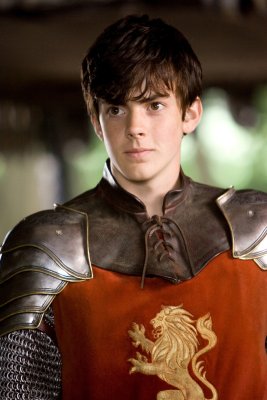
Presenting the newly rejuvenated NarniaFans Mailbag. We’re going to avoid confusion and pick up the numbering where we left off. If you would like to read any of the old mailbags, we’ve got them here. If you’d like to submit a question for next week’s mailbag, use our handy contact form.
After Edmund is a band that takes it’s name from the character “Edmund Pevensie” in “The Chronicles of Narnia.” I confirmed that with the band through their MySpace page. Matt replied, “I’m glad you asked
. From none other than CS Lewis’ Chronicles of Narnia!” They are releasing their first album, in stores starting today!
Sophisticated and complex musically, yet lyrically direct and accessible, new Slanted Records artist After Edmund is poised to take the Christian music scene by storm. Kicking off their debut album with the swirling chords of “Clouds” and the frenetic, driving “Thank God”, After Edmund tackles themes of a desperate desire to feel God’s presence, being honest in the midst of pain and losing everything to truly find Christ. Producer Sotty Wilbanks (DecembeRadio, Third Day) adeptly captures the crackling energy of the band’s powerful, kick-out-the-slats live shows.
Track Listing
01. Clouds
02. Thank God
03. No Tomorrow
04. Tears
05. Everyone
06. Darkest Room
07. Let It Go
08. Stealing Away (Sabade)
09. Like A Dream
10. To See You Leave
11. When You Need Someone
12. Go Oboe
If you become their friend on MySpace, tell them we sent you!
From Girl’s Life: As if you don’t know, The Chronicles of Narnia: The Lion, the Witch and the Wardrobe, a tale of four sibs who enter an icy, magical world through a closet, in theaters now. The film’s two kings, William Moseley, 18, and Skandar Keynes, 15, phoned us from their homes near London.
What was the most exciting part about being in this film?
Skandar Keynes: The free food!
William Moseley: The battle scene, definitely. I had to gallop a white Spanish horse across the battlefield toward New Zealand’s white snow-capped mountains. That was wonderful.
Skandar Keynes: At first, I was really bad at riding the horse and wondered why he didn’t listen. But then I gained confidence and did some cool rearing stunts on the horses. Sword fighting was cool too. I had wanted to do sword fighting–I saw it on Star Wars and wanted to do it.
You did this in full suits of armor, right?
Skandar Keynes: Yeah. I kept having to get mine refitted because I grew 6-and-a-half inches in the six to seven months we filmed. I’m now rather taller than most people.
William Moseley: It was kinda difficult to do my schoolwork in the armor. To think now that I was once sitting down, doing my English literature in full armor. You didn’t take it off during tutoring because it took such a long time to put it on and off.
What’s your favorite creature from the film?
William Moseley: The Cyclops. They were amazing. They were quite simple but had independent moving eyes that were so realistic, it was amazing. It was a rubbery plastic sort of thing, with one person in it. A really good mask. I had to battle the Cyclops.
Skandar Keynes: The wolves were really cool. There were about 12 wolves, and they were real. There was one they would let us touch, and I petted it.
Were there any on-set romances?
Skandar Keynes: Will liked the producer’s niece. She was really nice and really cute, which was sort of, “Oooh, tension.” She was told not to come on set for a bit ’cause he was really distracted. They kept saying I had a crush on Tilda [Swinton, who plays the White Witch], and it was really embarrassing. I don’t have a crush on her, but she is really cool.
Do you guys have girlfriends?
William Moseley: I do have someone special, but I’m not going to reveal who it is. We’ve been together for a while.
Skandar Keynes: I recently split up with a girl after about two months. I’m not sad. I’m over it now. It’s cool.
Are you prepared for having female fans flock to you?
William Moseley: I don’t know–it’s really bizarre. I will just take things as they come. I have to take it in my stride and take a few deep breaths and manage it in the most mature way I can. I think that’s probably the best way to deal with it.
Skandar Keynes: This one girl said she saw me in a magazine, and she was asking me all these questions about Will. I told her, “You know, Will has a girlfriend.” She was really disappointed.
Do you have any hidden talents?
William Moseley: I love juggling every now and again. I can juggle sort of anything, really. Anything that needs juggling, I can pretty much get it going. Much to my mother’s objection, I always juggle the fruit in the house. Whenever I see it, I pick it up and juggle it. But I try to be too elaborate or better at it than I am, so I drop it and my mom gets pretty angry with me.
Skandar Keynes: I can do different things with my tongue, like make it go into four parts. And I can crack my neck and my fingers. When I was young, I fell off a swing, so I have a massive bump on my middle finger that looks weird. I can bend my finger all the way back. The first time, it really hurt, but you sort of get used to it.
Thanks to Winny the Pooh Bear
It’s not easy being Edmund in “The Lion, the Witch and the Wardrobe.” Three of the four Pevensie siblings are brave, heroic and all-around noble in C.S. Lewis’ classic Narnia series. But Edmund causes most of the problems by taking the side of the evil White Witch.
And, ultimately, he makes the biggest change when he repents.
We wanted to know how 14-year-old Skandar Keynes feels about playing Edmund in the film “The Chronicles of Narnia: The Lion, the Witch and the Wardrobe.” But we figured the best person to ask the questions would be someone who’s tackled the part, too. Eric Kielczewski, 16, of Grand Prairie, Texas, played Edmund at Creative Arts Theatre & School in Arlington, Texas, in April. Skandar called us from his home in London to answer Eric’s e-mailed questions.
First, however, we had to know how he felt when he got the role:
“I was on the bus going to school, and it was raining. They said they would call me on Thursday, and it was Friday, so I was down, not feeling too great. My phone rang, and they said, ‘You’ve got the part!’ They were yelling at me on the bus, ‘Turn off your phone, boy!’ so I said, ‘Thanks! Bye!’ I was cheering inside, though.”
Q: What was the hardest part of developing the character of Edmund? For me it was making the live audience believe I had changed from evil to good (that and sustaining a British dialect).
Skandar Keynes: The emotional scenes were hard. I don’t usually cry, and that was a challenging thing to do. But once I had done it, it was really rewarding. It is a great feeling doing something that challenges you.
Q: How did you film scenes with Aslan (the lion) since he was CGI (computer-generated imagery)?
Skandar Keynes: I only had one scene with Aslan where I’m nodding at him. I was really nodding at a rock. In scenes with the other kids, Andrew (Andrew Adamson, the director) and his assistants would act out Aslan’s lines dressed up in green suits so they could be edited out.
The majestic lion doesn’t pal around with wacky sidekicks.
The haughty White Witch doesn’t cast a spell on a princess.
And the stately wardrobe, with a secret passageway that leads into an enchanted kingdom, doesn’t break into a jaunty chorus of Be Our Guest.
When the first trailer for The Chronicles of Narnia: The Lion, the Witch and the Wardrobe makes its U.S. premiere Saturday night during ABC’s showing of Harry Potter and the Chamber of Secrets’ airing at the same time in 30-plus countries – viewers are apt to gaze in wonder. And be taken aback.
The TV audience may feel as disoriented as the tale’s four young siblings – curious Lucy, disgruntled Edmund, smart Susan and sensible Peter -after they enter the wooden closet and suddenly stumble into Narnia, a frozen paradise terrorized by a power-mad sorceress. Before their eyes, the snow-globe fantasy land of the most popular book in C.S. Lewis’ treasured literary collection comes to swirling life with mythic beasts, snarling wolves and white vistas punctuated by a thunderous roar.
No cutesy creatures. No anachronistic wisecracks. What rushes by is like flipping through a picture book full of rich images. Those who catch the preview of the epic adventure due out Dec. 9, either on TV or when a longer version is attached to the May 19 arrival of the Star Wars finale Revenge of the Sith, may ask themselves, “Can this be Disney?”
Yes, says Dick Cook, the studio chairman and 34-year Disney veteran, about the PG-rated co-production with Walden Media (Holes, Because of Winn-Dixie) whose cost has been estimated as high as $150 million. “This is, without question, one of the most ambitious projects we have been a part of,” he says. “Our desire is to raise our level of storytelling and filmmaking.”
The same Disney that wouldn’t foot the bill for its Miramax label to do three films based on J.R.R. Tolkien’s Lord of the Rings trilogy (New Line Cinema did it, instead) is hoping to launch a seven-part franchise culled from the vivid writings of one of Tolkien’s colleagues. As a result, Wardrobe is a lavish spectacle that aims to reach heights of sophistication and scope that haven’t been seen in non-animated Disney family films since Mary Poppins floated onto the big screen in 1964.
“This is mature family entertainment,” says Narnia producer Mark Johnson, who has overseen such films as The Alamo and The Notebook. He and director Andrew Adamson, responsible for much of the wit and heart found in the Shrek computer-animated comedies, insisted that the digitally rendered animals would push the limits of photo-realism. As Johnson says, “It would be a big mistake if the creatures appear to be cuddly stuffed animals on a little girl’s bed.”
Just as The Little Mermaid rescued Disney animation from going off the deep end in 1989, Narnia aspires to restore the studio’s legacy as the leading maker of all-ages, live-action escapism. And in the nick of time. With its house-brand animation in decline and its partnership with Pixar (The Incredibles) in disrepair, Disney’s family entertainment crown has lost its luster.
“Disney used to be the only game in town,” says Paul Dergarabedian of box-office tracker Exhibitor Relations. “They were the gold standard of family films, but the rest of the world has gotten more competitive. A big prestige picture could boost the entire studio.”
Narnia, which has sold 85 million copies in 29 languages since Wardrobe was published in 1950, carries a built-in core audience that crosses generations, much like The Lord of the Rings. But fervid fans tend to be sticklers. One sign of Disney’s commitment: the casting of such semi-famous but skillful actors as Tilda Swinton as the Witch. The Scottish actress known for her androgynous looks and offbeat screen roles (Constantine, The Deep End) is about as far as you can get from the music-hall warmth of Julie Andrews.
“I’ve never made a children’s film,” says Swinton, 44, about personifying the most famous wicked witch in literature since The Wizard of Oz. “I’ve never made a film my children can see. I’m not even sure if they’re going to see this one. I don’t want them backing away from me for the rest of my life.”
Lewis invested his adventures with more than such whimsical beings as Mr. Tumnus, a gentle faun forced to do the Witch’s bidding, and Mr. and Mrs. Beaver, talking animals that aid the children in their quest.
The tales also are infused with Christian allegory, and the heroic Aslan is meant as a Christ figure, a redeemer who resurrects in triumph. The challenge: to attract the spiritual-minded moviegoer without turning off the secular crowd.
Disney, along with other studios, has often courted the so-called faith community when the appropriate movie comes along, including such religious-themed comedies as Sister Act or uplifting sports dramas like The Rookie. But since the advent of box-office sensation The Passion of the Christ, such wooing has become a science. For that reason, Disney and Walden have hired Motive Marketing, the company that oversaw The Passion’s outreach program, to assist them.
“It is natural that the press will manufacture more importance about the religious significance than is our intent,” says Dennis Rice, the studio’s vice president of publicity. “We are not going to reach out to one group over the expense of another, but embrace and acknowledge the fans of a very important piece of literature.”
Yes, the filmmakers hosted representatives of more than 30 faith-based and educational groups at a preview held at Disney’s Burbank, Calif., headquarters earlier this year. But, Rice says, “we’re also at Comic-Con in July,” referring to the annual San Diego fantasy, sci-fi and comic-book convention.
Mixing commerce and religion could be risky. But David Koenig, author of Mouse Under Glass: Secrets of Disney Animation and Theme Parks,suggests otherwise. “Left Behind would have been risky,” he says, referring to the evangelical sci-fi book series. “Narnia isn’t risky. It’s the safest way for Disney to reconnect with a large section of its core audience that it has alienated over the last decade.” That includes religious boycotts over gay-friendly policies at theme parks, as well as the often-controversial content of Miramax films.
Faithfulness to the source will likely be of higher importance than faith itself. That is where Adamson comes in. Much as director and fellow New Zealander Peter Jackson used his own love of Tolkien as a guide to bring the Rings trilogy to the screen, Adamson, 38, is relying on the good-vs.-evil battle that unfolded in his imagination as he read the books as an 8-year-old.
“You ultimately can only make something that appeals to your own sensibilities,” says Auckland-born Adamson, whose parents were both associate missionaries in Papua New Guinea. “I am not making religion an issue one way or another. It’s a story about family. People should take from it what they want to take from it.”
Douglas Gresham, Lewis’ stepson who controls the estate and is a co-producer on the film, has wanted to make a movie of Narnia for decades. Lack of the technological tools relegated adaptations to TV versions up until now.
Still, Lewis himself had a love-hate relationship with Hollywood, says Terry Lindvall, who will teach a Christian theology and film course at the College of William & Mary this fall and is author of Surprised by Laughter: The Comic World of C.S. Lewis. “He believed there was death in the camera. Meaning, when you translate word to image, the imagination dies.”
But if anyone could do justice to Lewis’ words, Lindvall believes the man who injected such hilarity into a sour green ogre is the chosen one. “Adamson is the perfect director for this. Lewis was never as somber as Tolkien. He was playful.”
Besides, Lewis believed in translating faith into the vernacular. And, as Lindvall puts it, “The vernacular of our age is movies.”
Great scans of the four children from the English Daily Mail. You can read the original article at Baz Bamigboye’s daily gossip column.


