Archive for August, 2007

“Prince Caspian” and the Return to Narnia: Making the Journey to Literacy Through Fantasy

Thursday, August 30th, 2007

Wesley Fryer attended a session titled “Prince Caspian” and the Return to Narnia: Making the Journey to Literacy Through Fantasy. It was a presentation done by Randy Testa, Vice President of Education for Walden Media, LLC. Randy shared this presentation at the 2007 EncycloMedia presentation in Oklahoma City on 8/29/2007.

There are 9 excerpts from “The Lion, the Witch and the Wardrobe” on the free DVD that was received, and an educator’s guide that goes with the DVD. The educator’s guide facilitates conversations with students about what happens in the movie, what happens in the book, etc.

Educator DVD has nice menu of 9 clips
1- Lucy Discovers the Wardrobe
2- Lucy & Mr Tumnus Intro
3- The White Witch Tempts Edmond
4- Mr and Mrs Beaver Explain the Prophesy
5- Father Christmas
6- The Children Ask Aslan for Help
7- Edmond is Forgiven
8- The Four Children are Crowned
9- Creating Creatures: Mr. Tumnus

We selected clips that really get at the guts of the story, not battle scenes
- there are extraordinary turning points in this story
- the narrator, CS Lewis, interrupts the story of Edmond’s forgiveness to say “never before and never since”
- ask students “What do you think Aslan said to Edmund?”

Walden Media did “Bridge to Terebithia,” “Charlotte’s Web,” “Because of Winn Dixie,” our sister company also did “Amazing Grace” about abolition of the slave trade
- We also did “Lion, Witch”
- some states have talked about requiring a curriculum where people learn about Wilbur Wilberforce

Have rich opportunities for comparative analysis between books and movies!

- Does there have to be an original text?
- Can there be a conversation between the texts?

Even more important

Coming from the point of view of a 3rd grade teacher: If you are going to, some kids need to experience a story in a variety of modalities; retention, comprehension, capacity for empathy (what Henry James called “the felt life”). It is an occasion to teach about media literacy and multiple forms of literacy.

A personal beef: Who, What, Where, When, and Why?

- WHO says children shouldn’t simultaneously be reading “on” “above” and “below” grade level?
- WHAT makes educators sabotage the very goals they extol? (e.g. “life-long readers”)?
- WHERE did the current obsession with “the grade level of this book” come from?
- Since WHEN is Charlotte’s Web “primarily for students in grades K-3?″
- WHY can’t AP ‘honors English’ students read “Prince Caspian?”

The “Annotated Charlotte’s Web” is a great work.

Educators always ask “what grade level is this book?”
- I wish had a lever
- since when is that the first question you ask about a book you don’t know??????

Reading Levels and Formulas Don’t Necessarily Create Lifelong Readers
Children who become lifelong readers:
- have access to books
– make THEIR OWN CHOICES about what to read
– are actively encouraged to read ‘above’ and ‘below’ ‘grade level’ (from “Formula for Failure” by Betty Carter, Associate Professor of Library Science, School of Library and information Studies, Texas Women’s University, Denton, TX)

Why teachers (generally) avoid using film
“Pop and play” is not teaching (popping in a movie and going down the hall
- opposite of kids seeing the movie is true: they see the movie, many want to read the book!
- perceived by school heads and/or parents as “babysitting” (i.e. not academic)
- “we can’t take the time in our school to show a movie”

Teachers don’t value film, as an art form, or in their own lives
- most teachers just see 4 movies per year
- this is in STARK contrast to the movie watching habits of our youth
- we need (as teachers) to watch more movies, be more literate of film as a genre and value it more

Librarians are the people in a school who know where the action is.
- AASL: we work with them a lot

Consider: Books and Films are both texts
- written text
- visual text
- same message: tell a story
- different symbol system

Big question: what do you mean by “faithful adaptation?”
- in your own off-stage life, consider “what is the difference between a LITERAL adaption and a FAITHFUL adaptation”

Lois Lowry’s definition: A faithful film adaptation is one that is “true to the spirit of the book”

Clive Staples Lewis
- brings us to The Chronicles of Narnia

Opening line “because of the air raids” was something everyone knew about and understood when the book was published just 5 years after WWII. There were posters all over the city that said sending your kids out of the city is your patriotic duty.

Juxtapose image of air raid opening scene from LWW and the twin towers.

Example of a five year old’s story about the twin towers.

- in some schools kids and teachers have been told, “we’re not going to talk about that [the twin towers attack and tragedy] because it is too scary”
- what we know is that, from Vivian Paley: “…the children must be able to imagine themselves swimming to safety and using their jackets as pillows…”

Another great piece of ammo: CS Lewis’ essay “On Three Ways of Writing for Children” from “On Stories and Other Essays On Literature”
- fantasy is vital because it helps children make sense of reality in a way that “school stories” do not and cannot

Making sense of reality
- twin towers
- through fantasy
- first grade art examples

At play, kids explore reality, morality, fantasy…

Lewis was well aware of the arguments.

Opening line of Charlotte’s Web: “Where is papa going with that ax?”

Lewis’ question: are we making the destinies of children BRIGHTER or DARKER?

So here we are, in Narnia on the screen
- Lewis felt that for a fantasy to work, it had to be grounded in the realities of the present day
- at the end of the film, the phoenix’s come into the battle scene and come in in the same formation as the German bomber planes at the start of the film.

From the creative brief for Disney/Walden for thinking about Prince Caspian
- a parallel universe that expands through time
- vast, multi-layered world

With Narnia time, things are really messed up. Powerful theme of Caspian blowing the horn. When you hear the call, will you be ready?

Walden Media will be holding a contest for kids and educators: Who is your Dr. Cornelius?

Aslan: “Things never happen in the same way twice”

That was then, this is now…
- more than 1300 years have passed, Miraz is in power.

Story of Prince Caspian: “is about reawakening lost faith in a new Narnia barely recognizable from its former self”

King Mirax is a real bad guy, a real bad villain.
- all three paths collide: children, Prince Caspian, and Narnia in a new era.

LA partners talk about the Narnia series as a “franchise”
- in Prince Caspian you will meet characters who you’ll see later in the series

Our new hero: Prince Caspian
- educated
- knowledge: “he learned the difference between wisdom and knowledge”
- Lewis hated what was going on in the schools at the time in England

Dr Cornelius: half dwarf, half Telmarine
- what does it mean to be devoted to one’s students?
- not just efficient or concerned, but DEVOTED?

Nikabrik: a black dwarf soured by hate
Trufflehunter: Prince Caspian’s most loyal servant
Trumpkin: good hearted dwarf
Reepicheep: (my favorite)
- there are 12 of them: not 6, not 4
- when Reepicheep has his tail cut off, his brothers are all going to cut off their tales so he is not shamed
- that is my favorite scene in the book

Same four kids in the movie
- they are a year older, voices are breaking

Great lion to Lucy: “You are a lioness!”

Aslan: again the voice of Liam Neesan.

Library of Congress doing a massive literacy camapign
- also “Read It Before You See It” campaign from Harper Collins

lots more on narnia.com

www.walden.com

- downloadable educator guides
- PD presentations and materials, like CS Lewis and the Moral Imagination
- Online discussions for teachers and librarians only
- previews of coming attractions

Walden IS doing all 7 movies
- we are Walden.com not Walden.org
- slogan is “Recapturing imagination, rekindling curiosity”

Drawn Treader has just been green lit and filming is about to start
- Director of “Amazing Grace” is going to direct it, Andrew Adamsen couldn’t do it because of timing

Also releasing “The Water Horse” this December.

For more notes and information, check out the full notes on “Moving at the Speed of Creativity

C.S. Lewis Society Update, 8/29/07

Wednesday, August 29th, 2007

David J. Theroux, the Founder and President of the C. S. Lewis Society of California has e-mailed us with the latest updates on many upcoming events that you’re all invited to attend! Please note the following in this issue of the C.S. Lewis Society Update (8/29/07):

1. More on Harry Potter and Christianity
2. Film News
3. New Publications
4. Next meeting of C.S. Lewis Society’s Bay Area Book Club: Studies in Words
5. Other Events

1. More on Harry Potter and Christianity:

In agreement with a recent Wall Street Journal review by Mechan Cox Gurdon of the new book, HARRY POTTER AND THE DEATHLY HALLOWS, Newsday columnist Raymond Keating discusses the Christian imagery in J.K. Rowling’s new and final book in her Potter series.

“Harry Potter and the Christian allegory,” by Raymond Keating

2. Film News:

A. A number of the fantasy novels by novelist, playwright, poet, biographer, and theologian Charles Williams, starting with his ALL HALLOW’S EVE, will be made into major films by renowned producer Ralph Winter. Mr. Winter is also producing the film version of C.S. Lewis’s best-selling book, THE SCREWTAPE LETTERS, which is scheduled for release in late 2008. Among his many other film credits are the X-Men, Fantastic Four, and Star Trek III-VI films as well as “Planet of the Apes,” “Mighty Joe Young,” and “Flight of the Intruder,” as well as the ABC TV series, “Lost.”

Charles Williams was a member of The Inklings literary circle at Oxford, which included C.S. Lewis and J.R.R. Tolkien, and Lewis’s acclaimed dystopian novel of a scientistic totalitarianism, THAT HIDEOUS STRENGTH, was heavily influenced by the work of Williams.

Web site for The Charles Williams Society

B. At the recent German Games Convention, Disney Interactive featured portions of a new video game based on Lewis’s Chronicles of Narnia book, PRINCE CASPIAN, which will be released in conjunction with the forthcoming film in May 2008. Here incidentally is the official web site for the Narnia films:
http://disney.go.com/disneypictures/narnia/

3. New Publications:

A. BOOK: For those interested in using Lewis’s books in schools and colleges, study groups, book clubs, churches, and seminars, the following new book is recommended. The book provides summaries, questions, references, and insights into how to teach Lewis’s books.

TEACHING C.S. LEWIS: A Handbook for Professors, Church Leaders, and Lewis Enthusiasts, by Richard A. Hill and Lyle Smith (Cambridge Scholars Publishing, 2007)

B. JOURNAL: The Arizona C.S. Lewis Society has recently launched SEHNSUCHT: The C. S. Lewis Journal, with the first issue featuring articles by Walter Hooper, Victor Reppert, and others. (”Sehnsucht” means longing.)

4. Next meetings of the C.S. Lewis Society’s Bay Area Book Club:

Book for Discussion:

STUDIES IN WORDS, by C.S. Lewis:

Wednesday, September 5th, 7:30 p.m.;
Meeting moderator/leader: Andrew Dosa

Wednesday, September 12th, 7:30 p.m.;
Meeting moderator/leader: Andrew Dosa

Man is unique among all creatures in his use of words, and words affect us directly in most every aspect of our lives. In this absorbing, breathtaking and entertaining book, Lewis examines eleven selected words and teases out their connotations from a vast range of English literature in which their meaning has changed through the centuries. The selected words are Nature, Sad, Wit, Free, Sense, Simple, Conscience and Conscious, World, and Life, plus the phrase, “I dare say!” Lewis reveals the “dangerous sense” of assuming a word’s current meaning in reading earlier literature, which can produce a complete misunderstanding of an author’s intent.

In STUDIES IN WORDS, Lewis invokes the mysteries of G.K. Chesterton’s Father Brown, quotes the deepest yearnings expressed by such writers as Homer, Dante, Chaucer, Lucretius, Seneca, and Coleridge, and traces shadows upon the Hellenic cave while juggling Anglo-Saxon monosyllables. He does this without a trace of the pointless and contradictory “deconstructionism” which, in the hands of contemporary writers more interested in condemnation than description, has cast an affliction upon modern literature. Far from leaving readers gasping for air, Lewis opens the layers of linguistics, “driving words from different languages abreast” in order to bring out the wonderful meanings of words.

“Rarely is so much learning displayed with so much grace and charm. My only regret is that the book was not twice as long.” –New York Times Book Review

“…a brilliant book addresses to students and lay people alike, unbaffling, deeply informative, and timelessly persuasive.” –Robert Burchfield, Editor of the Oxford English Dictionary

The meetings will be held at:

11990 Skyline Boulevard, Oakland, CA 94619 (atop the Oakland hills)
510-482-2906 phone
wine, soft drinks and other refreshments served

Here also are a couple short articles that discuss STUDIES IN WORDS and related issues:

“Studies in Words,” review by Michael Jose

“Studies in Words,” by Wikipedia

STUDIES IN WORDS in available in paperback

Here also is the schedule of future Lewis Society book club meetings.

Here also is information on C.S. Lewis

We hope that you and/or others you know will be joining with us! (Please feel free to forward this update to others.)

5. Other Events:

“The Crisis of the University: Freedom, Tolerance and the Pursuit of Truth”
Sponsored by the C.S. Lewis Foundation
University of Colorado, Boulder, CO
October 5-6, 2007
http://www.cslewis.org/programs/ff/2007/index.html

“C.S. Lewis: Man and His Work: A 21st Century Legacy”
Sponsored by L. Russ Bush Center for Faith and Culture
Southeastern Baptist Theological Seminary, Wake Forest, NC
October 26-27, 2007
http://www.sebts.edu/CSLewis/

“C.S. Lewis Conference”
Sponsored by Hope Lutheran Church
Atascadero, CA
January 25-27, 2008
(More details to follow)

“Sixth Frances Ewbank Colloquium on C.S. Lewis & Friends”
Sponsored by Taylor University, Upland, IN
May 29-June 1, 2008
http://www.taylor.edu/academics/supportservices/cslewis/colloquium/

“Charles Williams and His Contemporaries”
Sponsored by The Charles Williams Society
Sr. Hilda’s College, Oxford, England
July 4-6, 2007
http://www.geocities.com/charles_wms_soc/events.html

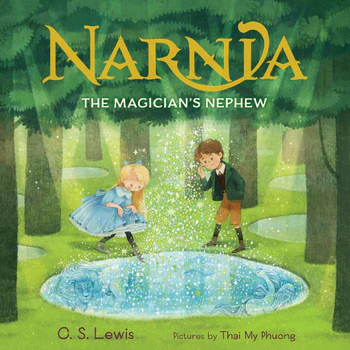
Tumnus’s Book Shelf: The NarniaFans Book Reviews : The Chronicles of Narnia: The Magician’s Nephew

Wednesday, August 29th, 2007

Welcome to Tumnus’s Book Shelf where we review any and all books related to Narnia and CS Lewis! For this weeks review, we will be looking at CS Lewis’s The Chronicles of Narnia: The Magician’s Nephew !

Book Title:The Chronicles of Narnia: The Magician’s Nephew
Author: CS Lewis
Illustrator: Pauline Baynes
Publisher: HarperCollins

Language: English

ISBN-10:0060764902
ISBN-13: 978-0060764906

Summary of the book:

Some Possible Spoilers.( Please Highlight to read)

Summary

Long ago in London around the turn of the 19th Century there was a girl named Polly Plummer. One day she was out in her yard when she saw a boy run out from the house next door. The boy was crying. She introduced herself to him and he to her. His name was Digory Kirke.

After a brief argument about who had the funnier name, who had the dirtier face and whether or not London was a hole, Polly found out why Digory was crying. His mother was horribly sick and about to die, his father was away in India and he and his mother had to come live in London with his insane uncle Andrew Ketterly.

The two children soon became friends and spent lots of time together as it was a very cold and rainy summer in London. Polly showed Digory her favorite hiding spot that they called “ The Smuggler’s Cave” which was an attic like space that connected between their houses.

One day the two of them entered into what they believed was the vacant house in between there respective homes. This house always posed a lot of mystery, as people heard strange noises and saw lights on at odd times of the night. The children believed it was either burglars or haunted while the adults said it was only the drains.

They entered the attic of this house to find a well lit and well furnished study that had many books, and scientific instruments. On a tray were several rings, half were yellow, and half were green. They find out that they were not in the empty house at all, but Digory’s . They turn and see Digory’s uncle standing in front of them.

He locked them in the room and refused to let them go. After a while he gave in, only to trick Polly into taking one of the yellow rings and putting it on. As she did, she immediately vanished. Andrew explains what happened.

The rings were forged from the dust of the lost civilization of Atlantis and had “magical” abilities. The dust was given to him by Andrew’s late godmother LeFay, in a special box that she had instructed him to destroy. He disobeyed and set about to find out what the dust was and what it could do. After several attempts he found out that it had the ability to send people to other worlds. He tested it on guinea pigs and none of them were successful. When Polly came, he tricked her into testing it for him.

After much persuasion, Digory agreed to put on a yellow ring and take two green ones with him. For one reason only: so save his friend. He put it on and soon vanished out of this world and entered into another that was a vast forest with many pools . He found Polly was sleeping.

He went to her and she woke up, at first they had no memory of each other or of life in our world, but after a short time their memories returned. They explored the wood and discovered it was actually a wood between worlds. The pools could send them to entirely new ones. They leapt into one pool and found themselves in a world where all the buildings were in ruins and a red sun hung over head.

They entered into a palace and found a hall of statues. At the end was a statue of a tall and beautiful woman. Next to it was a bell with a strange inscription next to it. The inscription not only warned them not to ring the bell or trouble would come, but also that they would go mad if they didn’t ring it.

Polly said they shouldn’t ring it. Digory ignored her and behaved like a bully as he grabbed her hand and twisted her arm around to keep her from leaving as he rung the bell.

The bell woke up the last statue, which wasn’t a statue at all, but Empress Jadis, the last ruler or the world of Charn who had placed herself under an enchantment. She told them what happened to her world and how she destroyed it by using the “Deplorable Word” in battle against her rebellious sister. The children thought it was horrible, but the witch told them she had the power so she had to use it. They tried to escape her. As they were leaving, she grabbed on to Polly’s hair and left with them.

Jadis was weakened in the wood between the worlds, but she managed to regain enough strength to grab onto Digory’s ear and follow them into our world. Andrew was immediately infatuated with her and agreed to take her into the city . She was less then pleased with him as he was only a man and not a magician or of royal blood, so he could only be her slave.

After fixing himself up, he called a cab for them. Polly had gone home and was ordered by her mother to go to her room for two hours. Some time later Jadis and Andrew returned and there was a riot near the lamp post as she was attacking many people with an iron bar from a lamp post.

Digory and Polly raced outside and managed to grab her in time. Jadis was in contact with Andrew, the cabby, and the horse and buggy, and they were all pulled along out of our world and into the wood between the world. They entered into a pool and found themselves in Nothing. They all heard a strange sound: singing .They watched as light, land and life came into being. Then they saw who the singer was. It was a Lion. They witnessed the creation of a whole new world. Jadis attempted to throw the bar at the Lion. It hit him in the forehead but glanced off him and landed on the ground.

Animals and other creatures were also created. The Lion selects some of them to speak, among them was the Cabby’s horse. Jadis ran away while the rest of them watched as a lamp-post grows from the bar. Andrew claimed it was the land of eternal youth were all things could grow. Digory hoped that meant he could find a cure for his mother.

He went to speak to the Lion who had called into a council several other creatures as evil had entered Narnia through the coming of Jadis. Digory spoke to the Lion, who is named Aslan. Digory asked Aslan to help him. Aslan agreed to nothing, but rather gave Digory a job.

SPOILERS!Since Digory was the one who brought evil into Narnia, he was the one to set it right. Aslan told him go to a hill top an pluck from a tree a silver apple. Digory agreed to the assignment and Polly asked to come with. Aslan turned the Cabby’s horse into a flying horse and instructed him to take them. The horse who’s name was changed from Strawberry to Fledge, accepted his job.

Fledge carried the children to the hill, which was far from the land that was called Narnia. Digory went into the garden where the apples were. The garden was surrounded by a wall, and only by going through the gate could someone go into the garden, to rightfully take the fruit. He found the tree as Aslan instructed. It was a massive tree with a beautiful bird nesting in it, who kept watch over it.

Digory took one of the apples, and turned to see the witch standing behind him eating one herself. After three attempts to get him to disobey Aslan, Digory refuses and returns with Polly to Narnia. Aslan instructed Digory to throw the apple. Then they all witnessed the coronation of Frank the Cabby and his wife Helen (who Aslan brought into Narnia) as King and Queen.

Then Aslan showed them where a tree had grown from the apple. He told them it would serve as a shield to keep Jadis out as she can’t stand the smell of the fruit due to the fact she ate of it. Aslan told Digory he may take one of the apples and give it to his mother. Aslan returned the children and Andrew to their world, but not before first giving them a warning about their race and the potential to be like Charn.

From then on Andrew no longer dabbled in “magic” and was a bit nicer. Digory and Polly were friends for life, and his mother was healed. They planted the core of the apple in the yard and it grew to a great tree, and they buried the rings in the backyard. Digory’s father returned from India and told them they were to go live in a big house in he country. Years later Digory became a professor.

Sometime after, the tree fell down in a storm and Digory didn’t want the wood destroyed. He turned it into a wardrobe and put it in a spare room in his big house in the country.END SPOILERS!

Review.

Where did the White Witch come from? Why was their a lamppost in Narnia? Why was the professor so knowledgeable about the possibility of other worlds? These were some of the questions Lewis sought to unravel in The Magicians Nephew, the prequel to The Lion, The Witch, and The Wardrobe. And he did a great job of doing it, too.

This story is set in the turn of the 19th century, and Lewis makes it clear from the outset that this is a fantastical tale as he informs the reader “At this time Sherlock Holmes was still living on Baker Street and the Bestabels children were searching for treasure on Lewisham Road.” This lets the reader, even a young reader know that they are reading a fictional story set in a strange and weird land as it happens in the same time as the mysteries of Arthur Conan Doyle’s Sherlock Holmes and E. Nesbit’s The Treasure Seekers.

We meet the young Digory Kirke who is around ten years old. He has very few friends and is grieving as his mother is dying. This continues to show how Digory is like Lewis, as Lewis drew from his own experiences as a child, when he watched his own mother die, and than latter in life as his step-sons Douglas and David watched his wife Joy suffer from cancer. Digory is one of few characters in “children’s literature” who encounters grief.

Digory’s best ( and only) friend is a girl named Polly. Lewis again continues to show a different view on girls then most writers had at the time. Polly is independent and free thinking, but also helpful and considerate. If Lucy Pevensie was a voice of faith for her siblings, than Polly Plummer is a voice of reason for Digory as she tries to tell him when to not do something stupid. Both children are very loyal to each other.

There are two villains in this installment. First is Digory’s Uncle Andrew who is in some ways like the villain Weston in Lewis’ Space Trilogy as he cares only about gaining power and wealth at everyone else’s expense. At one point Andrew paraphrases the ideas of Nietzsche by saying that some one of his intelligence and ability is above and beyond all morals, and deserves all the power they have.

Jadis shows similar views in her desire to dominate not only Charn but Earth and Narnia as well. Like Andrew she is willing to use any means necessary to gain power even by using the dreaded “Deplorable Word”, and also believes she is above morals and wishes to set herself above everything else, making her a representative of Satan.

SPOILERS!We also first encounter Aslan and see he is not only the Savior and Ruler of Narnia, but it’s Creator. Like JRR Tolkien in The Silmarillion , he draws on the idea of the music of creation as Aslan sings Narnia into being. It is well known, that through out Lewis’ life he heard all of the tales of Tolkien and was enchanted by them and had great respect for them. It is greatly shown here in the means that Aslan uses for creation.

Lewis draws again from mythology for creatures to inhabit his worlds as he shows the creation not just of the talking animals but the other beings that dwell in Narnia. Even some of the scenery is taken from ancient folklore. For example, the description of the tree upon the hill is drawn heavily from Yggdrasil, the World Tree from Norse mythology that was upon a hill, surrounded by a gate with a bird over looking it. Much as Yggdrasil in Norse mythology, the apples of the tree in Narnia could restore health and give long life to the eater. The wall around it is like the wall around the path to the Celestial City in John Bunyan’s The Pilgrim’s Progress, and it is only through the gate that people may enter.

Much like Tolkien, as well as other authors such as John Milton, Lewis explores the question of the problem of evil. If something is created good, where does evil come from? Lewis shows through the actions of Diggory, the witch and Andrew that it comes from within the created beings who have the right to choose good or evil, and through the extreme pride they all show.

Lewis shows this in a thinly veiled retelling of the temptation and fall of man as Digory awakens the witch, due to his curiosity. Digory giving into his curiosity draws on another story about how evil entered the world, that of Pandora’s box. Digory’s fall to temptation in the hall of wax brings sorrow and trouble to him, Polly and others around them as well as the new world of Narnia.

However, Lewis also shows that there is a solution to evil, that comes through willful submission to a higher authority and through love. Digory then acts not just as Adam-like figure, but also Christ like as it is he who must set things right by doing Aslan’s bidding, and not his own. He is even tempted by the witch, not once, not twice but three times on the hill, as Christ was by Satan. This not only draws on the Bible, but also Milton’s epic poems Paradise Lost and Paradise Regained, which Lewis studied greatly, that tell not only of how Paradise was lost through disobedience and the fall to temptation, but how it was regained through obedience and the resistance to temptation, and humility.

Lewis also shows one of his beliefs about humanity. In his essays on space travel he believed that humanity would bring it’s evil into other worlds and further pollute the universe, this was an idea dealt with in the Space Trilogy.END SPOILERS!

He also shows some of his roots in science fiction. First is that we discover Narnia is not an “imaginary world” but rather one of several parallel worlds that exist separate from our own in it’s own universe with it’s own time-stream( which he deals with heavily through out the other six books in the series.)

He also shows this through the means of getting into the parallel universes. It is through the rings which are forged from the dust from Atlantis. Andrew tells Digory that when our civilization was beginning, Atlantis was far more advanced then us in a variety of ways, which include the ability to travel to other worlds. This goes along the ideas of Arthur C. Clarke’s Third Law in his three laws of prediction, which states that, “ The technology of a sufficiently advanced culture will appear indistinguishable from magic to an under developed mind.” This would be the case for Andrew, and Digory not just with the travel to other worlds, but the witch’s power .

Another way is simply through the descriptions of some of the worlds. For example, Charn is described as an old, dead world. Because of this it has a red sun, which would be a red super giant. Such a star is one near the end of it’s life.

In this book Lewis deals with the questions of life, death, temptation and obedience. He also grapples with the question that is often ignored in adult literature and debated by theologians, that of the problem of evil. He warns against the destructive power of evil with Jadis, and her world of Charn, and even the allusion to Atlantis which according to some accounts was destroyed because of it’s evil. He also warns against the search for power and even more about the danger of pride.

Lewis’s narrations are again very welcome and comforting ,especially as we deal with such things as evil, and death and go to the cold and dreary world of Charn. It feels as though you have a good friend with you in these sad places, much as Digory and Polly had each other. But at the same time he also helps us share in the excitement and wonder of the creation of Narnia.

The only downside to this book, is that the origin’s of the Witch contradict what is told to the children in The Lion, The Witch, and The Wardrobe. Other than that, it’s a children’s book that actually deals with the very serious and philosophically difficult question of the problem of evil. No one can pretend it doesn’t exist for long and try to shield children from it. Lewis can be one author we can trust to help teach younger people about it.

The Magician’s Nephew will leave you as spell bound as Digory and Polly were on their own adventure.

Five out of Five shields

Order the book from amazon.com

In the footsteps of Narnia’s creator

Monday, August 27th, 2007

Visitors to Belfast can now follow in the footsteps of the man who wrote The Lion, The Witch and the Wardrobe.

A new series of tours celebrate the city’s link to Clive Staples Lewis.

The Belfast-born novelist became world famous for his Chronicles of Narnia where the forces of good and evil – embodied by Aslan the lion and the White Witch – battle it out for control of an enchanted land.

A statue was unveiled in Belfast in 1998, the centenary of Lewis’ birth.

The story of what happens when four children clamber through an old wardrobe, push their way past heavy coats and stumble into a snowy imaginary land has captured the imagination of generations of young people.

CS Lewis was born in Ballyhackamore, east Belfast in 1898 and spent his formative years in the city.

He left for boarding school in England in his early teens after his mother died, and spent much of his adult life as an academic in Oxford, depicted by Sir Anthony Hopkins in the 1993 biopic Shadowlands.

[Read the rest at BBC News]

New Prince Caspian Set Photos featuring Aslan’s How

Sunday, August 26th, 2007

We were sent images from the set by a friend of ours. They include what appears to be the cave set next to the Stone Table, and a closer look at armor and a cool looking shield. I’ll let her explain:

I am something like your colleague from Slovakia :) My name is Elendilka and I have website about Narnia like you. (www.narnia.cinemaview.sk) I am writing you because I’ve got a message from an anynonymous person, who had some pics from shooting for me.

And I know, that much more people will look at them when they will be on your page too. So I’m sending you link to those pics, who are in our gallery.
I hope, you will enjoy them :)

All the best, Elen;)

View them here or we’ve also posted them here at WaldenFans.com. They’re the seven labeled “Caspian Set” starting with the last two on this page.

Narnia Coming to Blu-Ray in Spring of 2008

Saturday, August 25th, 2007

Back in May, NarniaFans received an announcement that Disney would be releasing The Chronicles of Narnia: The Lion, The Witch and The Wardrobe to Blu-ray Disc. The official website recently featured an announcement from Walt Disney Studios Home Entertainment about it’s release.

The announcement says, ” The title will take advantage of the format’s astounding interactive capabilities with full motion picture-in picture bonus features.”

Fans can expect the release in the Spring of 2008, just in time for The Chronicles of Narnia: Prince Caspian.

There is still no word on what bonus features will be included on the disc or if this will be the theatrical or extended edition of the film. Stay tuned to NarniaFans for all updates.

GC 2007: Disney Shooting Narnia Scenes for Game

Friday, August 24th, 2007

From the Leipzig Game Conference in Germany comes this awesome news.

As the convergence between Hollywood and videogames moves closer, the relationships are producing otherwise impossible fruits on each side. Right now, Disney is filming The Chronicles of Narnia: Prince Caspian for a release next summer, and while 1UP checked out the early-in-development game adaptation, Traveller’s Tales revealed Disney just shot two scenes never to appear in the movie — they were done specifically for the game.
The game and movie are tied to the same release date in 2008, so it’ll be some time before we see what Disney put together for the folks at Traveller’s Tales, but it’s sure to be a neat bonus for fans looking for the complete Narnia experience.

This will help to make the game a unique experience for players that want to get more of the world of Narnia. Perhaps the footage, if it is not exclusively tied to a portion of the game’s storyline, will end up in a Prince Caspian Extended Edition. The real question on everyone’s mind right now is probably: if they are indeed filming everything from the book, with added material to make the film version more exciting, what could they have possibly shot footage for?
I do not think that it’ll be a favorite scene from the book, but perhaps something for the storyline that can bring you to a different part of the action. For instance, if there’s a part of the film that some characters get separated, and you only follow one character to a meeting point, perhaps the new footage is to show the other side of that same story. This is all speculation at this point, however. We’ve got a long time to wait until the game releases next spring.

Ultimate Narnia Fans’ Blog on Narnia.com!

Wednesday, August 22nd, 2007

NarniaFans Member QueenHelen, the winner of the Ultimate Narnia Fan Contest, has finally had her blog posted on Narnia.com!

She informed us on the forum: Disney has finally posted my written account of my trip on narnia.com (I’m still waiting on the video blog – think that will be closer to the release of the movie), so I can finally talk about my trip and answer questions.

KingFrank and I had a wonderful time in Prague and on the set of Prince Caspian. The call sheet for the day said “Visit from Ultimate Narnia Fan….and husband”. KingFrank got to follow me around and carry my stuff – I really did feel like royalty!

Read her blog entry here!

Talk with her about her experiences in this thread on the forum!

Tumnus’s Book Shelf: The NarniaFans Book Reviews : The Chronicles of Narnia: The Horse and His Boy

Wednesday, August 22nd, 2007

Welcome to Tumnus’s Book Shelf where we review any and all books related to Narnia and CS Lewis! For this weeks review, we will be looking at CS Lewis’s The Chronicles of Narnia: The Horse and His Boy !

Book Title:The Chronicles of Narnia: The Horse and His Boy
Author: CS Lewis
Illustrator: Pauline Baynes
Publisher: HarperCollins

Language: English

ISBN-10: 0064471063
ISBN-13: 978-0064471060

Summary of the book:

Some Possible Spoilers.( Please Highlight to read)

Summary

During the time when Peter, Susan, Edmund and Lucy reigned in Narnia, their lived a young boy named Shasta who lived in Calorman. Shasta was raised by an old fisherman. One night while in a stable with one of the horses, he over heard the fisherman talking with another man and the man offered to buy Shasta from him. The fisherman agreed. Shasta grew afraid and began to talk with the horse.

The horse spoke to him and revealed he was a talking horse from Narnia. The horse offered him the chance to leave Calorman and head for Narnia and the north. Shasta accepts and during the night the two run off together. The horse introduces himself as “Bree-hinny-brinny-hooey-ha.” or “Bree” for short.

During the night they are pursued by lions and speed up and come in contact with what appears to be the Tisroc on his war horse. The discover it is a girl named Aravis wearing her brother’s armor and riding a talking Narnian mare named “Hwin.”

After telling her story of why she was traveling North, the four of them agreed to travel together. They came to the city of Tashbaan where they posed as common people on ordinary horses. They agreed that if they were separated to meet at the old tombs on the other side of the city. While traveling Shasta is spotted by the Narnians, who are visiting the city, and taken in with them as they mistake him for the missing Prince Corin of Archenland.

While staying with them he meets King Edmund, Queen Susan, and Mr. Tumnus. He overhears their plan to leave Tashbaan in secrecy as Prince Rabadash, the ruler of Calorman, wants to marry her and she refuses. They know they won’t be allowed to leave in public so they have to do it in secret.

Meanwhile Aravis and the horses encounter her old friend Lasraleen who is extremely shallow and flighty. Aravis is forced to hide with Lasraleen and pose as her slave girl, as her father is in Tashbaan searching for her. While in the palace she over hears a plot by Prince Rabadash and Ahoshta Tarkaan to invade Archenland and then Narnia.

Back with the Narnians the real Corin returns. Corin tells Shasta where he has been and helps him escape. Shasta heads for the tombs where a small cat comes and stays with him through the night. He is frightened later on as he hears jackals howling. He awakens and thinks he sees a lion. He discovers it is only the cat.

In the morning the cat is gone. Aravis and the horses finally arrive and she tells Shasta of the plan. The two hurry to Archenland to warn the king. As they enter they look back and see Rabadash and his army are coming. The horses run faster to reach the city of Anvard and are pursued by a Lion who wounds Aravis. They find housing with an old hermit . The hermit agrees to watch after Aravis and the horses while Shasta continues on.

Shasta finds the king out hunting and warns him of the attack .Shasta rides back with the king and his hunting party but they are separated in the fog. SPOILERS!While lost he meets Aslan who tells him how he has helped him along the journey every step of the way , even when Shasta was a baby.

Shasta finds his way to Narnia the next day. He sends a message through a talking Stag to King Edmund and is looked after by some dwarves. Shasta meets up with King Edmund, Corin, and Queen Lucy and joins them in the battle. Aravis and the horses watch the battle through a magic pool.

Aslan soon reveals himself to Aravis, Bree and Hwin and tells how he helped them as well. Shasta arrives and also shares something with them. He is actually Cor, the older twin brother of Corin and a prince of Archenland. Usurpers of his father’s throne had attempted to kill him as a baby by sending him adrift to prevent a prophesy of him one day saving Archenland from being fulfilled.

Edmund, Lucy, Cor, Corin, and the rest of the heroes hold a council to decide what to do with Rabadash. Aslan appears and turns him into a donkey for his foolishness. Aslan assures him he will not be this way forever. If Rabadash returns to his kingdom and stays in the temple of Tash and never leaves it he will be restored. However, if he disobeys he will become a donkey again and the change will be irrevocable. Rabadash follows the command.

In time Cor and Aravis marry and he becomes king of Archenland.END SPOILERS!

Review.

Of the seven books in the Narnia series this is one that many fans have mixed feelings about. Partially because it feels different than the other ones. This story does not have any goings on in Earth. No children from our world go into Narnia as it is set during the time of the Pevensies’ reign in Narnia. This means that they are regulated to cameo appearances. Much of the story is also set south of Narnia where there is little or no mention of Aslan or if he exists as they do not believe in him in Calorman, but serve another god, Tash. SPOILERS!Aslan himself doesn’t even appear until near the end of the book, and it is only at that point when readers understand that he was in the story the whole time guiding Shasta and Aravis.END SPOILERS!

Because of these differences this book is often times confusing for fans and they like it far less than the others. It can some times take them several times to get the hang of this book and understand it. Many fans of the series often even said of the seven books they would not complain if it wasn’t filmed.

However, for the difficulties, differences and challenges the book presents to readers on the outset, it still bears the same ring that the other books possessed and contains as much depth and symbolism as the others and is a highly enjoyable adventure story set in a fantastical land, akin to Aladdin in The Arabian Nights rather than a strict “fantasy”.

Aside from the enjoyable cameos of Edmund, Susan, Lucy and Mr. Tumnus and Aslan’s stirring appearance at the end, we again meet some new characters in this story. First we have Shasta, a young boy who has a great destiny and as a child is set adrift only to be raised by a family not his own and one day grows up to be the one to save his people, despite the attempts to stop him.

Shasta bears some similarity to Moses in the Old Testament as like him some jealous and fearful people wanted to kill him to prevent a prophesy from being fulfilled, and in the process, he was protected and raised by a people not his own, only to return and fulfill what had to happen.SPOILERS! He also encounters Aslan as Moses encountered God, while out in the wilderness and discovers how he had lead him all the way.END SPOILERS!

This leads him to embarking on a dangerous journey to a land he has never been to like Abraham and Moses in the Bible, or even like John Bunyan’s Christian in The Pilgrim’s Progress. Such an influence of the later is possible as that was a book that was very formative to the young CS Lewis’ imagination and was among the many that were instrumental in his coming to the faith. This makes the book also similar to Lewis’s own Pilgrim’s Regress.

SPOILERS! We also meet his real twin brother Corin who is more impulsive and reckless than his brother and more prone to fighting. Cor, or Shasta is more peaceful. This makes the two similar to Castor and Pollex or the Gemini twins in Greek mythology as one was aggressive and war like the other peaceful, which lead to their deaths. Ironically the book was also dedicated to his real life step sons Douglas and David Gresham, who he was beginning to get to know at this point due to his relationship with Joy Davidman Gresham, and may have used their personalities as templates.END SPOILERS!

We encounter the character of Aravis, a young girl who is fleeing her home as she is forced into an arranged marriage, one that she doesn’t like. She is more headstrong and stubborn than Lucy, Susan or Jill were as unlike them she is born from a noble family. This means she is used to getting her way all the time. Along her journey she is humbled and learns to think of others.

Her family line is much like a line of the ancient Egyptian pharaohs, as she is of the family of the Tisroc who claim to be descended from the god Tash as the Pharaoh claimed to have been descended from the line of Amon Ra. The cities in Calorman are also named for rulers and deities as the Egyptians did. Their beliefs also feature a pantheon similar to that of the Hindus, this would not be surprising as Lewis was versed in the mythologies of the Greeks, Romans, Norse, Egyptians and Hindus, so to draw from any of these sources in creating his world is not surprising.

We also meet the talking horses Bree and Hwin who have lived so much among the dumb beasts of the south that they have forgotten much of Narnia and their beliefs. Bree even disbelieves that Aslan is really a lion. Their disbelief is much like the Hebrews in the Exodus, in that did not fully know of Yahweh due to their time among the Egyptians. It is only when Bree and Hwin truly encounter Aslan that they know the truth much as when the Hebrews encountered God in the wilderness.

The villain in this book is Prince Rabadash son of the Tisroc. He is called later in the book “Rabadash the Ridiculous” as he is a very foolish character who underestimates Aslan and the people of the North and makes rash choices . As a villain he isn’t as evil as either of the witches, or as cunning as Miraz in the other books, but more arrogant and stupid. His great flaw is his own hubris, or extreme arrogance against Aslan and Narnia, which for his sin he is punished.

Lewis’ narrations hit the spot as usual. He even at one point shows a self-depreciating sense of humor when he compares children in that world learning how to tell stories with children learning to write essays in our world and says that he thinks more people would rather hear stories than read essays. This comment is humorous for him to make as he wrote many essays, in particular on Christianity, and is best known for them, but was well aware that more people would rather read a story. This is what led to him writing Narnia in the first place, to allow him to write about the concepts he wrote of in essays and allow the readers to sneak past the watchfull dragons and understand these concepts of faith in an easier way.

This story deals a lot with humility and the belief something much larger than you is always in charge, though you may not always see it at the time.

While the story may be confusing at first and different than the others it is still an enjoyable read, and a thrilling adventure and well worth it for any fan of the series. Don’t be afraid to go to Narnia and the North with The Horse and His Boy. Much like Shasta and Bree’s journey it may be hard to get through at first but it is well worth it.

Four out of Five shields.

Order the book from amazon.com

Douglas Gresham is in Prince Caspian

Monday, August 20th, 2007

Well Narnia Fans, we’ve been given a scoop by our very own Into The Wardrobe! She talks to Mr. Douglas Gresham, C.S. Lewis’ stepson, from time to time. He’s given her a bit of information about Prince Caspian.

He’s got a role in the film. He’s not allowed to say what role that is, but it will probably include some amount of screen time this time around. In The Lion, the Witch and the Wardrobe, he was the voice on the radio at the professor’s. ITW says: What that roll is he can’t say. But, he’s in the movie. He said the production company might release it he’s not sure…but he can’t say what roll he’s playing.

We’re looking forward to learning more about it!