C.S. Lewis: A Fictional Character in The Indigo King

James A. Owen is the author of a series called “The Chronicles of the Imaginarium Geographica.” The first book in the series, “Here, There Be Dragons” introduced us to the characters that would become the heroes of the stories: Jack, John and Charles.

Jack is actually C.S. Lewis, John is J.R.R. Tolkien and Charles is Charles Williams. They were each members of a group called the Inklings. This series is based on fictional adventures that these characters embarked on, into the Archipelago of Dreams, where they became Caretakers of the Imaginarium Geographica.

The second book in the series is titled “The Search for the Red Dragon,” and introduces new characters and a few more writers from that era to the story.

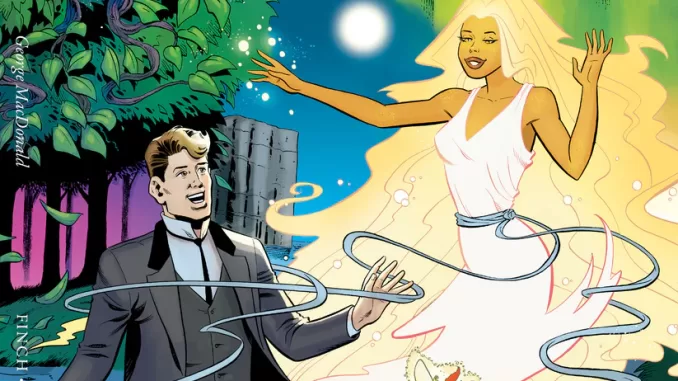
Now, author James A. Owen has revealed the cover art for the third book in the series: The Indigo King.

Having listened to the books on CD (I have the unabridged audio books!), I am very curious to learn what happens next in the adventures through the Archipelago of Dreams.

Check out the cover art on James A. Owen’s LiveJournal, and come and see him at LionCon, later this month!


Welcome to Tumnus’s Book Shelf where we review any and all books related to Narnia and CS Lewis! For this weeks review, we will be looking at CS Lewis’s The Chronicles of Narnia: The Voyage of the “Dawn Treader” !

Book Title: The Chronicles of Narnia:The Voyage of the “Dawn Treader”.

Author: CS Lewis
Illustrator: Pauline Baynes
Publisher(US): HarperCollins
ISBN-10: 0064471055
ISBN-13:978-0060764944

Summary of the book:

Some Possible Spoilers.( Please Highlight to read)

It has been another year since the last adventure of the Pevensies in Narnia. Peter is studying with Professor Kirke for an exam, while Susan has gone to America with her parents. As for the younger two they have the worst lot. They have to go stay with their Uncle Harold and their Aunt Alberta and their cousin, Eustace Clarence Scrubb.

Eustace is almost as bad as Edmund was when he first went to Narnia in terms of how he treats them. He can and will bully all of the Pevensie children, especially about Narnia. One particular day while Edmund and Lucy are talking in her room, Eustace comes to bother them. Edmund tries to get him to go away to no avail.

Lucy has been looking at a picture of a ship that reminds her of one in Narnia. When she mentions this, Eustace runs to rip it of the wall just to torment her. It is at this moment that the three children are pulled into the picture and find themselves in the water. They are fished out and find they are back in the world of Narnia.

Not only that, they are on board “The Dawn Treader”, the royal ship of King Caspian. They are reunited with Caspian and Reepicheep and meet his ship’s captain, Lord Drinian. They discover that Caspian is on a voyage to find the seven Lost Lords of Narnia and then to the very end of the world.

The first place they arrive in is in the region known as the Lone Islands. Upon their arrival Edmund, Lucy, Eustace, Reepicheep, and Caspian are taken captive by a slave trader named “Pug”. Caspian is sold to a man who turns out to be Lord Bern, one of the seven Lost Lords. Bern bought him because he could tell Caspian was the son of Caspian the IX . Bern informs him that the Islands are being poorly ruled by a man called Gumpas. With the help of Bern, Gumpas is removed from office. The two then rescue Edmund, Lucy, Reepicheep and Eustace. They return to the ship, with the Lone Islands safely now under Bern’s rule.

They continue on their voyage, Eustace of course is continuing to be unbearable. They stop at an inhospitable island were they make camp on a beach, except for Eustace who sneaks off . He watches a dragon slither out of its cave and die. He then sneaks into the cave and puts on an enchanted bracelet. As he is thinking dragon like thoughts, he himself becomes a dragon.

He returns to the ship and after many attempts finally convinces all of them that he is Eustace. It is only late one night when Aslan himself comes to Eustace that he is returned to normal. After his encounter he apologizes to his cousins for having been such a pain. They forgive him, and they also discover that the other dragon had been another one of the Lords.

They sail on and are attacked by a sea serpent. They stop at another island to repair the ship, but quickly leave the island as they see the body of one of the other lost lords. The lord has been turned to gold as the water is cursed. This causes the passengers of the Dawn Treader to argue with each other as it brings out their greed. They agree to leave quickly before they die as well.

Next they sail to an island that is filled with invisible people. They persuade Lucy to find a magic book and use it to make them visible. When she does it not only makes the invisible people visible but also makes the ruler of the island the wizard Coriakin (who is not human but a star who is under probation) and Aslan visible as well. Aslan reprimands her for her actions, which she apologizes for.

She returns outside and sees the invisible people are in fact one footed creatures who call themselves monopods.

From the island of the Monopods they pass through the Dark Island where nightmares and fears come to life. They rescue one of the lords, Lord Rhoop, and are lead out of the darkness by Aslan in the form of an albatross.

From the Dark Island it appears to be smooth sailing as they arrive at what is called the Island of the Sleepers. The sleepers are the last three Lords who are placed under an enchantment by Ramandu, a retired star.SPOILERS! It is here that Caspian meets Ramandu’s daughter and falls in love with her. He promises to return to her after the journey is complete.

As they arrive near the very end of the world Caspian cannot go further. He and the all but one of the Narnians must turn back as Aslan has ordered it . Only Edmund, Lucy, Eustace and Reepicheep are allowed to go further on.

Reepicheep must sail to the very edge as it is what he is destined for. He climbs inside a little boat and rows on to the edge, but not before getting a hug from Lucy and being cuddled by her. Edmund, Lucy and Eustace also disembark and sail into an area of water lilies where a lamb awaits them with a dinner of broiled fish.

The lamb transforms into Aslan and returns them to England. Before he does he reveals two things to the children. First is that Edmund and Lucy can never return to Narnia, as like their siblings they are now too old. Aslan also tells them that there is another reason they were brought to Narnia. By knowing him for a while in Narnia they could know him better in their world.

The book ends with a few final notes to the reader. First that Caspian did return to Ramandu’s island and married his daughter. Second that Eustace was a much better person back hone afterwards and his parents could never understand why.END SPOILERS!

Review.

Perhaps one of the reasons fans of CS Lewis’s Narnia Chronicles rank
The Voyage of the “Dawn Treader” as a favorite is that they see that the land of Narnia is more then the small country Lucy found in the wardrobe, but an entire world. It is in this book that we finally get to see the Lone Islands which have been referred to since The Lion, The Witch and The Wardrobe. We also encounter lands far beyond the realm of Narnia such as Dragon Island ( where Eustace becomes a dragon), Death Water Island ( where they found the man turned to gold in the cursed water), The Island of the Duffle pods ,and Ramandu’s Island.

Here CS Lewis begins to make up completely new creatures for his land beyond ones borrowed from mythology or talking animals. In a fantasy series this is one of the keys to making it a good one. Can you inhabit your realm with entirely brand new creatures that no one has ever meet besides your standard fair ( elves, dwarves, dragons and such)? One such new species is the Dufflepods, which are bizarre little men who only have one foot.

Another key to a good fantasy is how you can reuse certain fantasy conventions and at the same time make it different. This is the case with another new species we find in that of “the stars”. In the world of Narnia, stars are not balls of gas burning millions of miles away, but actual living beings who appear in human form at times. They are among the few beings in the world of Narnia who have magical capabilities. In this regard, Lewis uses another fantasy staple in granting magical abilities to beings who appear to be human but in actuality are far from human. These “stars” are then like Merlin in the Arthur Legends, the “Istari” (or Wizards) in Tolkien’s Middle Earth, or the various beings in Madeline L’Engle’s Time Quartet.

Because of this, Lewis sets up guidelines for what beings can and cannot perform magic. The stars can, as well as any “magical” being. However, humans cannot. This is evident when Lucy is reprimanded by Aslan for using the magic book, showing that it is forbidden for her to mess with such powers. Such rules are important as even a fantasy world needs it’s own set of rules and laws that cannot be bent. This further shows who Aslan is as he is the one who can defy all magic, as he is above it.

We also see further growth in the characters. One way of showing this is by giving a character flaws. It’s in this book that the once seemingly perfect Lucy is shown to be having some faults. She struggles greatly with caring about what others think of her, and with questions of her beauty as she compares herself to Susan who every one thinks is the most beautiful of the two. These character flaws are shown when she is tempted to use the magic book for those purposes.

Edmund has even more growth as a character. No longer is he Lucy’s tormentor but he’s her friend and protector. In this regard he has gone from the figure that everyone compares to Judas Iscariot in The Lion, The Witch and The Wardrobe, to a figure like the Apostle Paul: some one who at one point hated and tormented those of faith and breathed threats against them, but later becomes their strongest supporter and defender after he is given grace and forgiveness through the sacrifice of one who did no wrong. Edmund even paraphrases Paul’s comment in his epistles about being the chief of sinners when Eustace asks for forgiveness by saying , “I was the worst of all.”

Similarly Eustace is meant to be like another person who was against the faith and later believed. That of CS Lewis. In his biographies he noted that he thought the claims of Christianity were ridiculous, and he’d even mock the likes of Charles Williams and JRR Tolkien for their beliefs as Eustace did with the claims of Narnia, . Then he came to believe after his own encounter and also became a defender of the Faith. Interestingly Eustace’s middle and last initials are CS, and “Eustace” sounds suspiciously like “Lewis”. He also suffers from an equally intolerable name as Eustace did. ( In the first chapter Lewis wrote, “There once was a boy who was called Eustace Clarence Scrubb, and he deserved it. ” And Lewis was no less fond of his own name “ Clive Staples Lewis”, and preferred being called Jack.)

Reepicheep has also grown as a character. His bravery in battle makes him a far more confident creature, despite the fact he is just a mouse. He at times appears to be bigger then himself in this story as he is trying to fulfill his destiny that was spoken to him by a nymph.

We also see Caspian has grown from the boy-prince to the rightful heir to the throne. His voyage is not a pleasure cruise but a quest to continue to find a connection to his father by seeking these lost seven lords. His journey mirrors that of Telemachus in Homer’s The Odyssey, wherein he embarked on a quest to find out about his father and his past. His journey is also similar to that of Odysseus as he encounters many strange lands. One such land, Ramandu’s island, is similar to the Island of the Lotus Eaters in The Odyssey wherein people are put into an enchanted sleep.

We encounter on Caspian’s journey several new characters as Drinian, the various Lords, Coriakin, and Ramandu and his daughter.SPOILERS! It is Ramandu’s daughter that wins Caspian’s heart and ends up marrying him. This romance is a bit unbelievable( how can they be together after only one day!), but could perhaps be part of her tie in to such magical maidens as The Lady of the Lake in the Arthur legends, various fairie princesses in the fairy tales, and Galadriel in Lord of the Rings. It is also similar to Lewis’s poem “The Landing” where a traveler comes to an island and meets a woman of great beauty and falls in love with her instantly. END SPOILERS

Along the voyage readers can learn such lessons about greed, fear, and vanity. SPOILERS! Sadly, this is the book where we must bid good bye to Lucy and Edmund as like their siblings they have grown too old for Narnia. However, Aslan reveals some more of the deeper magic of Narnia to them by explaining that they were brought to that world to know him better in their world.END SPOILERS

Lewis is, as always, our very welcome narrator and guide in this story. No matter how good they make the films, his narrations will always be the things that are most missed in the movies. They add a certain life and vibrancy to the stories that is often missing in most books written for children or adults in this day and age.

“The Dawn Treader” is one exciting “Voyage” that you are going to want to read and reread again and again.

5 our of 5 shields

David Goyer developing ‘Here, There Be Dragons’

Writer-producer-director David Goyer (Batman Begins) told SCI FI Wire that he and Harry Potter producer David Heyman are co-producing a big-screen version of the James A. Owen fantasy novel Here, There Be Dragons, based on the real and fantasy lives of J.R.R. Tolkien, C.S. Lewis and Charles Williams. The book is the first volume in Owen’s The Chronicles of the Imaginarium Geographica franchise, and Goyer revealed that Owen is currently writing his own adaptation of the tale, hinting that he might direct the ensuing film if the timing works out.

“That will probably be a long, lengthy process,” Goyer said in an interview while promoting his upcoming film, The Invisible, which he directed. “I’ll be producing it for sure, and we’ll see [what else]. You just never know. These things take so long to get going, and you never know what your schedule’s going to be like at the time they come to fruition.”

Here, There Be Dragons brings together three strangers—John, Jack and Charles—in London during World War I, where they become entrusted with the Imaginarium Geographica, an atlas of all the lands that have ever existed in myth, legend, fable and fairy tale. They end up traveling to the Archipelago of Dreams, fighting the dark forces that threaten two worlds. It is later revealed that the three are future fantasy authors Tolkien (The Lord of the Rings), Lewis (The Chronicles of Narnia) and Williams, who met in real life at Oxford and enjoyed a competitive friendship.

“I’m a fan of what I guess I would term ‘meta-fiction,’ and James just came up with this really wonderful device that [brings together] all these characters, real-life people [like] Tolkien and C.S. Lewis and Charles Williams,” Goyer said. “At one point in time they all did really know each other, so he backdated that relationship between them and posited that they shared some real-life adventures in another land that became the source material for all their subsequent fantasy writings. The land that this takes place in is the land that gave birth to Narnia and Middle-earth, etc., etc. So it’s just a wonderful concept.” —Ian Spelling

Last Friday, IGN had the opportunity to interview producer/screenwriter David Goyer, where he spoke at length about the novel “Here, There Be Dragons.” The rights for the novel have been snapped up by Warner Brothers, pushing the book up the sales charts very quickly. For example, Amazon pre-sales ranked the book around 5,000. On September 29th, with word spreading of the movie news, “Dragons” was ranking at 644. As of this writing, it is sitting at 1,493.

The book takes place in two worlds, our world (In London, during World War I) and a fantasy world, and features three characters that go on adventures. The three adventurers turn out to be real life authors J.R.R. Tolkien, C.S. Lewis and Charles Williams.

Here are three questions extracted from the interview:

IGN: Does this story focus on these characters when they’re in their twenties at Oxford? I’m just wondering what the age range is for these characters.

Goyer: They were all slightly different in age. C.S. Lewis would be the youngest, probably his early twenties. Tolkien a little older, the mid-twenties or later twenties. Charles Williams was at least a good ten years older than the two of them and sort of functioned as a mentor. We liked that as well because for casting possibilities. We can pull from these different age groups.

IGN: It’d be funny to see if Here, There Be Dragons and Peter Jackson’s Temeraire end up going head-to-head in cinemas. The end of this decade will be all dragons onscreen.

Goyer: They both have dragons. Dragons is in the title of the first and the seventh books. Ours is not… yes, there happens to be a dragon in this first book but there are many, many other creatures and characters and things. So it’s not exactly a head-to-head dragon fest.

IGN: So how does one actually refer to the property since we can’t really call it the Dragons franchise?

Goyer: The franchise is actually called The Chronicles of the Imaginarium Geographica. For instance, the second book is called The Children’s Crusade. The Imaginarium Geographica is actually the fictional almanac of that other world. It’s kind of the almanac that maps all of these mythical lands and I guess it is what you would call the MacGuffin for the series. James’ studio is actually producing for Simon & Schuster an actual Imaginarium Geographica. It’s just this big book of maps of all these fantasy worlds.

[Read the rest at IGN]

J.R.R. Tolkien and C.S. Lewis in a Buddy Movie

Since The Lord of the Rings’ success, there have been many fantasy films released to try to cash in on the success. I think it’s a breath of fresh air, as far as movies are concerned. After all, movies are mostly fantasy anyway, depending on how you look at them. Recently, Peter Jackson has optioned a series called Temeraire.

Adding to that list, according to The Hollywood Reporter, Warner Brothers has picked up the rights to a soon to be released children’s novel by James A. Owen called “Here, There Be Dragons.”

Says The Hollywood Reporter: The book brings together three strangers — John, Jack and Charles — in London during World War I, where they become entrusted with the Imaginarium Geographica, an atlas of all the lands that have ever existed in myth and legend, fable and fairy tale. They end up traveling to the Archipelago of Dreams, fighting the dark forces that threaten two worlds. It is later revealed that the three are future fantasy authors J.R.R. Tolkien, C.S. Lewis and Charles Williams, who met in real life at Oxford and enjoyed a competitive friendship.

“It’s the ultimate story behind the story,” screenwriter David Goyer said of the project’s fictional treatment of the famed authors. “Very few people really know what they were like. They had really colorful lives, enough so you could tell straight biographies on them. By doing it this way, you get to have your cake and eat it too.”

“What sets it apart is that there’s a real quid pro quo between our world and their world and how events in the other world shape events our world,” he said. “Also, we get to cherry-pick the best public domain legends that exist, from the Homeric myths to tales like ‘The 7th Voyage of Sinbad.’ In this world, each island is a different fantasy world — it’s the mother lode of all that fantasy. And we get to have fun to see how Tolkien and Lewis got their inspiration. It just seemed like a no-brainer.”

Said Harry Potter producer: David Heyman: “The odd thing is, I’m not a fantasy fan. What drew me was that these characters are appealing and relatable and that the adventure takes place in a wholly conceived world. This is the place where all our stories come from, and the death of imagination equates to bad things happening to our world, which is such a beautiful idea.”

Heyman said he wants to fast-track “Dragons” even as he sees himself working on wrapping up the “Potter” movies for the next three or four years.

As far as the movie is concerned: WB is holding on to it as a project for Harry Potter producer David Heyman and Batman Begins screenwriter David Goyer to produce.