Hey, Narnia Fans! Welcome to “Behind the Wardrobe” an Interview Series with Douglas Gresham. Join me as we find out about CS Lewis, Narnia and more in this interview series.

Special thanks to Paul Martin (The Webmaster for NarniaFans) and to Mr. Douglas Gresham himself for this amazing opportunity. And an even bigger thanks to Mr. Gresham for putting up with a few of my impossible questions. Thanks for being such a great sport about it!

For this week: On The Lion, The Witch, and The Wardrobe .

On The Lion the Witch and The Wardrobe-

JS: The first Narnia movie did extraordinarily well at the box office, and exceeded many people’s expectations . What was your reaction to this?

DG: I expected it.

JS: So then it was really no surprise to you when The Lion, The Witch and The Wardrobe ended up being one of the top grossing films of 2005 along with the likes of Star Wars Episode III: Revenge of the Sith , Batman Begins, or Harry Potter and the Goblet of Fire?

DG: Not at all, what surprises me is that those other movies did so well. :-)

JS: I as a fan thought it was pretty neat that the first time outing for the Narnian film franchise did do as well as such films with a pre-established fan basis, such as Star Wars, Batman, or Harry Potter.

DG: We are all very happy about it too, but of course this success means that we have to make our next movie even better.

JS: Do you think Jack would have been pleased with the film? If so, in what ways?

DG: I certainly hope so otherwise I wasted five years of my life. I think he would have loved the realism we brought to unreal estates and characters. I also think he would appreciate our faithfulness to his book.

JS: Where you pleased with the film?

DG: As a producer of it, if I hadn’t, I would only have had myself to blame.

JS: What do you think led to The Lion, The Witch and The Wardrobe being done so well in terms of acting and quality of the production?

DG: Thousands of things, Philip Anschutz, Mark Johnson, Phil Steuer, Perry Moore, Marcus and McFeely, Andrew Adamson, KC Hodenfield, Roger Ford, Don McAlpine, Howard Berger, William Mosely, Anna Popplewell, Skandar Keynes, Georgie Henley, Isis Mussenden and —but I think you should be beginning to get the idea. Had I the time and you the space I would name every single member of all the teams that put the movie together from the very first to the very last in no particular order. The folks who cleaned the toilets, serviced the generators, drove the trucks and did a myriad of tasks that the public never even think of, all contributed to how well the movie was made. Each and every one of them was indispensable, and I owe them my heartfelt gratitude and admiration.

JS: Of any one in the film, who do you think gave the best performance?

DG: I did. How on Earth could I single out anyone else?

JS:So would you say the film was more of an ensemble piece?

DG: I think the nature of the story makes it imperative that the film be a team effort not only among the cast, but also with all the invisible members of the team, those amazing guys who do the CGI for example, and everyone else involved. I think that it is important that the star of the movie is in fact the story itself and that no one performance eclipses that.

JS: I felt in terms of casting one stroke of genius was that none of the actors were “major names” ( ie No Michelle Pheiffer as Jadis, or James Earl Jones as Aslan or Lindsay Lohan and Hilary Duff as Susan and Lucy).

DG: Yes, I agree with you.

JS: Adamson did a marvelous job directing the film. A lot of things he did had always been things I would have done if I made the film. (Such as opening with the air raid on London, haveing Peter and Edmund wear armor into battle, and even the relationships with the children.) He also did a great job making people who weren’t fans of the book interested in what was happening in the story and care for the characters.

DG: Yes indeed. Human beings are made for relationships, firstly a relationship with God and to achieve a good relationship with God we must guard and develop our relationships with our fellow human beings.

JS: In terms of the children, (and even Adamsons direction) they were perfect in the roles. They actually seamed like real life siblings!

DG: And I think that you will find that they actually feel very like siblings in real life. We are so fortunate to have found four really good young actors who are not only that but also very nice people. As the making of the film progressed it soon became evident that a strong bond was developing between the four children and that in turn came through onto the screen.

JS: How was it to have the cameo as the radio announcer?

DG: Fun, but not as much fun as my cameo in Prince Caspian. >:-}

JS: Did you approve the changes made to the film from the book?

DG: Again, I am a Co-Producer which means that I am one of the team that makes those decisions.

JS: I have to admit one of my favorite things in the film was the design of the wardrobe. Many fans of the book noted that etched onto it were scenes depicting the events of The Magician’s Nephew. Was this your suggestion?

DG: No, I think that came from Andrew or it may have been Roger, I am not sure.

JS: What was your favorite scene in the film?

DG: All of them.

JS: I take it as co-producer you got to be onset?

DG: Yes, of course. My ancillary duties meant that I could not spend as much time as I would have liked to on set, but I did spend quite a lot of time there.

JS: Seeing it on film was great , but to actually see it (come to life), well that had to be amazing!

DG: To me it was both exciting and hugely gratifying. After all it is not a gift given to many people to watch an almost life-long dream come true.

JS: I know when I saw the film it actually seemed like the Narnia I saw in my imagination.

DG: I am so glad that you say that, it means that we got it right.

That’s it for this week. Come back next week when wrap up the interview series with part six, in which we’ll get some special ( and spoiler free) sneak peeks into the next installment of the series Prince Caspian

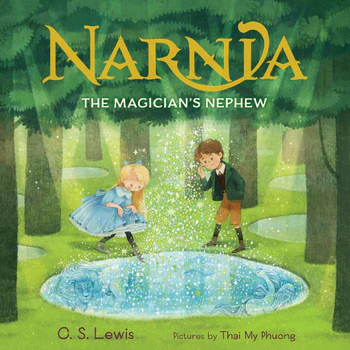
Welcome to Tumnus’s Book Shelf where we review any and all books related to Narnia and CS Lewis! For this weeks review, we will be looking at CS Lewis’s The Chronicles of Narnia: The Magician’s Nephew !

Book Title:The Chronicles of Narnia: The Magician’s Nephew
Author: CS Lewis
Illustrator: Pauline Baynes
Publisher: HarperCollins

Language: English

ISBN-10:0060764902
ISBN-13: 978-0060764906

Summary of the book:

Some Possible Spoilers.( Please Highlight to read)

Summary

Long ago in London around the turn of the 19th Century there was a girl named Polly Plummer. One day she was out in her yard when she saw a boy run out from the house next door. The boy was crying. She introduced herself to him and he to her. His name was Digory Kirke.

After a brief argument about who had the funnier name, who had the dirtier face and whether or not London was a hole, Polly found out why Digory was crying. His mother was horribly sick and about to die, his father was away in India and he and his mother had to come live in London with his insane uncle Andrew Ketterly.

The two children soon became friends and spent lots of time together as it was a very cold and rainy summer in London. Polly showed Digory her favorite hiding spot that they called “ The Smuggler’s Cave” which was an attic like space that connected between their houses.

One day the two of them entered into what they believed was the vacant house in between there respective homes. This house always posed a lot of mystery, as people heard strange noises and saw lights on at odd times of the night. The children believed it was either burglars or haunted while the adults said it was only the drains.

They entered the attic of this house to find a well lit and well furnished study that had many books, and scientific instruments. On a tray were several rings, half were yellow, and half were green. They find out that they were not in the empty house at all, but Digory’s . They turn and see Digory’s uncle standing in front of them.

He locked them in the room and refused to let them go. After a while he gave in, only to trick Polly into taking one of the yellow rings and putting it on. As she did, she immediately vanished. Andrew explains what happened.

The rings were forged from the dust of the lost civilization of Atlantis and had “magical” abilities. The dust was given to him by Andrew’s late godmother LeFay, in a special box that she had instructed him to destroy. He disobeyed and set about to find out what the dust was and what it could do. After several attempts he found out that it had the ability to send people to other worlds. He tested it on guinea pigs and none of them were successful. When Polly came, he tricked her into testing it for him.

After much persuasion, Digory agreed to put on a yellow ring and take two green ones with him. For one reason only: so save his friend. He put it on and soon vanished out of this world and entered into another that was a vast forest with many pools . He found Polly was sleeping.

He went to her and she woke up, at first they had no memory of each other or of life in our world, but after a short time their memories returned. They explored the wood and discovered it was actually a wood between worlds. The pools could send them to entirely new ones. They leapt into one pool and found themselves in a world where all the buildings were in ruins and a red sun hung over head.

They entered into a palace and found a hall of statues. At the end was a statue of a tall and beautiful woman. Next to it was a bell with a strange inscription next to it. The inscription not only warned them not to ring the bell or trouble would come, but also that they would go mad if they didn’t ring it.

Polly said they shouldn’t ring it. Digory ignored her and behaved like a bully as he grabbed her hand and twisted her arm around to keep her from leaving as he rung the bell.

The bell woke up the last statue, which wasn’t a statue at all, but Empress Jadis, the last ruler or the world of Charn who had placed herself under an enchantment. She told them what happened to her world and how she destroyed it by using the “Deplorable Word” in battle against her rebellious sister. The children thought it was horrible, but the witch told them she had the power so she had to use it. They tried to escape her. As they were leaving, she grabbed on to Polly’s hair and left with them.

Jadis was weakened in the wood between the worlds, but she managed to regain enough strength to grab onto Digory’s ear and follow them into our world. Andrew was immediately infatuated with her and agreed to take her into the city . She was less then pleased with him as he was only a man and not a magician or of royal blood, so he could only be her slave.

After fixing himself up, he called a cab for them. Polly had gone home and was ordered by her mother to go to her room for two hours. Some time later Jadis and Andrew returned and there was a riot near the lamp post as she was attacking many people with an iron bar from a lamp post.

Digory and Polly raced outside and managed to grab her in time. Jadis was in contact with Andrew, the cabby, and the horse and buggy, and they were all pulled along out of our world and into the wood between the world. They entered into a pool and found themselves in Nothing. They all heard a strange sound: singing .They watched as light, land and life came into being. Then they saw who the singer was. It was a Lion. They witnessed the creation of a whole new world. Jadis attempted to throw the bar at the Lion. It hit him in the forehead but glanced off him and landed on the ground.

Animals and other creatures were also created. The Lion selects some of them to speak, among them was the Cabby’s horse. Jadis ran away while the rest of them watched as a lamp-post grows from the bar. Andrew claimed it was the land of eternal youth were all things could grow. Digory hoped that meant he could find a cure for his mother.

He went to speak to the Lion who had called into a council several other creatures as evil had entered Narnia through the coming of Jadis. Digory spoke to the Lion, who is named Aslan. Digory asked Aslan to help him. Aslan agreed to nothing, but rather gave Digory a job.

SPOILERS!Since Digory was the one who brought evil into Narnia, he was the one to set it right. Aslan told him go to a hill top an pluck from a tree a silver apple. Digory agreed to the assignment and Polly asked to come with. Aslan turned the Cabby’s horse into a flying horse and instructed him to take them. The horse who’s name was changed from Strawberry to Fledge, accepted his job.

Fledge carried the children to the hill, which was far from the land that was called Narnia. Digory went into the garden where the apples were. The garden was surrounded by a wall, and only by going through the gate could someone go into the garden, to rightfully take the fruit. He found the tree as Aslan instructed. It was a massive tree with a beautiful bird nesting in it, who kept watch over it.

Digory took one of the apples, and turned to see the witch standing behind him eating one herself. After three attempts to get him to disobey Aslan, Digory refuses and returns with Polly to Narnia. Aslan instructed Digory to throw the apple. Then they all witnessed the coronation of Frank the Cabby and his wife Helen (who Aslan brought into Narnia) as King and Queen.

Then Aslan showed them where a tree had grown from the apple. He told them it would serve as a shield to keep Jadis out as she can’t stand the smell of the fruit due to the fact she ate of it. Aslan told Digory he may take one of the apples and give it to his mother. Aslan returned the children and Andrew to their world, but not before first giving them a warning about their race and the potential to be like Charn.

From then on Andrew no longer dabbled in “magic” and was a bit nicer. Digory and Polly were friends for life, and his mother was healed. They planted the core of the apple in the yard and it grew to a great tree, and they buried the rings in the backyard. Digory’s father returned from India and told them they were to go live in a big house in he country. Years later Digory became a professor.

Sometime after, the tree fell down in a storm and Digory didn’t want the wood destroyed. He turned it into a wardrobe and put it in a spare room in his big house in the country.END SPOILERS!

Review.

Where did the White Witch come from? Why was their a lamppost in Narnia? Why was the professor so knowledgeable about the possibility of other worlds? These were some of the questions Lewis sought to unravel in The Magicians Nephew, the prequel to The Lion, The Witch, and The Wardrobe. And he did a great job of doing it, too.

This story is set in the turn of the 19th century, and Lewis makes it clear from the outset that this is a fantastical tale as he informs the reader “At this time Sherlock Holmes was still living on Baker Street and the Bestabels children were searching for treasure on Lewisham Road.” This lets the reader, even a young reader know that they are reading a fictional story set in a strange and weird land as it happens in the same time as the mysteries of Arthur Conan Doyle’s Sherlock Holmes and E. Nesbit’s The Treasure Seekers.

We meet the young Digory Kirke who is around ten years old. He has very few friends and is grieving as his mother is dying. This continues to show how Digory is like Lewis, as Lewis drew from his own experiences as a child, when he watched his own mother die, and than latter in life as his step-sons Douglas and David watched his wife Joy suffer from cancer. Digory is one of few characters in “children’s literature” who encounters grief.

Digory’s best ( and only) friend is a girl named Polly. Lewis again continues to show a different view on girls then most writers had at the time. Polly is independent and free thinking, but also helpful and considerate. If Lucy Pevensie was a voice of faith for her siblings, than Polly Plummer is a voice of reason for Digory as she tries to tell him when to not do something stupid. Both children are very loyal to each other.

There are two villains in this installment. First is Digory’s Uncle Andrew who is in some ways like the villain Weston in Lewis’ Space Trilogy as he cares only about gaining power and wealth at everyone else’s expense. At one point Andrew paraphrases the ideas of Nietzsche by saying that some one of his intelligence and ability is above and beyond all morals, and deserves all the power they have.

Jadis shows similar views in her desire to dominate not only Charn but Earth and Narnia as well. Like Andrew she is willing to use any means necessary to gain power even by using the dreaded “Deplorable Word”, and also believes she is above morals and wishes to set herself above everything else, making her a representative of Satan.

SPOILERS!We also first encounter Aslan and see he is not only the Savior and Ruler of Narnia, but it’s Creator. Like JRR Tolkien in The Silmarillion , he draws on the idea of the music of creation as Aslan sings Narnia into being. It is well known, that through out Lewis’ life he heard all of the tales of Tolkien and was enchanted by them and had great respect for them. It is greatly shown here in the means that Aslan uses for creation.

Lewis draws again from mythology for creatures to inhabit his worlds as he shows the creation not just of the talking animals but the other beings that dwell in Narnia. Even some of the scenery is taken from ancient folklore. For example, the description of the tree upon the hill is drawn heavily from Yggdrasil, the World Tree from Norse mythology that was upon a hill, surrounded by a gate with a bird over looking it. Much as Yggdrasil in Norse mythology, the apples of the tree in Narnia could restore health and give long life to the eater. The wall around it is like the wall around the path to the Celestial City in John Bunyan’s The Pilgrim’s Progress, and it is only through the gate that people may enter.

Much like Tolkien, as well as other authors such as John Milton, Lewis explores the question of the problem of evil. If something is created good, where does evil come from? Lewis shows through the actions of Diggory, the witch and Andrew that it comes from within the created beings who have the right to choose good or evil, and through the extreme pride they all show.

Lewis shows this in a thinly veiled retelling of the temptation and fall of man as Digory awakens the witch, due to his curiosity. Digory giving into his curiosity draws on another story about how evil entered the world, that of Pandora’s box. Digory’s fall to temptation in the hall of wax brings sorrow and trouble to him, Polly and others around them as well as the new world of Narnia.

However, Lewis also shows that there is a solution to evil, that comes through willful submission to a higher authority and through love. Digory then acts not just as Adam-like figure, but also Christ like as it is he who must set things right by doing Aslan’s bidding, and not his own. He is even tempted by the witch, not once, not twice but three times on the hill, as Christ was by Satan. This not only draws on the Bible, but also Milton’s epic poems Paradise Lost and Paradise Regained, which Lewis studied greatly, that tell not only of how Paradise was lost through disobedience and the fall to temptation, but how it was regained through obedience and the resistance to temptation, and humility.

Lewis also shows one of his beliefs about humanity. In his essays on space travel he believed that humanity would bring it’s evil into other worlds and further pollute the universe, this was an idea dealt with in the Space Trilogy.END SPOILERS!

He also shows some of his roots in science fiction. First is that we discover Narnia is not an “imaginary world” but rather one of several parallel worlds that exist separate from our own in it’s own universe with it’s own time-stream( which he deals with heavily through out the other six books in the series.)

He also shows this through the means of getting into the parallel universes. It is through the rings which are forged from the dust from Atlantis. Andrew tells Digory that when our civilization was beginning, Atlantis was far more advanced then us in a variety of ways, which include the ability to travel to other worlds. This goes along the ideas of Arthur C. Clarke’s Third Law in his three laws of prediction, which states that, “ The technology of a sufficiently advanced culture will appear indistinguishable from magic to an under developed mind.” This would be the case for Andrew, and Digory not just with the travel to other worlds, but the witch’s power .

Another way is simply through the descriptions of some of the worlds. For example, Charn is described as an old, dead world. Because of this it has a red sun, which would be a red super giant. Such a star is one near the end of it’s life.

In this book Lewis deals with the questions of life, death, temptation and obedience. He also grapples with the question that is often ignored in adult literature and debated by theologians, that of the problem of evil. He warns against the destructive power of evil with Jadis, and her world of Charn, and even the allusion to Atlantis which according to some accounts was destroyed because of it’s evil. He also warns against the search for power and even more about the danger of pride.

Lewis’s narrations are again very welcome and comforting ,especially as we deal with such things as evil, and death and go to the cold and dreary world of Charn. It feels as though you have a good friend with you in these sad places, much as Digory and Polly had each other. But at the same time he also helps us share in the excitement and wonder of the creation of Narnia.

The only downside to this book, is that the origin’s of the Witch contradict what is told to the children in The Lion, The Witch, and The Wardrobe. Other than that, it’s a children’s book that actually deals with the very serious and philosophically difficult question of the problem of evil. No one can pretend it doesn’t exist for long and try to shield children from it. Lewis can be one author we can trust to help teach younger people about it.

The Magician’s Nephew will leave you as spell bound as Digory and Polly were on their own adventure.

Five out of Five shields

Order the book from amazon.com

The Right and Left Paws of Aslan

The idea of a “left wing” and “right wing” in politics and society is a fluid one, subject to a lot of confusion. You can’t understand liberals unless you know what they want to liberate, and you can’t understand conservatives unless you know what they want to conserve. The things people want to conserve or liberate vary widely from nation to nation, and from generation to generation.

It isn’t enough to say that it’s about order vs. freedom, law vs. liberty. There’s no one anywhere who really wants EVERYTHING to be 100 percent restricted OR 100 percent unrestricted. Each of us, and each society, decides WHICH THINGS we believe should be more or less restricted. The Scandinavian countries, for instance, are extremely wide-open with sexual permissiveness, but exert stern control over some other things. A woman from Norway informed me once that Norway has a law dictating WHAT NAMES Norwegian parents can give to their children! I consider that to be a tyrannical intrusion upon the rights of parents; but it had never even occurred to my Norwegian correspondent to resent this law.

A single essay can’t sort out all the elements of what makes a person or an idea “right wing” or “left wing.” But it may help us toward clarity if I attempt, presupposing what I think to be reasonable modern definitions of the left and right, to identify some places in The Chronicles Of Narnia where C.S. Lewis expressed sometimes liberal ideas, and sometimes conservative ones.

In “The Magician’s Nephew,” Jadis is revealed to have destroyed all life on her home planet by using the tremendous magic spell called the Deplorable Word. Before the book is over, Mr. Lewis has strongly hinted that this evil spell is to be compared to nuclear weapons. An insistence that nuclear weapons are inherently immoral and should never be used at all would be a liberal position on Mr. Lewis’ part. On the other hand, the coldly inhumane approach of Uncle Andrew to his research is very much like today’s left-wing scientists wanting to use unborn human beings as laboratory animals and stem-cell reservoirs (while dishonestly obscuring the fact that they could be using ADULT stem cells WITHOUT killing any babies); therefore Mr. Lewis, a pro-lifer, could be said to be acting as a conservative in his condemnation of Uncle Andrew’s attitude.

The Telmarines in “Prince Caspian” come in for a two-sided rebuke. They are shown to be descended from Earth humans who had committed violence and oppression against persons of another race; accordingly, it is liberalism that gets the credit for condemning this prejudice-related evil. But the society created by the Telmarines in the Narnian world also features a left-wing evil, such that opposing it is the act of a good conservative. I refer to the Telmarine school system, which is dedicated to denying the existence of the supernatural, ESPECIALLY the existence of Aslan. This is very much like the government school system in the United States today, where sex education for kindergarten children is advocated, yet God is not supposed to be mentioned.

The scene where Aslan disrupts Miss Prizzle’s class is PRICELESS.

When the aging Trumpkin in “The Silver Chair” fails to act promptly after Eustace and Jill turn up at Cair Paravel, causing the Talking Owls to intervene to assist the children, Trumpkin could be said to personify unimaginative, foot-dragging, custom-bound authority. Thus Mr. Lewis is wearing his liberal hat when making us understand that Trumpkin, though by no means evil, is in error.

Later, when the Green Witch tries hypnotically to convince the children and Puddleglum that neither Narnia nor Aslan exists, she is reflecting a bad sort of liberalism: the liberal theology, rooted in the so-called Enlightenment, which denies the truth of God’s Word and the involvement of God Himself in our world. Mr. Lewis is being spiritually conservative when he shows her arguments as serving the cause of evil. (And indeed, it is a plain and indisputable fact of real-world history that the ATHEISTIC Communist system has murdered far more people than ANY supernatural religion ever did.)

In “The Horse and His Boy,” we are clearly shown that the overall form of society prevailing in Narnia is morally superior to the culture of Calormen–as when, for instance, the Narnians visiting Calormen are described in a strikingly favorable light: “They were obviously prepared to be friends with whoever was friendly, and didn’t care a fig for whoever wasn’t.” Mr. Lewis was being a true conservative–and frightfully politically incorrect in today’s terms–to say that all cultures are NOT equally good and valid. But don’t despair, my liberal friends. Later in the book, when King Lune talks about the responsibilities of a king as understood by Narnians and Archenlanders, Mr. Lewis is uttering what could be considered a liberal idea through Lune’s mouth: the idea that rulers OWE it to their people to be just. In real-world history, the vast majority of monarchs everywhere have treated their subjects as one big rug to wipe their feet on. Thus, if Lune of Archenland were transported to Earth at any of most periods in history, he would emerge as a liberal hero in the very best sense, wanting to see justice done for the undeprivileged.

These examples should be enough to demonstrate that C.S. Lewis was well-rounded in his approach to social and theological issues, not blindly adhering to the right wing or the left. I try to emulate him in this; and if I ever seem to lean extremely to one side, it’s because I see so many others in society leaning extremely to the other side.

Ut fidem praestem in difficultate!

JOSEPH RICHARD RAVITTS, U.S. NAVY RET.

NarniaFansCast – Episode 12

The newest episode of NarniaFansCast has just been released! Join Paul Martin (Specter) and Austin Fury (CSLewisFan) as they discuss the news, talk about the upcoming movie, and answer questions submitted by YOU! Also included is a new short story by Roger Thomas (PrinceOfTheWest) called “Complications.”

This week, the hosts discuss :
~A duel in Prince Caspian,
~Polly and Digory’s influence giving talking animals the English language, and
~What if C.S. Lewis was alive and still writing? What would it be about?

There are a number of ways where you can listen to NarniaFansCast:
Click Here to subscribe through iTunes
Click Here for a direct link.

If you have a question that you would like to be answered on the show, please send them to NFC AT narniafans dot com

If you are interested in transcribing or editing our shows, send an email to NFC AT narniafans dot com with your name, age and why you would like to be on our staff. If you are applying to be an editor, please also include a sample of your work.

Lewis Inspires Lunch Debates

C.S. Lewis Societies are nothing new, but they are gaining in popularity. There is no doubt that the recent films based on properties of Tolkien and Lewis have helped to inspire more people to join these groups, or start new groups at colleges and universities across the country and around the world.

One such group meets for lunch-time discussions at the University of Georgia. Last week, the discussed a portion of “The Magician’s Nephew.” According to its bylaws, the University’s C.S. Lewis Society’s primary objective is “to recognize our God-given ability to participate in rational, orderly and coherent thought and to use it to impact the culture for Christ.”

If you’re interested in attending the luncheon at the University of Georgia, here are details on when they meet, and topics for this week and next:

According to the flyers posted on campus buses, both Christians and skeptics are invited to attend the luncheons.

The luncheons are held from 12:30-1:30 every Wednesday afternoon in Tate room 145.

This week’s topic is “Was C.S. Lewis a Fundamentalist?” and next week’s topic is “Moral Relativism and UGA.”

We’d like to compile a good list of C.S. Lewis groups around the country, by state, so if you have one you’d like listed, please contact us with your group name, location, website and perhaps a paragraph about the group, and any contact information you’d like included on the listing!

[Find more C.S. Lewis groups on our links page (remember to bookmark us ;) )]

Narnia Fans Mailbag #7

We’ve just posted the seventh edition of the NarniaFans Mailbag. We’ve answered seven letters this week, including such topics as the “enhanced effects” of the Extended Edition, The Magician’s Nephew, and more!

Click here for the seventh NarniaFans Mailbag!

An Analysis of Selected Narnia Chronicles by Aslan the Wise One

The Lion, the Witch and the Allegory: An Analysis of Selected Narnia Chronicles
By Ian aka Aslan The Wise One

**Spoilers – LWW and Magician’s Nephew**

The Narnia Chronicles are undoubtedly the most popular works of writer C.S. Lewis. And although they are recognized as children’s fantasy novels, they are also popular with students and adults, including many Christian theologians. In the Narnia Chronicles, Lewis typifies the Biblical character of Jesus Christ as the character of Aslan the lion, retelling certain events in the life of Jesus to children in a this new context in a way that is easy for them to understand; most importantly, however, children can both relate to and enjoy the fantasy of Narnia. This essay will analyze The Magician’s Nephew and The Lion, the Witch and the Wardrobe to demonstrate that the Narnia Chronicles are not so much didactic allegories, but rather are well-crafted children’s fantasies that incorporate Biblical themes in a way that young readers can appreciate.

Although it was the sixth book to be written in the seven book series, the story of The Magician’s Nephew takes place several decades before that of The Lion, The Witch and the Wardrobe. It describes the creation of the land of Narnia, and how humans came to be associated with this other world. The narrative draws heavily from the creation story in Genesis, but Lewis’ account of Narnian creation is clearly geared to appeal to a younger audience.

One of the the literary techniques Lewis uses to appeal to a younger audience is his use of children as the main characters; in The Magician’s Nephew, for instance, Polly & Digory are present throughout the entire narrative. Lewis describes Aslan’s creation of the world of Narnia as seen by these two children, immediately establishing a rapport between his young audience and the narrative. As they enter a light-less Narnia at the beginning of its creation, Lewis uses the children to describe their surroundings: “We do seem to be somewhere,” said Digory. “At least I’m standing on something solid.” (Lewis, 1988, p.91). Digory’s first description of this new environment not only establishes a connection between the young readers and the narrative, but is also representative of a trend in Lewis’ retelling of the creation story: Lewis draws on the Biblical creation story, but does not attempt to directly parallel the story of Genesis. In Genesis, after creating the heavens and earth, the first thing he does is to create light: “And God said, ‘Let there be light.’” (Gen 2:4). It is not, in fact, until the second day that God creates dry land (Gen 1:9-10). The reader of The Magician’s Nephew, however, learns from a child’s description that even while the world of Narnia is still dark, the earth (or “something solid”) has already been created. Obviously, Lewis’ primary goal in writing the story of Narnia’s creation was not to make an exact allegory to Genesis, but perhaps to draw from select Biblical creation images, and patterning a children’s story from them.

Lewis continues to draw from Biblical creation images as he describes the introduction of light into Narnia. The singing stars are the first things to the children see in Narnia, and Lewis again uses the character of Digory to establish a connection between the text and a youthful reader: “If you had seen and heard it, as Digory did, you have felt quite certain that it was the stars themselves which were singing,” (Lewis, 1988, p.93-94). Genesis, on the other hand, automatically appeals to adult sensibilities when describing the stars, relating them to such “grown-up” concerns as the calendar: “Let them serve as signs to mark seasons and days and years, and them be lights in the expanse of the sky…” (Gen 1:14-15). The singing stars image that Lewis draws from here is located in Job 38:7. Comparing these two passages, it is evident that Lewis chose to convey his creation story using the Biblical images that are not only easier for children to understand, but also easier for children to appreciate and enjoy.

Another device Lewis uses in the Narnia Chronicles is the personification of animals. Narnia is a land of talking animals, and as children usually find the concept of animals and magical creatures more interesting than that of a historical reality of long ago (i.e. the reality of Jerusalem 2000 years ago). Narnia proves to be the perfect vehicle for a captivating work of children’s literature. Upon comparing the creation stories in The Magician’s Nephew and the book of Genesis, Lewis’ technique of making animals a central part of his narrative is readily noticeable. In Genesis, God creates animals that inhabit land on the fifth day: “God said, ‘Let the land produce living creatures according to their kinds: livestock, creatures that move along the ground, and wild animals, each according to its kind.’ And it was so.” (Gen 1:24-25). The interesting choice of words in this verse may well have been the inspiration for Lewis to write his creative description of the creation of animals in Narnia, where the animals are literally produced by the land, out of the ground: “In all directions it [the land] was swelling into humps. They were of very different sizes some no bigger than mole-hills, some as big as wheel-barrows, two the size of cottages. And the humps move and swelled until they burst, and the crumbled earth poured out of them, and from each hump there came out an animal.” (Lewis, 1988, p.105) Lewis’ emphasis on the animals in his creation story is especially apparent with his use of Aslan the lion as a God figure: “The Lion opened his mouth…he was breathing out a long, warm breath; it seemed to sway all the beasts as the wind sways a line of trees.” (Lewis, 1988, p.108). This image of life-giving breath directly correlates to a passage in Genesis: “The Lord God formed the man from the dust of the ground and breathed into his nostrils the breath of life, and the man became a living being.” (Gen 2:7). Lewis equates the significance of the creation of man in Genesis with the creation of the animals in Narnia, and thereby appeals to a child’s natural attraction to animals by making them the central part of the Narnian creation story.

Since animals have taken, at least to some extent, the role of man in the creation story, the human characters of Polly and Digory (and their team) must obviously assume a slightly different role in the creation. At this point, Lewis introduces the concept of evil entering Narnia, and the concept of the introduction of sin into a new world. “Before the new, clean world I gave you is seven hours old, a force of evil has already entered it; waked and brought hither by this son of Adam,” says Aslan (Lewis, 1988, p.126). Lewis has cleverly associated Digory with the Biblical Adam in two ways. The obvious connection is that Digory is a male human being, and therefore a “son of Adam”. But the the deeper connection that Lewis implies is that just as Adam first brought sin into the world in Genesis, Digory is charged with bringing the first evil into the new world of Narnia.

Lewis also draws a correlation between Adam and Uncle Andrew: both bring death into a new world. The apostle Paul describes Adam as one who brought death into the world: “Sin entered the world through one man, and death through sin,” (Rom 5:12). Uncle Andrew, while he does not bring death into Narnia, does bring the concept of death with him. Upon seeing Aslan, his first reaction is to kill: “A most disagreeable place. If only I were a younger man and had a gun

” (Lewis, 1988, p.96). This image of a gun-wielding Uncle Andrew is seen again and again in the narrative: “The first thing is to get that brute shot.” (Lewis, 1988, p.103). Lewis is able to affiliate humans not only with evil, but with the race of Adam: a people that brings death and sin. The way in which he achieves this is also very important: by using the image of the slaughter of animals, Lewis once again appeals to the sensibilities of a younger audience. Children are likely to be more upset at the death of an animal than that of a man who lived long ago; a man they never knew. In this way, children might sympathize more easily with the proposed death of a Christ-like lion than that of a historical Jesus (a theme explored later in this essay).

The analysis of evil entering Narnia would not be near complete, of course, without examining the character of Queen Jadis (known in The Lion, The Witch and the Wardrobe as the White Witch). Like Uncle Andrew, the Witch is antagonistic towards Aslan. She too wishes to destroy the lion, and attempts to kill him with an iron bar: “She raised her arm and flung the iron bar straight at its head.” (Lewis, 1988, p.99). Later Aslan makes it clear that she is the evil that has entered Narnia: “The world is not five hours old an evil has already entered it” (Lewis, 1988, p.111), “There is an evil witch abroad in my new land of Narnia,” (Lewis, 1988, p.125). The allegory of the Witch is still unclear, though. In the creation story in Genesis, two elements of evil can be found. The first is Adam and Eve’s direct disobedience to God’s commandment (Gen 2-3). The second element, however, is not of human origin, but is rather the character of the serpent (Gen 3). The Witch in The Magician’s Nephew can be perhaps seen as an image of the introduction of sin (in the context of the Narnian creation story), but later in the novel Lewis also alludes to her relation with the character of the serpent.

This marks a move away from the theme of creation, and a step towards the theme of temptation in the Narnia Chronicles. The theme of temptation is present in both the Bible and the Narnia Chronicles, and Lewis often models his presentations of temptation after stories and characters from the Bible. A good example of this phenomenon is that of Chapter 13 (Lewis, 1988), which is a retelling of the story of the tree of knowledge. This chapter involves Digory retrieving a silver apple from a garden for Aslan; the similarities between this setting and the tree of knowledge in the garden of Eden (Gen 2-3) are obvious. The role of the Witch, however, evolves from being a symbol of evil to being compared with the serpent in Genesis 3. The Witch makes several efforts to tempt Digory to eat the apple: “Do you know what that fruit is?…It is the apple of youth…Eat it, Boy, eat it,” (Lewis, 1988, p.150). This role of temptress is analogous to the role of the serpent when it speaks to Eve (Gen 3:1-5). Lewis has also put Digory in the role of Adam and Eve. Digory’s connection to Adam is made explicit by Aslan referring to him as “Son of Adam” throughout the novel. In this retelling of the Garden of Eden story, however, Lewis has Digory make the righteous decision of not eating the apple, but returning to Aslan instead. By having the Witch eat the apple instead (Lewis, 1988, p.149), Lewis allows the roles of protagonist and antagonist to remain clear and distinct. By manipulating the story of the fall of man in this way, Lewis has simplified and contained the forces of good and evil into single characters, making the distinction easier for his children readers understand.

Digory is not the only character to be tempted in Narnia. Uncle Andrew is tempted throughout the narrative by his greed; his lust for money and power. He is forever scheming and dreaming of ways to capitalize on the discovery of Narnia: “The commercial possibilities of this are unbounded…I shall be a millionaire.” (Lewis, 1988, p.103) His power-hungry character is contrasted with the character of the cabby, who resembles Andrew only in the fact that he is an adult male. The cabby, however, has a kind of reverent awe of Aslan and the land of Narnia, and voices his disgust in Andrew for not being able to appreciate the miracle of the creation of Narnia: “Oh, stow it Guv’nor, do stow it. Watchin’ and listenin’s the thing at present; not talking.” (Lewis, 1988, p.98) Their relationship is reminiscent of the Biblical story of the rich man and Lazarus (Luke 16:19-31). Just as Lazarus received the kingdom of heaven, the cabby becomes the first king of Narnia (Lewis, 1988, p.159), while Andrew is not repaid for succumbing to temptation. This is an example of Lewis’ gift to subtly weave Christian teachings into his stories without sacrificing their readability for a young audience.

Perhaps the best example of surrendering to temptation can be found in the second book of the Narnia Chronicles (the first Chronicle, however, for Lewis to write): The Lion, The Witch and the Wardrobe. The character of Edmund struggles with temptation throughout his time in Narnia, and like Digory, his temptress is the White Witch. Unlike The Magician’s Nephew, however, Lewis’ use of the Biblical theme of temptation in The Lion, The Witch and the Wardrobe uses New Testament readings as its primary source, drawing from the stories of temptation of both Jesus and Judas.

Keeping the former distinction in mind, an examination of New Testament teaching concerning temptation proves useful. James illustrates some key Christian teachings concerning trials and temptation: “The brother in humble circumstances ought to take pride in their position…He [God] chose to give us birth through the word of truth, that we might be a kind of firstfruits of all he created.” (James 1:9, 18). When writing about a good Christian facing temptation, James places emphasis on the righteousness of a man in humble position. He also places importance of the concept of the “word of truth” in humanity. The character of Edmund adheres to neither of these principles.

Edmund’s first significant sin is to succumb to the temptation of gluttony (King, 1998). The White Witch offers him enchanted Turkish Delights. The description of his gluttonous and decadent behaviour is very clear: “At first Edmund tried to remember that it was rude to speak with one’s mouth full, but soon he forgot about this and thought only of trying to shovel down as much Turkish Delight as he could, and the more he ate the more he wanted to eat…” (Lewis, 1986, p.37) This scene not only the image of Eve succumbing to the temptation of eating the fruit of knowledge, but also to the New Testament theology of Paul: “…many live as enemies of the cross of Christ. Their destiny is destruction, their god is their stomach, and their glory is in their shame. Their mind is on earthly things.” (Phil 3:18-19).

Edmund continues to fill his mind with earthly desires by also succumbing to the temptation of improving his humble position (see James 1:9 above) when the White Witch entices him with the prospect of princehood: “I think I would like to make you the Prince

some day when you bring the others to visit me.” (Lewis, 1986, p.39). This temptation of power is very like the story of Jesus being tempted by Satan in the desert. Satan, like the Witch, tempts Jesus with power in exchange for service: “The devil took him to a very high mountain and showed him all the kingdoms of the world and their splendour. “All this I will give you,” he said, “if you bow down and worship me.” (Matt 4:8-9). In addition to succumbing to these various temptations, Edmund also agrees not to reveal his knowledge of the Witch to his siblings (Lewis, 1986, p.40), and consequentially ends up lying to his them about his discovery of Narnia: “Lucy and I have been playing pretending that all her story about a country in the wardrobe is true.” (Lewis, 1986, p.44) By doing this, Edmund fulfills the antithesis of Paul’s virtues of the good Christian in face of temptation (see James 1:18).

Lewis masterfully intertwines these Biblical themes of temptation into the character of Edmund. But Edmund’s character is, in fact, most closely allegorized to the Biblical character of Judas; the betrayer (Matt 26). Edmund betrays his siblings and the Beavers by going to seek the White Witch in Chapter 8 (Lewis, 1986). All he could think about were his earthly desires and wants: “Turkish Delight and to be a prince” (Lewis, 1986, p.82). Comparing a mere child to Judas, however, is a very serious allegory for a children’s novel. To deal with this, Lewis creates the idea of the Witch giving Edmund enchanted Turkish Delight: “She knew, though Edmund did not, that this was enchanted Turkish Delight and that anyone who tasted it would want more and more of it, and would even, if they were allowed, to go on eating it till they killed themselves.” (p.38). By making Edmund’s cravings for Turkish Delight the fault of the Witch and not his own, Lewis alleviates some of the gravity of Edmund’s offense; once again taking Biblical imagery and softening it to appeal to a young audience. And in the end, of course, Edmund is forgiven for his betrayal; an event which involves the most important allegorical theme in the Narnia Chronicles: Aslan’s synonymy with Jesus Christ.

Before continuing, it should be said that many academics have gone too far in deconstructing the Chronicles of Narnia; theorizing about Lewis’ intended “true” meaning for all of his symbolic Bible imagery; to analyze the books in this fashion is to miss Lewis’ point in writing them (Schakel, 1979, p.xii). In 1954, Lewis was asked to explain the Aslan-Christ parallel to some fifth graders in Maryland. He replied: “I did not say to myself ‘Let us represent Jesus as He really is in our world by a Lion in Narnia’; I said ‘Let us suppose that there were land like Narnia and that the Son of God, as he became a Man in our world, became a Lion there, and then imagine what would happen”. (Lewis, 1954, 1998) Bearing this in mind, it still proves fruitful to examine how Lewis relates Aslan to the character of the Biblical Jesus, because the analysis yields a better understanding of Lewis’ craft: to use Biblical motifs to create a captivating story for children.

Edmund embodies many characteristics of Judas, including the characteristic of betrayal, and Aslan’s similarity to Jesus is noticeable in the way he forgives Edmund. Lewis, however, has specifically evaded allegorizing Jesus not forgiving Judas (Mark 14:21), and instead turns to more general Christian teachings on forgiveness: “If someone is caught in a sin, you who are spiritual should restore him gently…Carry each other’s burdens, and in this way you will fulfill the law of Christ.” (Gal 6:1-2). In this way, Lewis once again manages to dilute the Biblical narrative into guilt-free children’s readability. Aslan forgiveness of Edmund is expressed by his rescue of Edmund from the White Witch (Lewis, 1986, p.124-125). The Witch, however, claims Edmund’s life as hers to take: “You at least know the Magic which the Emperor put into Narnia at the very beginning. You know that every traitor belongs to me as my lawful prey and that for every treachery I have a right to kill.” (Lewis, 1986, p.128). Aslan then offers his own life in exchange for Edmund’s; this action is cataclysmic in its Biblical meaning, because not only is Aslan merely forgiving and dying for Edmund’s sin, but the act is also symbolic of Christ dying for the sins of humanity. Edmund’s sin of treachery becomes symbolic for all human sins, and Aslan pays for it with his life, as did Christ: “While we were still sinners, Christ died for us.” (Rom 5:8).

These events set up the narrative of the execution of Aslan. The former account is incredibly similar in imagery to that of the death of Jesus in the Bible. Lucy and Susan, two of the four child protagonists in the novel, follow Aslan to his execution: “And both the girls cried bitterly (though they hardly knew why) and clung to the Lion…” (Lewis, 1986, p.136). Jesus too had followers not unlike the children: “A large number of people followed him, including women who mourned and wailed for him.” (Luke 23:27) Once he is in the hands of the Witch, Aslan is subjected to humiliation and ridicule: “‘Stop!’ said the Witch. ‘Let him first be shaved.’…they worked about his face putting on the muzzle…he [was] surrounded by the whole crowd of creatures kicking him, hitting him, spitting on him, jeering at him.” (Lewis, 1986, p.139-140) This imagery is, once again, remarkably similar to that of the Gospels: “The men who were guarding Jesus began mocking and beating him. They blindfolded him and demanded, ‘Prophesy! Who hit you?’ And they said many other insulting things to him.” (Luke 22:63-65)

Aslan’s resurrection involves the same kind of Biblical allusion. In the Gospel of Luke, the women who had followed Jesus went to his tomb: “Very early in the morning, the women took the spices they had prepared and went to the tomb. They found the stone rolled away from the tomb, but when they entered, they did not find the body of the Lord Jesus.” (Luke 24:1-3) in the same way, after Lucy and Susan take off Aslan’s muzzle, they leave the Stone Table where he was executed. In the early morning they return to find the Stone Table broken in two and the resurrected Aslan standing before them (Lewis, 1986, p.142-147). The breaking of the Stone Table is obviously not so similar to the stone in Jesus’ tomb as it is to the curtain of the temple being torn (Luke 23:45). The image is even more allusive to the breaking of the tablets containing the Commandments in the book of Exodus. These latter correlation, however, is probably not so much direct allegory as it is an example of Lewis’ command of Biblical imagery as a literary device.

Lewis, then, has retold the story of the death and resurrection of Jesus in the context of Aslan and Narnia. He has used several devices, however, to transform this heavy content into material for a children’s novel. The obvious difference in Lewis’ retelling of the Biblical story is his use of Aslan the lion and the land of Narnia. There is, to an extent, use of lion imagery in the Bible: “You are a lion’s cub, O Judah; you return from the prey, my son.” (Gen 49:9), “A king’s wrath is like the roar of a lion…” (Proverbs 20:2), “They will follow the Lord; he will roar like a lion.” (Hosea 11:10). Most important is the reference of lions in the Book of Revelation, referring (we assume) to Christ: “See, the Lion of the tribe of Judah, the Root of David, has triumphed.” (Rev 5:5). Evidently, Lewis’ choice of a lion to represent Christ is not completely original; there are, however, other reasons for Lewis to choose this animal to represent Jesus. For instance, perhaps he assumed that children might better sympathize with the death of an animal than the death of a historical figure. Lewis uses a similar technique in using “Deep Magic” to explain the miraculous events that take place, like the resurrection: “‘It is more magic.’ They looked round. There, shining in the sunrise, larger than they had seen him before, shaking his mane (for it had apparently grown again), stood Aslan himself.” (Lewis, 1986, p.147) The young audience for whom the Narnia Chronicles were mainly intended would have an easier time understanding the concept of magic, rather than the theological implications that arise in the Bible stories of the resurrection. Finally, Lewis uses children as the main characters of the Narnia Chronicles. Immediately this establishes a connection for young readers that the Bible rarely offers. Children are also more likely to relate to a Messiah figure that constantly treats children with respect and love; a figure like Aslan.

The Narnia Chronicles have already established themselves as timeless works of literature. They appeal to both the atheists and the God-fearing, to both the uneducated and to scholars; to children and adults. An understanding of the Biblical allegory in these books is not essential to their appreciation. A critical analysis of these works, however, does allow the reader to more fully appreciate Lewis’ unique gift to simplify complex narratives and craft beautiful children’s fantasies. This, in turn, allows the reader to gain both a deeper understanding of Lewis as a skilled creative writer, and a deeper satisfaction of his art. To be able to appreciate C.S. Lewis as such a craftsman can only add to one’s enjoyment of his works.

Bethany Dillon performs Hero at Creation Music Festival

Narnia spy BerninBush attended Creation Music Festival this week and heard Bethany Dillon sing her song “Hero,” which will be on the “Inspired By Narnia” soundtrack this September! Here is the report:

I didn’t have anything to write with (*blush*) and didn’t get down all the lyrics, but it’s called “Hero” and the refrain is “You are the Hero we’ve been waiting for/ You have done the impossible.” It was a lovely song, and I’m looking forward to hearing it on the soundtrack. After that one was done, she told us that her next song had been inspired by the chapter in The Magician’s Nephew where Aslan sings the world into being. The song is called “New” and I absolutely loved it, but the lyrics were too complicated to remember easily. (Parts of it did remind me of the part where Aslan weeps for Digory’s mother.) I think this song is going to appear on her next album in August, which I will definitely think about buying now.